Lottie’s Husband, Out of His Skin by Nick Black

I was tossed twenty, thirty feet into the air, without, I noticed, my body coming with me. My mortal remains, below, stood a second or two, then dropped like a pile of kicked-over books.

Mourners rushed over, no trace of decorum, blocking my view from above…

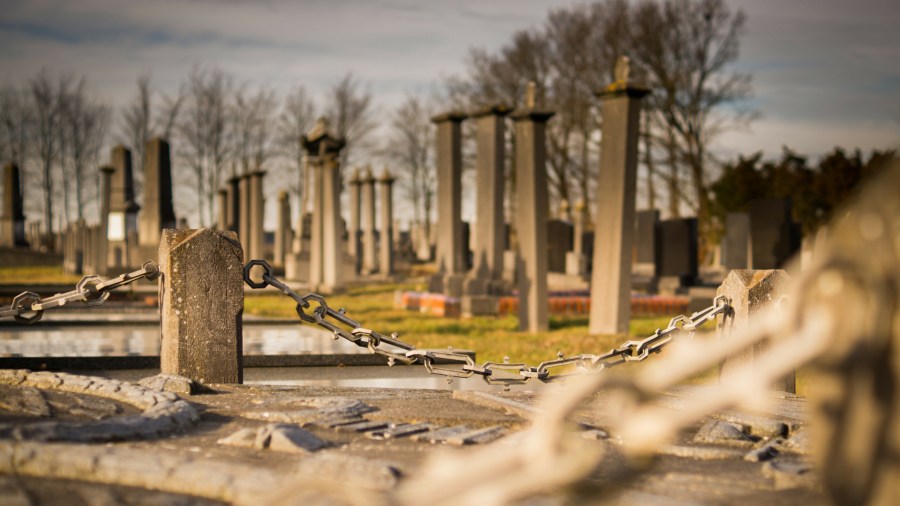
…where I hang suspended, high above the plot where, moments ago, I’d been officiating the funeral of Saul Rubinstein.

Now I’ve never felt entirely comfortable around Rubinstein – Rubinstein whose shadow only darkened my shul on High Holidays, and only then to pass his business card around, not that this is so rare, Rubinstein who’d shoot me looks that could slice salmon if I even glanced at his wife (his second, a convert half his age, if that) in passing on the street, Rubinstein who shuffled like a thief in his oversized shoes whenever I went with Lottie to buy a nice dress in his shop – but I’d thought burying him at least would be easy.

It had started fine: in the prayer hall, tears, wailing, everything good. Things done the way they’re always done. It’s not the best part of being a rabbi but I’m told I give a good funeral. “They’re queuing up to be buried by you,” Lottie would tease. “Because you sound like Paul Robeson. If he came from Manchester. Or even…,” and she’d bump her eyebrows up toward the ceiling, once, twice, until I poked her to be more reverent.

After the service, we went out to the graveside, the less steady attendees catching a ride on the back of the groundsman’s buggy. It rattled off between the gravestones, passengers clutching each other, risking death and mutilation. Nevertheless, a beautiful day, rows of wet marble sparkling in the sunshine. There must have been rain in the night.

A few minutes to get to the plot, then wait for the stragglers. This place is always expanding but people won’t stop dying. “I’m glad we didn’t get lost,” I said to the widow. “It wouldn’t have been the first time.” She smiled at me, and wouldn’t look away, and I didn’t want to be rude, so there we were, staring at each other, until finally she said, “You want to carry a sat nav around widya,” in her Irish accent and laughed. It’s actually not such a bad idea.

Everyone finally gathered, I was just about to say some words, my head dipped, the crumbling mouth of the grave in the corner of my vision, when suddenly I heard five loud raps against wood.

And that’s when I seemingly leapt out of my skin.

* * *

I don’t like this.

“I don’t like this!” I cry, no Paul Robeson now. Nobody looks up. Can they not hear me? Or see me? (I’m not a small man.) Is a six foot three rabbi hovering in the air a thing to ignore?

I flap, I flail, to no avail.

Looking down at the mourners crowded around my body, I wonder can they not hear Saul’s banging either? Who knows what sort of mood he must be in, almost choking to death on a fish supper, then waking up to find he’s being buried alive?

And I think I’m having a bad day.

* * *

My mind, as it’s wont to do, begins to fret.

My late wife, Lottie, may her memory be a blessing, I drove crazy from the first day we met with my thoughts and doubts. “What if we’ve been wrong all these centuries?,” I’d ask, four in the morning. “You think Jesus will forgive us?”

“I know,” another time, “The Lord gave us Free Will so we must actively choose the right path, but couldn’t He have at least given us a nicer nature with it?” For four hours in this vein. That one got me banned from drinking coffee after 7 pm.

Our daughter Simone was even worse, all big black eyes and bad nerves from birth. Her night terrors would have her paw the paper off the bedroom wall, that when we could wean her out of our bed and into her own. We’d talk to her, “What are you so frightened of, darling? You’re such a good girl, we love you ‘til our hearts burst” – not a good thing to say, it turns out.

I’d watch “The E.T.” with her, over and over, she loved that one, we must’ve worn the video tape thin, and Lottie would radiate with amusement to see how it wet my face, every time.

Lottie said Simone had an overactive imagination, something she’d outgrow. (“Don’t you worry,” she’d whisper, stroking hair off Simone’s forehead. “Don’t you worry about her,” she’d whisper, doing the same with me, hours later.) Now Simone lives in Tel Aviv, and takes medication against “panic attacks.” She should know the morning Saul and I are having, she thinks she has anything to panic about! Of course, she should never know such a thing. My little girl.

Her husband Yoshi Muginstein is a giant. Even I, at six three, have my face pressed into a wall of chest when he insists on embracing. “Let him be,” Lottie would say when I’d complain. “He’s a warm man, and he makes her feel safe.” Reading my mind: “Most the time.”

I wish he were here now, the giant Yoshi, to reach up and pluck me from the sky.

I wish Lottie were, even more so.

A handsome young man, seeing the waving-around arms and poor Mrs. Rubinstein, the young widow, is sprinting from his service to ours, leaping over headstones, skullcap clutched to his head with his right hand so it doesn’t fly off. The huddle around my body breaks to let him in. I hope he’s a doctor and not just nosey.

* * *

I’m still here.

Turning somersaults.

Though I think I’m managing to slow now, thank HaShem. I was only trying to reach down, wave for attention… The spinning’s made me dizzy. Like a hamster wheel, round and round! Oy gevalt, I hope it stops entirely soon…

This reminds me of the night Lottie and I tried to help Simone with her P.E. phobia. Ha! Never a small-boned creature, she’d come home from primary school sobbing, drained, her face like putty, “Please write me a note that I never have to do P.E. again!” So Lottie and I, and we weren’t young parents, Simone was a late and unexpected blessing, like with Abraham and Sarah, we dragged all the furniture in the living room to one side and we were all three of us practicing forward rolls on the carpet, my legs and feet crashing into the side tables, Lottie toppling sideways, bottom over head. Oh, we ached and hurt afterwards, but for the laughter, it was worth every bruise. What the congregation would have thought to see us, rolling about. We could probably have sold tickets.

* * *

The young grave-hurdler is performing CPR on me. Some of the mourners are getting restless. They see enough medical drama on television. Stray members begin to drift off.
My gaze falls upon a girl in her forties on the edge of the party. Lottie always complained that I had an eye for the ladies, and I cannot, floating above holy ground, deny this girl’s a beauty, her eyes, under her hat, huge and dark like prunes soaking in water. A healthy figure, too, but I’m not dwelling on that, Lottie. I’m noticing that, hand raised against the sun, she’s got her back to everyone else, and is looking around.

Can she see me? Did she spot a foot, dangling down, black polished shoes shining in the sun?

Someone calls, and she turns. She’s walking towards an older couple and the three of them are striding away, to the car park. So maybe not.

Then suddenly she stops and turns again, touches the older woman’s arm… What’s she pointing at?

Quieter from up here but tap, tap, tap…

He’s behind you!, I want to shout. Could I sound more like a pantomime?

Tap, tap, a couple more.

I turn…

And in the far trees see a tiny woodpecker.

I’m floating in the air, a blimp, because of a farshtinkener woodpecker.

If I wasn’t probably already dead, I’d die of shame.

* * *

A short time later, and Mrs. Rubinstein’s hugging the young man. Men are hugging him. They’re queuing up now to hug him, to pat his shoulders, bank notes are being stuffed in his top pocket to his protests.

All the while, I’m drifting down, slow as tree fluff airborne on a hot summer’s day. My face is a few feet below me, the eyes still closed but there’s colour in my cheeks, egg yolk in my beard. Why didn’t I notice that before leaving home? The least of my problems.

Not too decrepit looking, from a certain distance. Would you still take a dance with me, Lottie?

Before I even get there, my old dry lips start to part in a smile.


Nick Black manages two small public libraries in North London. His writing has been published in lit mags including FlashBack Fiction, Entropy, Jellyfish Review, (b)OINKzine, the Lonely Crowd, Open Pen, Train Lit Mag, and Funhouse, He tweets about things he likes as @fuzzynick.


 

Eryx and Hypatius by Ray Ball

Before the stoning
before the council
condemning those who claimed
there was a time when He was not
as heretics, Hypatius
charmed a snake.
The serpent coiled in the emperor’s treasury
like a dragon guarding the royal gold.
The bishop of Gangra arrived,
wielding his staff as a weapon. Perhaps,
as the legends say,
he beat the snake, striking its mouth repeatedly, until wearied,
the giant reptile surrendered its free will
and slunk after the saint to be sacrificed at the pyre.
But perhaps,
that is only
a story we tell
ourselves
about good and evil patterned too simply to tell
wisdom from venom. The shape of the staff
matters when a holy man
comes to hook a snake, when the snake sheds
its skin in the marketplace
and winds on as if resurrected,
when something nearly extinct,
like the sand boa,
reappears.


Ray Ball grew up in Oklahoma and Texas and received her PhD in History from Ohio State. She is currently a history professor based in Anchorage, Alaska. When not in the classroom or the archives, she enjoys running marathons and drinking bitter beverages. She is the author of two history books and her creative work has recently appeared or is forthcoming in Breadcrumbs Mag, L’Éphémère Review, and The Cabinet of Heed. She tweets @ProfessorBall.

A Nearly Beautiful Thing by Cathy Ulrich

There’s a ballerina your husband’s been fucking. While you’re at home, he meets her in hotels. She soaks her feet in oatmeal baths. Her feet are battered, torn. It would make you sorry to see them. Afterward, she wraps them in gauze. Your husband lolls on the hotel bed, watching Animal Planet.

While you’re at home, this is what your husband is doing. Lolling on the hotel bed, watching a special on bear attacks. He sees reenactments of a bear dragging a 10-year-old boy from a tent, a bear breaking through the window of a 91-year-old woman’s kitchen. He hears the word mauling, he hears encroachment, he hears territory. In the bathroom, the ballerina dries her feet with a hand towel, drains the bathtub. Bits of oatmeal cling to the base. The maids will hate that when they clean in the morning. The ballerina thinks, briefly, of wiping up the oatmeal with one of the towels.

The ballerina isn’t a bad girl. She is very young, a corps de ballet dancer. She’ll never be the prima ballerina, never dance Odette. She has an audition for a featured part tomorrow. She has practiced for months. Your husband tells her good luck when she mentions it to him hesitantly. The ballerina dips her head, nearly smiles. The ballerina is very beautiful when she nearly smiles. She wiggles her ugly toes before she wraps them in gauze.

While you are at home, the ballerina nearly smiles and becomes beautiful. Your husband kisses her chin, which she doesn’t like, kisses her throat, which she does. The ballerina sighs. The ballerina rises up on her wretched feet, falls back onto the hotel bed.

She doesn’t think of you, or, when she does, it is as an abstraction, the frigid wife. Your husband didn’t say frigid, but the ballerina thinks of wives as being cold things, thinks of ice and unyielding bodies.

You are at home. Your husband leaves the television on while the ballerina pulls her top over her head, while he kisses her navel, while they fuck. The television is the hum of park ranger chatter, statistics, bear growl.

The ballerina arches beneath your husband’s body, thinks of Prince Siegfried, thinks of swans, says yes, more. She knows your husband likes it when she says that. You know it, and all of his old girlfriends too, yes, more, such a simple little phrase. Such a nothing little phrase.

While you’re at home, the ballerina says yes, more, arches her body, and you trace your finger along the stem of a wine glass.

The ballerina rewraps the gauze around her feet after she and your husband are done, shy of him seeing her feet. She sips a glass of water, wonders how clean the cup could be, even with the sanitary seal over it.

Your husband kisses the ballerina’s wet mouth. Your husband says the usual things, makes the usual promises. The ballerina nods, says of course, of course. The ballerina isn’t holding her breath. The ballerina is familiar with the things men say.

She thinks of her aching feet. She thinks of her audition tomorrow, the shine of spotlight, the scuff of stage.

She says: I should go.

She says: I have a big day tomorrow, shoves her gauzed feet into some oversized sneakers, kisses your husband on the temple. He’s watching Animal Planet again, habitat, attack, bear, bear, bear.

Good night, says the ballerina.

Good night, says your husband, closes his eyes, listens to the delicate sound of her steps, the click of the door, the growl of a bear.

You are at home, tip over empty wine glass, watch it roll across the table, and wait for it to fall to the floor, and shatter.


Cathy Ulrich saves newspaper briefs on bear attacks because there is something really, really wrong with her. Her work has been published in various journals, including Little Fiction, Former Cactus, and Pithead Chapel.

No One Holds a Grudge Like a Crow by Mac Crane

You wake up to the cawcawcaw of the crows outside. They still hold a grudge against you for that one month Lynx made you foster a cattle dog mix. He barked at the crows every time he took a shit, and they haven’t forgotten. Crows can remember individual faces. They pass this information down from generation to generation. In many ways, they are smarter than your own family that can’t even manage to call once a year. Somethingsomethingsomething about the June bug coffins lining your windowsill. They freak people out. Even over the phone. They can hear the June bug ghosts wailing.

Cawcawcaw, only louder this time. You muse over who you might be to the crows. “That imbecile with the evil dog” or perhaps, “That super cool guy we simply cannot pardon for his wrongdoings. No matter how rad his Saved By the Bell crewneck is. Yes, we mean it. No matter how rad.” You roll over and grab the notebook you keep on your nightstand for moments such as this and add the latter to your long list of crow speculations. You consider how the president may wind up pardoning himself before the crows pardon you.

You tried to make the crows forget. You started wearing a beanie whenever you left the house. They went crazier than ever as if to alert one another. A few even dive-bombed you and stole your beanie. It was a nice beanie too. Lynx had crocheted it for you. A pretty baby blue hue that calmed your tap-dancing neurons. After the crows stole your beanie, you started painting your face. First like a June bug, because why not? They didn’t like that. They took large dumps on your Welcome mat. Swirled like soft serve and impossible to fully clean up.

When you painted your face like the pink Power Ranger they cooed and fluttered their feathers. Yeah, they liked that shit. You thought you’d finally won and then what you think happened is one of the elders slammed down his gavel and said, “No, he is guilty regardless of his beauty.” Then one of the crows jimmied your bedroom window and broke in and stole the photo of Lynx that you kept on your nightstand.

Your last reminder of her.

The crows remember when you finally broke it off with Lynx. They remember it as well as you do.

You recall quite clearly covering her body in stamps. She just lied there and let you. Like it was the most natural thing in the world. Like love is only love if you drive that person away. The crows gathered at the windows and pecked the glass with their black beaks.

It was a Sunday so you set her on the counter by the door where you wouldn’t forget her, but on Monday it was raining and on Tuesday you were late for work. On Wednesday your horoscope warned against taking chances and on Thursday you got into a fight with the sky. On Friday you worked from home and drank whiskey far too early. On Saturday you scribbled the return address on her chest, in hopes that she’d be sent back to you, but it’s been more than three years now and the mailman got a new job so he wouldn’t have to continue disappointing you.

You climb out of bed and put your robe on, wrapping it tightly around you. You examine the June bugs, take roll call. Sylvester, Frangelica, Bryant, Nuchi, Manuel, Zane, Eva, Bo, Jian, Arnold. Everyone is present and accounted for, their exoskeletons perfectly intact. You are envious of their armor.

You take a deep breath, pull your hood over your head, then walk out the front door. The elder crow alerts the others of your presence. Cawcawcaw cawcawcaw, a new urgency in their calls. You shadow-box the air, daring the crows to challenge you. One by one, they begin to surround you. Left, right, uppercut, right, right, you dance around your yard like a more agile, less sad version of yourself.

The crows fly in circles around you, so fast that you can’t see the individual birds. Just the dark blur of their hostility, like a tornado.

Over the years you grow old and fragile inside that tornado. Your punches turn to gentle waves, your feet become cement blocks. The crows lose their voices and the only thing you can hear is Lynx telling you that the stamps were expired. That she’s here and everywhere.

Mac Crane is a queer, nonbinary writer and editor. Their work has appeared or is forthcoming in Pigeon Pages, Pidgeonholes, and Drunk Monkeys, among others. They currently live in San Diego with their wife. You can read more of Marisa’s work at marisacrane.org and their twitter handle is @mcrane_12.

with an empathy so fatal #44 by Darren C. Demaree

the children want to be
aggressive

with their empathy
they want to hold

the rooster of each day
so they can show you

the rooster of each day
they’ve already asked

for tattoos of that rooster
on their chests

i told them if empathy
is an alarm if you think

empathy should be
an alarm then i find

no fault in you making
that permanent

the minute you’re eighteen
until then i’ll keep

buying orange to red
markers for your early

morning routine


Darren C. Demaree is the author of eight poetry collections, most recently “Two Towns Over,” which was selected as the winner of the Louise Bogan Award from Trio House Press.  He is the recipient of a 2018 Ohio Arts Council Individual Excellence Award, and the Nancy Dew Taylor Award from Emrys Journal.  He is the Managing Editor of the Best of the Net Anthology and Ovenbird Poetry.  He currently lives in Columbus, Ohio with his wife and children.

Agonal Respiration by Caleb Michael Sarvis

Spencer and Josie are hosting a house warming party. I bring Dakari, because Megan’s left him and we arrive close to the end. I meant to arrive on time, but we saw a fox when we stepped out of our Uber and followed it briefly into the woods. It watched us from behind a fallen tree and we passed the boxed wine back and forth, content to wait for its return. I would have offered my meatball of a heart had it meant one caress of that fox’s tail.

It never did, and now we’re shirt-stained and late.

Spencer and Josie bought their place in Bartram, a newly-developed area of town surrounded by forest awaiting more destruction. It’s an end-unit townhouse, succulents planted underneath expensive rocks. When we step inside, familiar teeth play cards around the dining table. Spencer asks us to take our shoes off, Josie recommends a glass of Garfield’s sangria, who I recognize to be the husband of the woman I love. In the coming weeks, I’m supposed to raise their newborn baby because neither wants to be a parent. He and I’ve never met, and I don’t think he knows who I am. She and I decided the adoption over pizza.

I realize Garfield looks exactly like me, only beardless, with different eyes. His eyes are all white, no pupil, and I’m not sure where he’s looking.

Josie’s plastic wings shake as she deals the cards. I avoid the Sangria, though Dakari’s finished off our box, and my thirst is only worsening. For a while I was sober, but I can’t remember the value in that.

The three other friends leave, they’ve been there for hours. Dakari deals and Spencer asks me how I’ve been. I tell him my new job has a lot of free snacks, plenty of dead time, and I can swear as much as I want. Spencer nods, he was a copywriter long before I was, is part of the reason I fell into it. I’m supposed to have edited this novel we’re going to publish through our small press, which I haven’t, and he’s avoiding asking me about it.

“How do I get a job like that?” Garfield asks.

“You have to be an artist,” I say. Dakari snickers at this and throws me a thumbs-up, shoves grapes in his mouth.

“You could be an artist, Garfield. Just have to become a little less practical,” Josie says. The wings she’s sewn into her shoulder blades look weathered and torn. She needs to replace them, just as I do my windshield wipers, but I imagine the process is plenty more difficult. Josie believes she is a fairy – has chosen to be a fairy – and doesn’t want any children of her own. Spencer waves it off, thinks her youth currently speaks for her, and like her youth, this mindset will fade.

Garfield pulls a pill from a zip-lock bag. He washes it down with some of his sangria. There isn’t much about him I dislike, I guess, other than he’s married to the woman I love. He shuts his eyes, smiles, and returns to the conversation. Creases slowly fade from his brow.

“Everything will be fine soon enough. Just a waiting game now,” he says and collects his cards.

“Game isn’t over,” I say.

“Evidently, you’re mistaken.”

I’m worried the baby will have his blank eyes, his smug stillness. How will I ever trust it? Dakari is out of his seat, dancing without music. Josie laughs and takes the hand he offers, teeth marked purple. Garfield pulls cigars from his shirt pocket, motions them towards Spencer and me. We join him on the porch.

The smoke is chalky and stale. I’ve never been good at this.

“How does the world look to you?” I say.

Spencer peers over his shoulder, watches Dakari and Josie.

“Different than you, I imagine,” Garfield says. He can puff rings, tiny and large. When he relaxes, smokes normally, it scoots from his lips like a seahorse. “How does the world look to you?”

“Hard to explain.” But it’s not. The world is a finely-painted aluminum ball. We’re the afterthought of someone else’s lunch. I spend most of my day wondering how to peel it all open. I won’t say this aloud. Instead, I say something stupid, like, “Babies are an art.”

“Hmm.” Garfield’s eyes appear to be made of the same smoke he spews into the night.

Spencer laughs at this, cheeks fat with drink. “My intuition only works in hindsight. I think I’m broken.” He sucks on his cigar, blows a large cloud to the sky, “She had me cut slots in the back of all her shirts.”

We sit in silence, listening to the minute crackle of our burning cigars. Smoke leaks from my mouth, a foggy sort of drool. I don’t believe in souls, but I imagine mine to be a little droopy, heavy with nonsense. I forwent efficiency in exchange for meditation long ago. No turning back now. A fox, perhaps the same as before, trots around the man-made lake behind their townhouse. It appears present, immediate, hungry.

Dakari knocks on the sliding glass door. We turn and see his face, eyes in bloom, face sagged. In his hands, he holds Josie’s wings.

Spencer opens the door, takes the wings from Dakari, then runs up the stairs. “Josie!” he says.

Dakari grabs three beers from the fridge, joins us on the porch.

“What happened?” Garfield says.

“She went to get comfortable. Her dress got caught, so she pulled harder.”

The fox returns, begins its second lap. I feel for it, the chase. Perpetual.

We drink our beers, content to watch the lake and overstay our welcome. Garfield’s voice grows soft. He tells us he doesn’t want to go home, that it doesn’t make a difference, either way.

Spencer’s returned downstairs. He has blood on his hands, his shirt, no concern for us. He’s flushed, hair slicked back. He washes his hands in the kitchen sink, returns upstairs. He leaves the water running.

Dakari finishes his beer, orders an Uber. “Beach bars?” he says. I think he might be asleep.

Garfield walks backwards, away from us, towards the lake, leaves his cigar and beer behind. When I think he’s looking at me, his eyes are lunar. “Make sure you do it right,” he says. The fox approaches lap three, fearless. When it passes, Garfield takes off after it, a pacing sort of trot, and my chest swells like the Hindenburg.


Caleb Michael Sarvis is a writer from Jacksonville, Florida. He is the author of Dead Aquarium or (i don’t have the stamina for that kind of faith) (Mastodon Publishing 2019). He is the fiction editor for Bridge Eight Press and co-host of the Drunken Book Review Podcast. His work has been featured in or is forthcoming from Hobart, Split Lip Magazine, Saw Palm, Fjords Review, Eyeshot, and others. You can read his column on FX’s Atlanta at barrelhouse.com.

Ashes than Dust by Iris Jamahl Dunkle

“Let go said the
What.
Let go said everything.”

–Brenda Hillman, “Split Tractate”


A fox sprinted across the dark driveway:
orange spark that trailed through the headlight’s spot.

You register this sighting as a totem. Then,
drive on into the life you’d written one way,
then revised due to characters disappearing.

In the nightmare. No, in the dream. (never
sure when it’s called a dream or a nightmare.

My son says it’s only a nightmare if
you wake up screaming
) there’s a dead body

being consumed by a writhing nest of
black and white snakes. They are re-writing what was lost.

When you wake you decide you would rather
be ashes than dust. You’d rather blaze out
like the fox, like a fur of sparks in the night,
than be left to rot, be untold.

By now, you thought time would have righted the swerve.
Thought your tires would have found tread. Instead,

you live in an echo chamber where owls
call and call, asking for forgiveness.


Iris Jamahl Dunkle was the 2017-2018 Poet Laureate of Sonoma County, CA. Interrupted Geographies is her third collection of poetry. It was featured as the Rumpus Poetry Book Club selection for July 2017. Her debut poetry collection, Gold Passage, was selected by Ross Gay to win the 2012 Trio Award. Her second collection, There’s a Ghost in this Machine of Air, was published in 2015. Her work has been published in publications including San Francisco Chronicle, Fence, Calyx, Catamaran, Poet’s Market 2013, Women’s Studies, and Chicago Quarterly Review. Dunkle teaches at Napa Valley College and is the Poetry Director of the Napa Valley Writers’ Conference.

Birds of a Feather by Tianna Grosch

The small view on the New Mexican plain doesn’t offer much from the barred windows of cell 118, but sometimes I catch a glimpse of a bird out in this heat. These are the ones I sketch, in quiet moments to myself with a pen and paper I bought from Charlotte. Her favorite, she told me, are hummingbirds. Mine too. I draw them from memory. My garden used to attract them for miles. I would sit by the window, glass between us, and watch as they swarmed, wings buzzing and beating against the stiff air miles a minute.

I fondle three pills tucked away in my breast pocket, imagine what it would feel like to pop them in my mouth and swallow. I wouldn’t need water to chase them down, but I don’t dare take them. The little pills anchor me in more ways than one.

I think back to Charlotte’s proposal, her nonchalance in telling me how to start. I could see how it would become a habit, hiding the tiny pearls in my cheek at each Med-Line, transferring them to the secret pocket fashioned in the breast of my jumpsuit.

Charlotte and I sat together in the middle of the block, two months ago now, a sea of women surrounding us. I looked around, keeping my head low. My eyes registered the human shades coloring the room – midnight, chestnut, olive, porcelain. The rhythm of voices pulled me in and pushed me back out, a tide of small talk, complaints, criticisms, and misfortunes – secrets were the undercurrent.

I focused back on Charlotte.

She leaned in, whispering. “You know those little pills you get?”

“Yeah.”

“Share those with me and I’ll share my commissary.”

“What do you want with them?”

Charlotte chuckled, tugging at her scraggly, braided hair. “Same as you, sweetie. An escape.”

Charlotte reached out and traced the tip of her finger across the back of my hand.

“Take your time, think about it.” She smiled at me, and her eyes wrinkled at the corners. “We have all the time in the world.”

Charlotte is invincible, I’m almost certain. Like a hummingbird flitting her wings, she is unstoppable. But then again, she’s already caught.

A bird without wings at all. Just like me.


Tianna Grosch received her MFA at Arcadia University last year and works as Assistant Editor at Times Publishing Newspapers. She is working on a debut novel about women who survive trauma, as well as a memoir. Her work has previously appeared or is forthcoming in Ellipsis Zine, Crack the Spine, Burning House Press, Who Writes Short Shorts, New Pop Lit, Blanket Sea Magazine, Echo Lit Mag, and Nabu Review, among others. In her free-time she gardens on her family farm and dreams up dark fiction. Follow her on Twitter @tianng92 or check out her writing on CreativeTianna.com.

Kitchen, West-Facing Window by Jackie Sherbow

In our morning conversations the creature
on the roof might be invisible; a ducks’ nest
hanging batlike from the ceiling;
someone and their dog as one body.
Flour dripped on potting soil makes
bread grow—thick, healthy loaves,
stalagmites in our kitchen. I ask for
twine and you bring me
a length. I tie it around the stringy
stalks I’ve just replanted. This thing
always seems to lean away
from the sun—I turn it, like
I know better. To be happy
is an effort—you know this
about me.


Jackie Sherbow is a writer and editor living in New York. Her poems have appeared or are forthcoming in Moonchild Magazine, Bad Pony, Luna Luna, Day One, The Opiate, and elsewhere, and have been part of the Emotive Fruition performance series. She works as an editor for two leading mystery-fiction magazines, as well as Newtown Literary, the literary journal dedicated to the borough of Queens, NY.

Feeding Time by Tara Isabel Zambrano

Almost spring, and a sparrow hits the fan and falls into the mutton curry while we’re having lunch. Papa says it’s something to do with feeding her chicks, the bird’s always in a hurry. I pick up and carry the stunned little creature to the bed where Papa and Ma don’t sleep together anymore.

Year after year these sparrows have been making nests in that corner of the living room―one morning a broken egg on the floor, yolk clinging to the fractured shell. The same week Ma woke up in a pool of blood and cried for weeks because it was a boy.

Every few days, Ma cleans the bird shit stuck on the floor and the wall. Back in the nest, the mother’s at attention, a rush of wings as if responding to Ma’s curses. Some days the sparrow sits on the fence, flies around, swoops this way and that, shows off.

Now the bird lies on her side, breathing hard, until she puffs her gravy stained chest and stands up. Before I help Ma to dispose the mutton curry―the only food we had because we’re down to single meals a day since Papa got fired last month, I check on her again―and sure enough she’s back in the nest, peeping at our empty dining table.


Tara Isabel Zambrano lives in Texas. Her fiction has been published in Tin House Online, Bat City Review, Slice, Yemassee, and other journals. She works as a semiconductor designer in a startup and holds an Instrument Rating for single engine aircraft. She reads prose for The Common.