The Angle of Depression by Patricia Q. Bidar

Mignon, as always, wants to know what I’m thinking.

I’ve finally agreed to meet her in person, at the Berkeley Art Museum. The new one, with its blinding white walls and tomato-hued doors and echoey stairwells. A basement café with wine and salads of watermelon and feta and mint.

“Meat time,” Mignon called it.

But by the time we finish viewing the Peter Hujar photos in the lower gallery, I’ve formed the view that no one, ever, should visit an art museum in the company of another person. I want to stomp in the metal stairwell.

Yet here we sit in the museum café, emptied splits of champagne before us. It’s hot and my hair is heavy, redolent with horsey-smelling henna. Everyone else is in camisoles and shorts in ice cream colors. Last night I did my hair — yes, for “the occasion”– and it came out too bright.

“I liked the ones of the wrecked cars,” I say. “And that glum man with the giant penis.” What I am really saying is what I am always saying at museums. “You don’t know me! You don’t know my taste!”

I met Mignon online. Our exchanges have been filled with nuance and shy disclosures. Once, I related the details of a violent crime to which I’d been victim. Mignon confessed she’d once driven into a kid on a bike. Another time, we’d negotiated logging off to cry, after confessing to each other the depth of our loneliness.

But in person, Mignon emits a river of combat and insecurity. Just like everyone else around here. What band/bistro/hiking trail am I obsessed with, that no one else has heard of? Who eats the local-est, grass-fed-est food? Who’s vacationed in the farthest-flung place?

I gaze at the office supply store across the street with its industrial carpeting, balm of greenish light and wide aisles.

“It’s annoying how Hujar framed his subject in the middle of the shot.” I say.

Mignon brightens, pouring the remaining champagne into her flute. “He learned a way of composing called the Angle of Depression,” she explains, eyebrows raised self- importantly. “See, it’s the idea that the viewer’s eye takes this angle — technically this diagonal line ends below the bottom edge. There’s something we don’t see.”

She continues, telling me how Hujar’s last name would be pronounced in Spanish, if he were Spanish, which he probably is. How the British television show, The Office, was modeled after a David Foster Wallace story about working for the IRS. Then she shyly adds that she puts away a bottle of wine every night before allowing herself to open her computer to see if I’ve written.

Mignon meets my eyes then. She picks up a ball of melon and tucks it into her mouth. Meaningfully, it seems.

“Will you excuse me?” I said, then glide to the women’s room. A pullover youth with pimples around their mouth enters behind me.

Determined to act casual, I attempt a “selfie” in the bathroom mirror. My russet hair smolders nicely in the recessed lights. Then my bag slips into the sink, setting off the automatic gush from the faucet. My legs fly from under me. Fucking hell!

I consider staying down for a day or so. Who would know, other than half-in-the-bag Mignon and now this waif currently attempting to exit their stall.

“Hi! Help!” I say, rolling aside. The waif’s sweater as they easily lift me smells of fabric softener.

They ask if I’m all right. “You betcha!” I say, and the waif toddles off.

I gingerly settle back at the table. I feel like I’d been attacked by a javelina. My flank throbs. I swear to fucking god the infant is coming back with a fresh split of champagne.

“You know him?” Mignon asks. “He’s so… frat boy.”

“No frat boy uses Downey.”

“You have an awesome day, ma’am,” the waif says, their mouth a hard line.

Why did  I wear these ridiculous heels? And why does this pain feel good and right and deserved?

Mignon snaps her fingers, as if an idea has occurred to her, or maybe just to capture my attention. How long have I had my nose pierced? Because she recently removed her nipple ring, which she got in her thirties “because of National Geographic.”

“I could give it to you!” she says. “I just have the one…”

“Oh! I guess I always thought they came in twos, like earrings. Or, you know, none,” I say.

“… although I have been wondering how much I could get for it, like, at a We Pay Cash for Gold place…”

Meat time. Who needs it?

Let’s say I summon the courage of my convictions. Soothe myself by purchasing pencils and notebooks across the street. A squishy strip to soothe my wrists.

Or more dramatically, I could emulate the mountain lion in that recent news story. Remember? The one where the two cyclists did all the things we’re told to do: holler real loud, make themselves appear larger. If I could be that magnificent beast, I’d rake Mignon with my claws and let the pimpled waif go, to tell the tale.

But that isn’t the way the story went. Remember?

In real life, it was an elderly couple. The lady neutralized the mountain lion by jabbing it in the eyes with her ball-point pen. She saved herself and her mate.

See, in the end that you can do everything you are supposed to do, and fate really doesn’t give a hoot. Me, Mignon, the cyclists. The mountain lion. The waif from the woman’s room. Even beautiful Peter Hujar, with his portraits of the famous, the abject, the endowed, and the ruined cars.

‘I like people who dare,’ Hujar famously said. Yet here we are frozen, cast in our living roles. I am lonely as hell, and that is no lie.

I split the bubbly between our glasses and say, “To meat.”


Patricia Q. Bidar is a California-based writer with family roots in New Mexico, Arizona, and Utah. An alum of the UC Davis Graduate writing program and a former fiction editor at Northwest Review, Patricia’s work has appeared or is forthcoming in Sou’wester, Wigleaf, ellipsis…art and literature, Litro Online, The Citron Review, Jellyfish Review, Barren Literary Magazine, Crack the Spine, and Riggwelter, among other places. Her Twitter handle is @patriciabidar.

Email to My Boyfriend When Rent Is Due by Micaela Walley

My sweet,

Remember the first time you went down on me
in your mother’s house, when I knee’d you in the chin but you still kept going?
Remember how after we got tired of touching each other, we’d go outside
to lay on your trampoline after you’d swept all the sticks and thorns
off? That black polypropylene material never felt so soft and warm
between the holes of my socks. I felt the heat rising off our bodies, blending into
the world around us as we basked in the sun, a new kind of hot.
Those were the best afternoons. I loved you the most as you’d sync
your jumps with mine, letting me go higher and higher, until I hit my head
on the edge of your roof and we laid down to take another break. I asked
you if it was bleeding and you said no. I asked you to check again, and you did,
and you still said no. I can never pay you back for things like that,
or things like this, when you take the brunt of what I can’t face alone.
I know on days like today, you forget those kids on the trampoline,
sticky with sweat and sex and a little blood. I know how often I forget
them too. Do you think they’d be proud of how far we’ve made it?
Do you think they’d let us lie down with them and stare into the sun?
I don’t think they’d even notice we were there.

All my love,


Micaela Walley is a graduate from the University of South Alabama. Her work can be found in Gravel, Occulum, and ENTROPY. She currently lives in Hanover, Maryland with her best friend — Chunky, the cat.

A Tremendous Head, Uneasy by Nell Ovitt

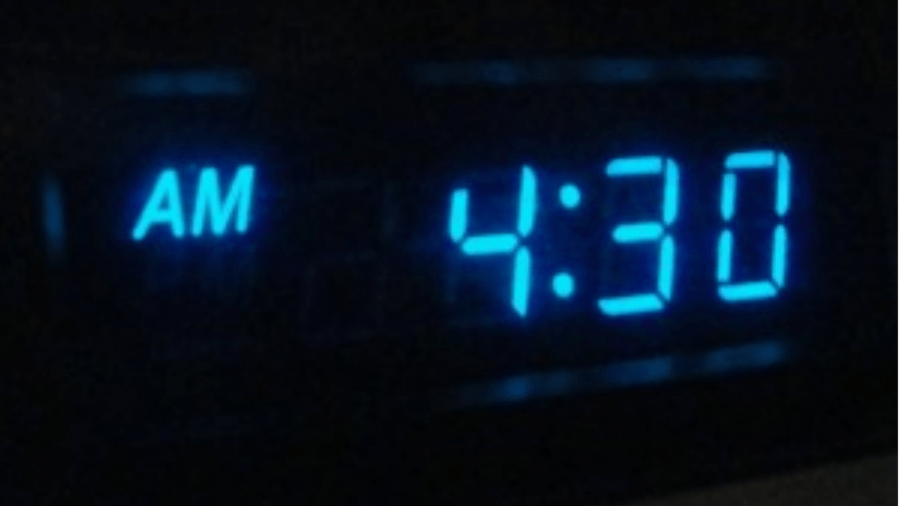
Blue light on the nightstand woke me up again. Like a hole I’ve been filling keeps turning up empty. Eagle and the liver guy, that guy’s me. Can’t remember his name, but I get him big time.

Four-thirty in the morning. Loud when it’s quiet like this.

I could make someone be awake. Whatever I want I can do.

Usually there’s someone in the kitchen. I’ve checked. This time of night it’s one guy. He sits in the corner, I don’t know what else he does, probably nothing. He gives me pizza when I tell him I want some. But he doesn’t look at me. Got some problem with me, maybe, doesn’t want to talk to me. I don’t know why—there’s people, a lot of people out there, and what they’re saying is, I’m a very likable guy. A very likable guy.

So I think I won’t go down there tonight. Anyway I’ve got other options, got a million of them. I put on a robe. It shines in the light on my nightstand. Little flash of gold. Looks good on me.

I turn on the TV and stand in front of it, let my jaw hang loose. Doctor says I have too much tension, on account of I’m a tremendously busy guy. So I let my jaw hang very loose. The people on the screen are talking fast, always up. I know all about what they’re saying. My head starts to feel not so good, so I turn them off. How do they like that.

I’m gonna go somewhere. Shake things up.

I sneak out the door quiet. No shoes, I realize, once I’ve already gotten started. But I can do it. It’s all up to me, so I can do it.

Walk soft down the hall, scratchy carpet under my feet. Don’t know who decorated this house but tell you what, the guy’s a little out of touch. I go by a picture on the wall. I don’t look at the picture but I know what it is of. It’s a man with a horse and they’re both important.

I walk outside. Feel the night come into my robe. Little cold, and the hair on my skin, it lifts up hard. Makes me wish I had socks now, so I walk fast past the garden and the big white columns. There’s a door up ahead that’s got a window made of funny glass. I stop, want to check me out. But I forgot it’s nighttime so I can’t see. Well I know I’m good-looking, don’t have to see to know.

I go into the building. Take rights and then lefts. It’s fine if I don’t one hundred percent remember the way right now, I’ll remember it soon.

I’m starting to wonder where is everybody. Hallways too empty. I left the blue light in my bedroom. Should’ve brought it with me so things wouldn’t be so quiet, but I didn’t. My stomach feels it first. Realize I don’t know where I am. Why I’m.

Maybe I’ve been going down.

Now there’s something, I can hear it. I want to leave all of a sudden, but before I can do that a man comes around the corner up ahead. He’s got gray hair and a suit and looks mad at me. I’ve seen this guy before, definitely. He puts a hand on my shoulder. Steers me back.

Have you done it, he says. Have you done what I told you.

No, I tell him, no, I forgot. I’ve got a lot of stuff going on.

Dammit, he shakes his head saying dammit a few more times. Then he walks fast, me with him, my robe starting to come loose, but I don’t care. So what if people see, I’m a good-looking guy.

I’m just tired, is what it is, I need a break. I try to tell him. He doesn’t answer. I feel his hand grip hard on my shoulder and I start to think he won’t let go ever. I wonder if I ran would he try to catch me. I could try it. But I’m not wearing any shoes.

When we finally stop it’s at the room, that one. I tell him can’t I just do it in the morning. I’ll be terrific in the morning.

It is morning, he says. You have to do it now.

I don’t want to go in there, I say.

He opens the door. It’ll be quick, he says.

It’s dark when I go in. He turns on the light. The walls round in on my head. He points to the desk where there are some papers and a phone.

He points to the phone. Make the call, he says. Then you can go to bed. Then you can go home.

I want to tell him where he’s talking about isn’t home. Real home’s where there’s a phone but it’s only for calling a woman who brings me pizza if I want her to and never pushes me around the hall unless I tell her to. I have a robe there that’s way shinier than the one I’ve got now. I know all the rooms in it even though there’s a lot, and I decorated it myself basically. Home’s where I never wake up in the night to the blue light glowing on my nightstand, to things growing back huge and worse in the morning.

Make the call, the man says again, holding up a piece of paper with numbers on it.

I pick up the phone and press the numbers. He watches me the whole time I dial. This guy, I’ll tell you what he is, and you know it’s true—unbelievable. I’ll get him back for this.

A voice on the other end of the line says something to me. Why they had to answer. I’ll get them back too.

The man in front of me points to the nameplate on my desk. I guess he wants me to say something. Okay, I can say something. I was going to anyway. I know how things work.

This is Donald, I say.


Nell Ovitt is a recent graduate of UNC-Chapel Hill, where she focused on English and Religious Studies. She is an artist and a sometime traveler, and is currently working at a university in Japan. This is her first published story.

Directions by Jeffrey Yamaguchi

Can you just get on
top and also let me breathe
it’s been a long day

Slice the tomatoes
it doesn’t matter how thick
just keep all the juice

See if you can get
a forming wave and then crash
across the sequence

Just one ice cube please
let that fucker melt on down
takes away the harsh

Pay close attention
to the last very sentence
you’ll find the right words

Remember that time
we met at that hidden spot
let’s do that again

Turn out the lights
tell me that one story
will it to my dreams


Jeffrey Yamaguchi creates projects with words, photos and video as art explorations, as well as through his work in the publishing industry. He can be found on Twitter @jeffyamaguchi and at https://www.jeffreyyamaguchi.com. His recent publications include Vamp Cat Magazine, Nightingale & Sparrow, Failed Haiku, Naviar Haiku, Memoir Mixtapes, formercactus, and Three Drops from a Cauldron.

here is the whole history of us chapter one by Amanda Claire Buckley

we came out of the ocean. coming out of the ocean began with your attempts to get on land. you’d developed lungs. they were badly formed. no one had even thought to try to get on land before you. you said it was easier for you on shore. it felt better. i worried about you. come down from there. i called from the sea bed. i’m ovulating. we had a child who inherited both your lungs and my gills. i worried my gills made her lungs even weaker. you died above us not long after she came out of me. it was too bright. your scales and your eyes had nothing on your lungs and your lungs were barely there to begin with. your lungs were small half-formed pockets that were continually ripping and sloshing with salt water. you’d cough up the salt water on the beach. you’d tell me about how the sand got wet where you coughed. you leaked our home out of your lungs. you said the shore wasn’t so different from what we had down below. everything was just heavier up there. the sand. your body. our child is already swimming and your bones are where the light is. she asks about you. i tell her i remember very little. i tell her she will have to remember better. her brain is bigger than the both of ours. but she has your cough. i worry about her lungs. i put my ear to her chest and hope. our books say nothing about what to do with these new bodies. i have read them all. our child is already kicking. i can’t believe it. she launches her body above the break of the ocean. into the air above us. then she crashes back down into the dark weightlessness. back to where we live together. we’re a small family compared to the others. i beg our girl to please stay near the sea bed but she says it’s easier for her up there. in the air. i tell her not to go on shore. i worry. she says she’ll try not to go on shore but it’s just so easy. it’s so easy for her up there. away from me. she’s growing. she doesn’t need her mother to tell her anything anymore. she doesn’t need my gills. i weave seaweed in my hair to make myself look younger. our child is growing faster than the others. i write the books i wish i could read to her. our child is grown. she is tan. one day she is late for dinner and i call her and ask her if she’s alright and she tells me she’s seen your skeleton on a nearby beach. how long have i known she asks. i tell her i didn’t want her to learn this way and she tells me she thinks she’s going to stay on the beach above me from now on. it’s just easier for everyone this way. by everyone she means her and her new child. my grandchild’s lungs are so wide they can’t help but float at the surface of our world. i would cry but I have not evolved tear ducts yet. i give a lecture to the others about paradigm shifts. the others say the world is flat. i tell them i’ve seen feet.


Amanda Claire Buckley is a writer who was once a waitress who was once a philosophy student who was once a musical director for a sketch comedy troupe. Her work has been featured in X-R-A-Y, The Same, and Story Club Magazine. She’s currently an MFA candidate at Sarah Lawrence College and is a contributing editor for the literary journal Pigeon Pages. She can be found on Twitter @aclairebuckley and online at http://www.amandaclairebuckley.com

In All My Memories Flowers are Taking the Place of Faces by William Bortz

instead of telling you my name / I will unravel my hands from my pockets / and show you what I have lost / those little eternities know me best / they dig their eager claws into my tender belly / and call me to be hungry / I am not ready / I am a removal / I often do not believe morning when it tells me it will arrive with newness in its small mouth / like the steady light of home turning the front porch into a lighthouse / I am uncertain / so do not consider it a blade / to your throat / when I tell you that I am unsure if our eternity will outlive the others / give pain a body / and it will press your arm between your shoulder blades / until you cannot hold who you love anymore / I’ve given pain a whole country / I have tilled its fields and fed the children / until they were plump and perspiring / I fashioned crude knives from steel  / and taught them to dance with the killing thing resting patient in their teeth / something I meant to learn myself / I’ve waited and waited and waited so long and now all I know is surrendering / I am frail and bleached / now I eat only what pain gives me / and slowly / in cool, fragmented light / I am forgetting your face


William Bortz is a writer and editor from Des Moines, Iowa. His work has been published in Luck Magazine, 8 Poems, Folded Word, Empty Mirror, The LOVEbook, and others.

Port Town/El Pueblo del Puerto by Édgar Omar Avilés (translated by Toshiya Kamei)

After the tsunami, in the port town some mermaids comb their hair in bathtubs, others swim at the bottom of tequila glasses, drivers see them reflected in their rear view mirrors, housewives find them when they open cans of sardines, the radio interrupts cumbia and lets the enigma of their songs be heard, children find them while playing hide and seek, the parish priest assures that a swarm of them goes to church and seduces angels on rainy nights.

After the tsunami, the port town remained under water, and the mermaids are terrified that this human memory still lingers under the sea.

* * *

Luego del tsunami, en el pueblo del puerto hay sirenas peinándose en las bañeras, otras nadan en el fondo de los vasos de tequila, los conductores las ven reflejadas en los espejos retrovisores, las amas de casa las encuentran al abrir una lata de sardinas, en la radio la cumbia se interrumpe y se escucha el enigma de sus cantos, los niños las descubren jugando escondidillas, el párroco asegura que en las noches de lluvia un ejército de ellas va a la iglesia y seduce a los ángeles.

Luego del tsunami, el pueblo del puerto quedó sumergido, y a las sirenas les aterra que aún persista aquel recuerdo humano bajo el mar.


Born in Morelia, Michoacán in 1980, Édgar Omar Avilés has authored several books, including the story collections Cabalgata en duermevela (2011) and No respiramos: Inflamos fantasmas (2014), as well as the novels Guiichi (2008) and Efecto vudú (2018). His short stories have appeared in various journals and anthologies, including The Airgonaut, New Flash Fiction Review, and Queen Mob’s Teahouse.

Toshiya Kamei holds an MFA in Literary Translation from the University of Arkansas. His translations include Liliana Blum’s The Curse of Eve and Other Stories (2008), Naoko Awa’s The Fox’s Window and Other Stories (2010), Espido Freire’s Irlanda (2011), and Selfa Chew’s Silent Herons (2012). Other translations have appeared in The Global Game (2008), Sudden Fiction Latino (2010), and My Mother She Killed Me, My Father He Ate Me (2010).

Telephone by Jill Mceldowney

I am beginning to view the body as a well

I could shout Hello, Hello into—
call it a mistake, hang up

out of alarm, because
            tell me

what you thought you were doing answering
when you’ve been dead five whole years?

And is it really you?
How have you kept alive?

What have you grown
down there in the gloom of after like salt?

Perhaps I should say mine—the body is a salt mine.

And I never call
            but you answer anyway.

Was it ever cheerful?
The sound called ringing.

Don’t talk to me,
please

don’t tell me I need you

disoriented, buried alive,
            clawing your way up from the mouth of a cave to show me

the way home
            and tell me,

            what does this even mean? Tell me to spread open my palms, cut
another deck of cards face up—

these lines arch me far
from home.

            I cannot stop from coming—

are you my fate,
my annihilating angel?

Tell me about my love line, my one day call me
bitch. I love that hands on

unmaking: making
I must impossibly bloom
forth; that tallest mountain.

            I dial the dead and you answer.

Hand me the telephone, let me receive
your ice,
your hour of starving, your nude—promise me
I will die dark haired

and still—maybe one day the dead you and I will burn
buildings together for warmth. You will

            speak to me. Tell me about me.

I want to be believed.
Believe me when I say

            it is love that calls me
            to the cruelty of this world.


Jill Mceldowney is the author of the chapbook “Airs Above Ground” (Finishing Line Press) as well as “Kisses Over Babylon” (dancing girl press). She is a cofounder and editor for Madhouse Press. She is also a recent National Poetry Series Finalist. Her previously published work can be found in publications such as Prairie Schooner, Muzzle, Vinyl, Fugue, and other notable publications.

The Candy Children’s Mother by A.A. Balaskovits

I had to send them away. They were children not born of me; they came rushing out between some other woman’s legs, one right after the other, and I was told she lost so much of her liquid that, as soon as they squealed in the air, she had dried up, all broken apart, and pieces of her blew away with the gust of their father’s grief. I had not known her, being so young myself when she died, barely out of my first bleeding, that when I was invited to her funeral, as the whole village was, I looked at the fractured remains of her bones with the curious pity one has for a dead animal. I expressed the appropriate grief to the father, my eyes cast down and my lips trembling, but he must have seen something genuine in me, though there was none at all, and he asked my father if I would be a suitable replacement. My father hand hesitated to grant the blessing, but when a bag of coins found their way into his fingers, my father’s hand was firm.

It was not so bad, at first. The children would not suckle from my breasts, but I warmed milk from the goat and dripped it into their mouths until their skin stretched over their expanding bones. They grew fast: the boy, Hansel, with his greedy appetite, and the girl, Gretel, long and thin like a branch, but whose arms knocked the china from the table if she did not get her way. They loved me, I suppose, as much as their father did, though when they saw my belly begin to expand they huddled together and whispered. When the rain forgot to fall on our small garden and the ground cracked, our lone goat’s milk refused to be coaxed, and the four of us knew what would happen: a fifth would devastate us. Two of us would have to go. We would all starve if we remained together. I have not been taught numbers as men are, but even I know that three is less than five.

My grandmother once told me that once you go into the forest, you come back a changeling. Or you don’t come back at all.

Gretel was awake the night I decided. Our small house had only one room for sleeping, and so all of us dreamed together. I climbed above their father and massaged his neck and behind his ear, as he likes. I pressed his hands to my belly and rejoiced at what we had created.  In his ear I whispered that I would not die with its birth, for I was made of stronger things than dust.

It was difficult, after we finished, to fall asleep, for that daughter who was mine but not mine stared at me all night, the moon reflecting off her dark eyes.

They cried, of course, the boy more than the girl – his emotions reflected his appetite, and he could keep neither in check. Their father cried as well when he held the door open, but I held my hand on my belly – my only bargaining chip – and he gave them a little bread and told them they were old enough to make their own way, though they were young, too young.

At night, I asked them to forgive me, though they were already gone.

*  * *

I bore him my daughter and I did not die. She suckles from my breast and squirms and laughs with all the happiness of a small thing. I see myself in her, that bit of myself that did not have to choose. With so few mouths to beg, the goat returned to its milk. We are saved.

Their father weeps for them, though quietly, as he knows it upsets me and my daughter. I don’t voice what flows in my veins: I do not want them to come back, not my long-armed daughter nor my voracious son. If they come back, it is I who will pay the price for saving us, I who will pay the price for desiring my own daughter over them, I who will pay the price for making the difficult decision, though it was their father who held the door. After a few months, I suspect that they have died out there, and while I feel the ache of loss, I am also relieved that I will not suffer their retribution, even though they would be within their right.

* * *

One night, a little time before the birth of the new year, as I sit on the little landing with my daughter wrapped up against my breast, showing her snow for the first time, I see two figures make their way towards the house. Rather, I smell them first, the sickly stench of rotten sugar clings to them like a death. The boy is so big he makes the earth shake with each step, and the girl, tall and thin as she always was, had a red glint in her eye, and her teeth, when I they are near enough to see, are filed to uneven spikes.

They are almost upon me, and I hold my sweet baby daughter to my breast as I stand tall to receive them, these children that I have sacrificed to save my own, these children who are mine and not mine, these children who now sniff at my arms and neck, looking for the place to bite.


A. A. Balaskovits is the author of Magic for Unlucky Girls (SFWP). Her writing can be found in Indiana Review, The Southeast Review, The Missouri Review, Apex Magazine, and many others. She is the Co-Editor in Chief of Cartridge Lit. On twitter @aabalaskovits.

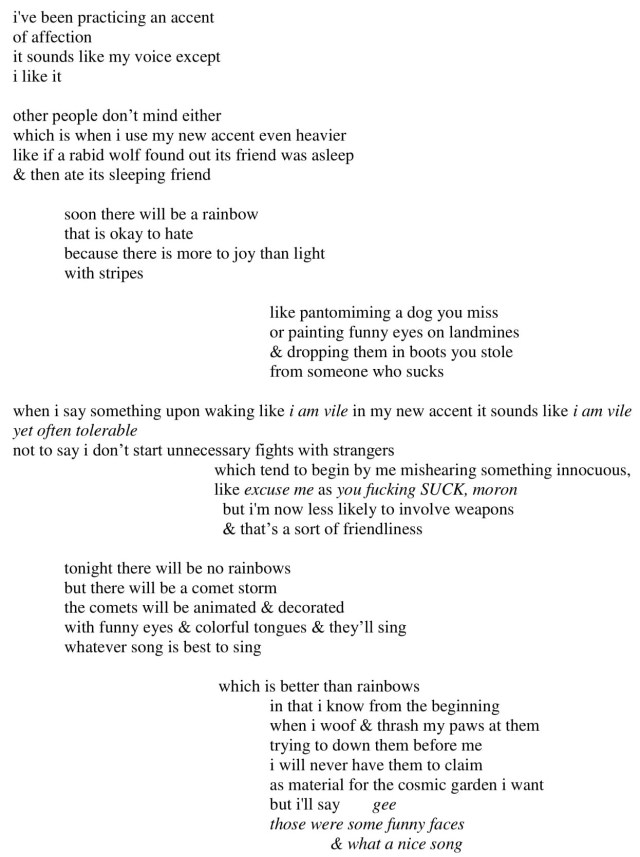
landmines with silly eyes by Nicholas Alti

landmines with silly eyes


Nicholas Alti’s writing is influenced by chronic pain, depression, addiction, and an affinity for strangeness. He aims for an acceptable symbiosis of pop and pretension, and would like to see more cases of demonic possession. Nicholas is an assistant editor for poetry and fiction at Black Warrior Review. His recent and upcoming work can be found in DIALOGISTDream PopThe Hunger Journal, TERSE, and Yes, Poetry.