A Seal Skull Seems To Be a Wolf Skull by Erin Rice

Its boneheadedness its bark
texture – they are both trees
when you get down to it. Upside down
a sculpture with a cliff face to hang
onto for fun. What about the children
who could get lost in the nostril cavern.
A warning should be posted to the mothers:
          the ear, nose, and throat wells
          are the most fun for pups
          and the most diseased.
Repelling down the bridge is a good family
time but climb back up
before you reach the caves or –
If you were a skull,
seal or otherwise,
don’t you think your best rest would be bobbing
postpartum in a walled sea of parts? The sockets,
the departed mandible, the furry stitching
between plates, pairs and pairs
and a funny one here and there.


Erin Rice currently lives in San Antonio with her dog, Dewey. She got her MFA from the University of San Francisco and is now studying immunology.

Ganymede by Chelsea Harris

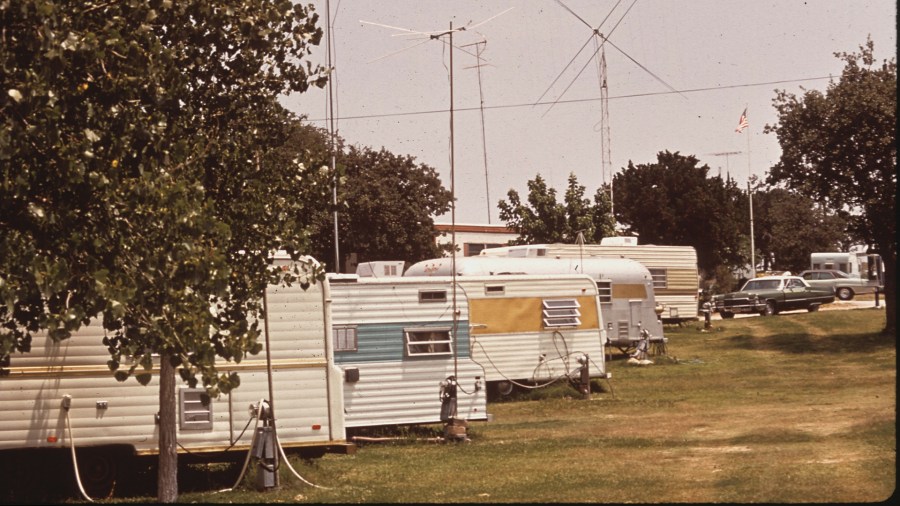
Daddy bought a trailer in Leisure Woods Mobile Home Park when I was a freshman in high school. The owners before us were in their seventies, stabbed in the heart and the neck by a couple high on junk, looking for money. Daddy got it for a steal. They replaced the carpet before we moved in. He said, Baby I know it’s not much but it’s something. That’s what everyone says in Leisure Woods, I know it’s not much but it’s something, as if something, whatever it is, is enough.

The walls are stacked with wood paneling. There’s a chip in the refrigerator door, right by the handle. I didn’t even know a fridge could chip. There’s a futon and a mattress on the floor, a Lay-Z-Boy in the corner by the TV. Daddy buys top ramen and Busch Light and fudgesicles. Daddy tells me he’ll take me clothes shopping one of these days, trade out my Faded Glory for something from the strip mall.

I pull a pop from its greasy sleeve and toss the wrapper on the floor. The TV is on, always. When I was a kid I’d pretend it was my momma. When we’d make gifts for Mother’s Day at school, folded sheets of construction paper with lopsided hearts strung on their covers, booklets of coupons labeled with UNLOAD DISHWASHER and PUT AWAY THE GROCERIES, necklaces laced with clay beads, I’d give them to the TV. I’d lay them on the carpet at its feet, place them on its head, try and stick them in the VCR. I’d say, I love you, Momma. I’d say, Happy Mother’s Day. The TV would flash, would shine its gritty, pixelated teeth.

Outside the trailer there’s a rusted bike, a molded canopy, an old grill smothered in bits of charcoaled scraps, in gallons of grease. There is also a boy. He lives next door. The first thing he said to me was, Did you know that the Ganymede moon is the largest moon in the solar system? We play planets every day after school now. Sometimes he lets me be Ganymede. He says they named it after Ganymede the Trojan prince. He was gay, he tells me. He scrunches his face into a zit and we don’t talk about it again for a long, long time.

We’re on my daddy’s mattress and she’s touching me all over. Her name is Carmela and she’s two grades above me and lives four trailers down, three over. Afterward, we count the pockmarks in the ceiling. She turns to me and scans my face, says, I gave up after eleven. I don’t know if she’s talking about herself or the ceiling. I knew them, she says. She sits up, tosses the sheet off her legs. I think one of them died in here. I knew this wasn’t true, but I let her have it. Sometimes that’s the nicest thing you can do for someone.

Turns out Ganymede wasn’t gay, just pretty. Tonight I am Venus. We’re sitting on top of the kitchen counters. Daddy hasn’t been back in days but I’m not worried. The boy says that there is life on Mars. That he wants to be Mars. I rub my finger on the splintered wood beneath the lip of the countertop. A shard stuffs itself inside my skin, like sheets in a dryer. It is a part of me now, the wood, and I don’t even flinch.


Chelsea Harris has appeared in Smokelong Quarterly, Portland Review, Literary Orphans, Grimoire, and Minola Review, among others. She is the co-curator of Wallpaper Magazine and received her MFA from Columbia College Chicago.

The Lazarus Questionnaire by Ted Mico

Please list the ways in which our concept of death might be improved upon:

The sin of living, the sin of not dying: which is the greater sin?     

Would peacock cremation be the best way to jump-start the phoenix population?   

Did you meet the dead animals you’d killed in your first life? How’d that go?

To the best of your recollection, what was the average wingspan of a seraph?

Were they beautiful? If yes, did you feel judged by this loveliness?  

Did you hear the Cocteau Twins coming or going?  

Was there forgiveness? Was there?

Did you hear the crows peck open the field above you?

The regret of going, the regret of coming back: which is the keener?

Do you feel you’ve stopped living or stopped dying?

To the nearest decimal point, please count your blessings:

When you examine a Lichtenstein self-portrait, do you see a self?

Do you feel you’re the victim of a father and son magic act?

Do you consider earth your new birth mother?

Describe your feelings toward God the Father and his apprentice son:

How many times a week do you now have sex with your wife?        

Is this more or less than before?           

Define the traits you have in common with a) a seraph, b) a peacock c) a phoenix

Do people see you as coming or going?

Please use the space below to tell us what you want to see the next time:


Ted Mico began his writing career in London as a critic for the weekly music paper Melody Maker. Since then, he has edited three books, written columns for places such as The Guardian and Huffington Post, and had his poetry published in journals such as Caesura. He is now based in Venice, California.


The Flat by Michael Alessi

I’m changing a tire with my father when his hands fall off. There’s no blood, though they wiggle in the heat, palm up, like two helpless crabs kicking on their backs. My father continues to twist at the lug wrench with his arm stumps. His face continues to sweat and groan because wrenching is hard work, even harder without hands. Good thing we prepared for this, he says, meaning, I think, the flat. While this is happening a hawk swoops in between us and snatches one of the hands off the ground. Do you want me to call someone? I ask. He grunts, meaning, I think, that I have a job already. It’s to pocket the lug nuts and not lose them. I lift my father’s remaining hand out of the dirt and dust it off as I might a worn leather glove. Maybe this is a hand’s true purpose: to grasp nothing. Maybe because the rest of him is sweating nearby, it’s easy to believe he still controls its grip, the way it seems to tirelessly wrestle mine for the surest hold, always slipping. Does it hurt? I ask. My father juts his chin as if to say yes, as if to say this is the only question that can link us; enough to let me know his answer, before he speaks it, will be no answer at all. This one’s starting to give, he says. He moves his arm stumps as if to choke up on the wrench. Overhead the hawk becomes a dot and then a hawk and then a dot again.


Michael Alessi received his MFA from Old Dominion University. His work has recently appeared in Mid-American Review, Passages North, The Pinch, the minnesota review, Paper Darts, and The Cincinnati Review, among others. A native of Virginia’s Shenandoah Valley, he currently lives in Chicago.