When Your Mother is a Mermaid by Candace Hartsuyker

When your mother is a mermaid, no one except you gets to see her before the show starts, poised on a fake rock, tail curled in a spiral behind her, arms above her head and pressed against her ears, ready to dive in. There are four mermaids, but your mother has the most experience. This gives her a special privilege: she has a show where she performs by herself.

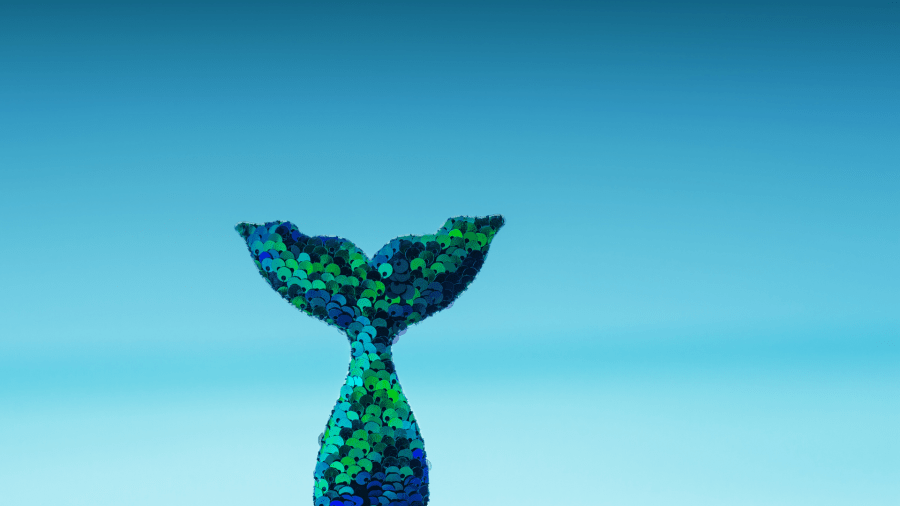
Before the show, your mother applies waterproof mascara to her eyelashes. In the mirror, she blinks rapidly, purses her mouth like a fish. You love your mother’s shell bra, the turquoise color. But it’s the tail you love the most, its luminescence, glowing sea glass green. You watch your mother pull on her heavy sequined tail, twisting her hips and peeling it upward. You have a ritual before every show, a way of wishing your mother good luck. You rub the scales on her tail with your hand, gently. It makes you feel brave to do this, like the time your mom took you with her to her boyfriend’s house and he let you hold his pet. The corn snake zigzagged up your arm, pink tongue flicking, body heavy and warm against your skin.

The audience waits. All they see is the large glass window of the aquarium reflecting darkness. Then, the lights above are turned on. During the show, your mother swims past leopard sharks, sea turtles and angelfish. Her body twists next to coral and seaweed and her tail skims the shells on the sandy ocean floor. Your mother is more graceful than a dolphin. She dips and twirls, flips and pivots. She’s not a mother now but a real mermaid. Her long hair billows. The mermaid cups her hands, delighting in the pebbles she picks up from the bottom of the sea.

You love the looks of admiration the audience gives your mother: the oohs and aahs. The flashes from their cellphones or handheld cameras, the jostling of bodies, mothers plucking children out of strollers and holding them to their chest so they can have a better view.

Your mother surfaces. Water beads her bare swimmer arms. Then she plunges down, tail slapping the water. And even though you know how the show ends, there’s always a moment when you panic. Watching silvery bubbles stream from your mother’s mouth, you leave a small, smeary handprint against the glass as a sign for your mother, to let her know she’s been down there long enough, that it’s time to return to the surface.


Candace Hartsuyker has an M.F.A in Creative Writing from McNeese State University and reads for PANK. She has been published in Cotton Xenomorph, Heavy Feather Review, The Hunger, Maudlin House, and elsewhere.
inarticulate by Angelina Martin

what a deep dumb hell it is to be
subjected to the storm of myself
violently flung about
by malicious memory
nearly drowned by my own
convictions
to crawl my way to the border of the surface
to gasp for air and cry for relief
that I did not receive the death I begged for
and when I try to warn
the clueless shore huggers
of the treacherous depths of pain
lurking in the vast wet dark
all that comes out
of my reckless child mouth is:
            “WATCH OUT! BIG ROCK!”


Angelina Martin is a writer, comedian, artist, waitress, and jock based in Austin, Texas. She has previously been published in Inconnu Magazine, Sea Foam Mag, and Be About It Press, as well as in the book Anthology: The Ojai Playwrights Conference Youth Workshop 2006-2016. Her stand up and poetry both repeatedly touch on themes of sexuality, loneliness, and the lifelong process of healing from trauma. Find her on Twitter at @AngelinaJMartin.

Nursing by Gary Fincke

After our father left, my mother decided to become a nurse. She’d always taken care of him, she said, but now he was gone. She’d loved having babies to tend to, but now my sister was four, I was six, and my brother was eight, all of us old enough to manage a few hours a day with our unmarried aunt. “Harry was a faithless prick,” our mother said to her on the phone, her back to us as if that set her voice on mute. When she turned around, she smiled and said, “Now we’re getting educated and starting over.”

Our mother came home with thick books and samples of the things we’d seen at the doctor’s. She measured our height and weight. She took our temperatures. She wrapped a cuff around our arms and read the numbers for our blood pressure. While she listened to our hearts and lungs with a stethoscope, she said good or excellent or perfect.

She brought home a book called Human Anatomy. It was big and full of pictures like ones we had in our rooms, but my brother said there wasn’t a story. “Oh yes, there is,” our mother said. “Let me tell you.” She told us to lie down and be still so she could identify all the body parts. It sounded easy—arms and legs and knees and all the rest, but instead she named the bones—tibia and fibula, ulna and radius—while she tickled us and recited.

“There are more characters,” she said, and she started on all the places inside us, the things we had to imagine—kidneys, liver, stomach, lungs.  She poked us softly as she found the spots, but my brother said, “Stop” and walked away.

She located the parts of my sister and me I’d never heard of—pancreas, gall bladder, diaphragm. She turned pages to show us the pictures in her book, but my sister had already begun to play with her dolls. “You’re so sweet,” she said to me each time she turned a page.

I was the only one who learned where my thyroid was and what it looked like. I was the only one who could put my hand over where my appendix was and know that a doctor could remove it someday, and I’d never miss it because it didn’t do anything anymore except get infected and make you sick. “Vestigial,” mother said. “No longer with a function.”

“Enough anatomy,” she said one evening. “I need to practice the things I’ll be doing soon. Who wants to let me get an IV started?”

Nobody, not even me, wanted to be stabbed by a needle. “We’re not cars,” my brother said when she asked again. “We don’t need a fill-up.”  My sister began to cry.

“It’s just a prick,” she said, but we all shook our heads. “It’s just a tiny prick and a slow drip. Before long, you’ll forget it’s there.”

I said, “None of us are hospital sick, but there’s a patient in my closet.”

“Pretend isn’t the same as real,” our mother said, but she waited until I came back with the Barbie our father had sent for my seventh birthday, the limited-edition rubber one our mother had laid on her bed before saying, “It looks like you know who.”

“Make her have something wrong inside her where nobody can see,” I said.

“Her esophagus,” our mother said at once, and pointed. “She’s so skinny because she can’t swallow her food.” She sucked up water in her eyedropper and tried to get the doll to drink, but Barbie drooled and slobbered all over herself. “See?” our mother said.  

All three of us got in close to watch. Barbie didn’t even move as the needle pushed into her hand. “This is just to get things started,” our mother said. “To keep her hydrated until I learn how to do a feeding tube.”

“Poor Barbie,” my sister said, but now our mother was smiling. She said she could learn everything else without us. That things were more complicated than names. What Barbie needed was a surgeon, someone she would be able to help when she learned enough to be a real nurse and she could hand the doctor the proper knives.


Gary Fincke’s latest collection is The Sorrows (Stephen F. Austin, 2020). His story “The Corridors of Longing” will appear in Best Small Fictions 2020. An essay “After the Three-Moon Era” has been selected to appear in Best American Essays 2020. He is co-editor of the international anthology series Best Microfiction.

to eat the sleeping sky, whole by Ashley Cline

“honey, you’ve got to know your name was always in bloom on
that tongue—one way or another, love makes a garden of us all.”

[your mother, after the funeral]

i.

i bet i could swallow the moon, you say & smile. such a simple
& magical thing, & how easily i believe in this yawning fever;
in such grinning hunger, gentle. how easily i believe—

ii.

that mouth, without arrogance or question. that mouth, which i’ve
watched drink from the sky & come up for air twenty feet beneath
rolling waves of sycamores & still, offering yet more of itself—

spilling & gasping & swearing & filling & asking for no more than
it can carry home, easily. that mouth, that was not built from gilded
things, but rather, found: in peach stones & nerve endings &

half-wild things; in match strikes & clementines & two-for-one bargain
bins—& still, how it shines like karats left on the halcyon vine: summer-
drunk & overripe & full of every season we’ve tried to name, but

settle on home, instead. that mouth, with its crescent laugh & pendulum
tongue: swinging & swinging & swinging—always—towards north or
nostalgia or the karaoke bar over on 9th & isn’t it funny how they’re

all the same, really? it’s just that we’ve taken such care in calling our
happiness by anything other than her name: a practice borrowed of
indigobirds.
that mouth, & how it stretches philosophy into

bubblegum pop, how it flexes & fashions new mountain ranges
from my favorite song stuck in its throat in late-June; how it
calls my name, & even the tides turn to shore.


An avid introvert and full-time carbon-based life-form, Ashley Cline crash landed in south Jersey twenty-eight years ago and still calls that strange land home. Most often found listening to Carly Rae Jepsen, her essays on music and feelings have been published by Sound Bites Media, while her poetry has appeared in 404 Ink, Third Point PressSidereal Magazine and, most recently, Lychee Rind Zine. She graduated from Rowan University in 2013 with a Bachelor’s degree in Journalism, and her best at all-you-can-eat sushi is 5 rolls in 11 minutes. Twitter: @the_Cline.

The Chorus in My Walls by Elisabeth Ingram Wallace

Honey I say, honey, I think we have bees, listen I say listen: he freeze frames and listens, and there’s an unmistakable thud behind the chipboard; Badgers?, he says, or rats, or a ghost, this is our first house and we have no fucking luck he says, of course it’s fucking possessed, No I say, no it’s bees, look at the electric socket, and he does, he sees the gold gloop splooging down the eggshell blue, my choice, Shit he says, do you think this will be like France, when we had the millipedes?, no I say, thinking of how the black walls would scatter scuttle under the floorboards when we flicked on the ampoule to eat le souper Lidl, and the night he’d said “maybe we should have a bit of time apart?,” not fucking likely I’d said, and we slept in the car, then I called an exterminator and put it on my credit card and said it was only 200 Euro but I still haven’t paid it off, God I hope not he says, definitely not, I say, I think it will be more like the time I dropped the crystal champagne glass in the kitchen on our wedding day, and it shattered into a thousand billion splinters, and a full six months on my bare feet will occasionally catch one and bleed profusely, then hurt profusely because crystal cuts they go deep and go black blood hard, and I will not “just put some bloody shoes on” and I will not pull the splinters out either because each time I step-hurt I remember you, that cloudy cold day, the beach the rain the arduously selected Non-Denominational master of ceremonies who turned out to be a religious nut job and rambled about The Judgement Of God for thirty minutes while my mascara ran and you squinted rain and shivered like a puppy and then on the way home my ring disappeared, but I only noticed after an hour after we’d wondered around the town drunk like eejits, and you paced up and down the streets all night looking for it, even up streets we hadn’t ever walked down, didn’t even know existed, because I was crying and you wanted to make me smile.


Elisabeth Ingram Wallace is the winner of the Mogford Short Story Prize, Writing the Future, and a Scottish Book Trust “New Writers Award.” Her work has appeared in SmokeLong Quarterly, Atticus Review, Flash Frontier, and many other journals and anthologies, including Best Microfiction 2019. A founding editor of “BIFFY,” the Best British and Irish Flash Fiction series, she is currently Submissions Editor at SmokeLong Quarterly, and Senior Editor for Flash Fiction at TSS Publishing.

Earth Witch by Christina Thatcher

How the dust never shakes off, even
after stripping, even after climbing
back onto the horse. How mud clumps
in the hair, smears on the cheek. How
everything is dirty, how she is always
dirty from heaving shit onto the shit
pile. How when it rains, cliff tumbles
into creek at her bidding. How she anticipates
the turning of her body into mulch
which will sink into the earth,
decompose and recompose,
and how she, then, can transform
into anything: a cottonmouth,
an oak, a man, another
girl.


Christina Thatcher is a Creative Writing Lecturer at Cardiff Metropolitan University. Her poetry and short stories have featured in over 50 publications including The London Magazine, Planet Magazine, And Other Poems, Acumen, The Interpreter’s House, and more. She has published two poetry collections with Parthian Books: More than you were (2017) and How to Carry Fire (2020). To learn more about Christina’s work please visit her website: christinathatcher.com or follow her on Twitter @writetoempower.

The Falling Baby by John Jodzio

I caught a falling baby once. He hadn’t fallen out of a high-rise apartment window or anything fancy like that. It happened at a birthday party where some people knew me from the horse track and some people knew me from selling them horse drugs. There was a trampoline. Someone set a baby down on the trampoline. Soon the baby flew through the air.

I caught the baby like a football before he landed on a concrete patio. No one gasped and only one person clapped. This was the 1990s and sometimes babies flew off trampolines and sometimes their parents took horse drugs that made them want to dig hundreds of holes in their yard or not move from their couch for a week.

The baby had dark hair and brown eyes. He wore a onesie with a green turtle on it. He was not crying, but he was certainly breathing heavily. Hey little one, I said, cradling him in my arms, maybe this will only be a tiny blip in an otherwise unscarred life? Hey little buddy, I said, maybe this will only make you terrified of trampolines and not scared of the entire goddamn world?

I walked around the party, asked everyone if this was their baby. Fifteen minutes went by and no one said he’s mine. Fifteen minutes went by and I couldn’t help but imagine a future where the two of us moved into a house near a river with a backyard that would occasionally flood, a place where I would not sell horse drugs or regular drugs or at least would only sell them to supplement his college fund. 

“Why is my drug dealer holding my baby?” a woman yelled out.

This woman had feathered blonde hair and light blue eyes. I did not remember selling her drugs because I sold a lot of people drugs and usually tried to not to look anyone in the eye unless they made me.

“How do I know he’s yours?” I asked.

“How do you know he’s not?” she said.

I turned the baby toward the mother. I wanted to see if there was any sort of joy or connection between the two of them when they looked at each other. Instead of recognition or happiness, the baby yawned.

“I saved his life,” I said.

“I gave him life,” she told me.

She held her arms out and stepped toward me. Instead of handing the baby to her, I tucked him under my arm and sprinted toward my car. 

I did not get far. Two men tackled me and the mother pulled the baby from my arms. Some people at the party wanted to call the cops, but most of the people there did not want to lose their connection for their horse drugs. In the end, I was kicked in the ribs a couple of times and told to leave.

I sat inside my idling car as the party went on. The mother was holding the baby now, watchful, bouncing him up and down on her knee. He seemed fine? Soon the two of them went inside and I watched people jump up and down on the trampoline for a couple of minutes and then I drove back to my apartment that was not by the river and would never flood.


John Jodzio’s work has been featured in a variety of places including This American LifeMcSweeney’s, and One Story. He’s the author of the short story collections, KnockoutGet In If You Want To Live, and If You Lived Here You’d Already Be Home. He lives in Minneapolis.

my mouth is full of words i don’t know by Monica Kim

like godingeo. full fish without the head, bones
still poking through flesh. americans like their fish
cleaned, served in bite-sized pieces you can pop
easily in your mouth, melting on your tongue and
swallowing with ease. we like the challenge
of the game: tongue working around a bone
the size of a hangnail, spitting it out onto
the plate, lifting a skeleton of bones with our hands
from the entire fish, making our own nonuniform
pieces with our chopsticks. what is godingeo
in english? i’ve never had to say it out loud
before.

before, i knew what this banchan was
in korean. now when my friend asks what
i ate for dinner the name sits on the tip of my tongue
but melts away before i can even recall
the letter in hangul. i don’t know the name
in english. americans don’t eat this type
of side dish, thin chewy strips of some squid
covered in a spicy sticky red sauce that coats
your tongue with tiny pinpricks. i can describe
it in english but i don’t know what
it is in either language.

when i eat i never ask what i’m eating. some dishes
i know, some i don’t. my mind can recall
the color and the texture and the smell and
everything else except the name. recognition
of food in my mouth but my tongue
unable to speak its name.


Monica Kim is a recent graduate from the University of Michigan with a B.A. in English. She is published in Stirring, and has an upcoming chapbook titled “An abridged medical family history & multiverse of selves” as well as a poem from the chapbook in the Michigan Quarterly Review.

American Movie by K-Ming Chang

She was born in Hefei but only wanted to watch American movies that took place on coasts where it snowed. She’d never seen snow and I’d never either, but we invented for each other its taste: I said sweat and she said sunlight. I said she was wrong, that snow was just a kind of dandruff, something to brush off our shoulders in the morning. We were literal with each other. I love you so wide, she said, and slipped me her fingers, my legs lended over her shoulders. I love you so lean, I said, when we couldn’t afford our appetites. At fourteen we were both in factories, hers for skirts and mine for shirts. We matched in ways we’d rather not, like how her father died in an electric scooter accident, struck by a minivan full of mushrooms, and how mine died eating a poisonous mushroom on purpose because he’d read about it in the newspaper, a listicle about common mistakes made by children, and he believed reports that it had been painless. It was determined later, though I didn’t know how, that he vomited until his lungs collapsed. We both believed we would not repeat the mistakes of our ancestors. She didn’t ride anything with two wheels and I did not eat anything I touched. Instead she fed me, powdered my mouth with instant noodle packets, fitted my teeth with slices of peach. I only ate what she gave me. Every swallow a trust exercise. She said she used to believe Americans only wore jeans. At the factory, she made denim skirts and came home with fists strangled blue. One time she brought me a zipper with nothing attached to it, a zipper as long as my arm. She fed it to me, unfurled it to the bottom of my belly. I swallowed its whole cold length, waiting for something to unzip inside me. Wondered if this was the waiting my father did. He used to grow tomatoes in an urn full of soil, teaching me when they were ripe, just before their skins sauntered off, watered into waltzing. At night, she repeats the lines of American movies. Hands up. I love you. Drop your gun and kick it to me. She tells me again she’s getting in trouble for dropping buttons on the factory floor, fistfuls for fun. She likes the sound they make, like rain. We wonder if snow clatters when it lands, if it weighs anything in the palm, if it falls like a flock of birds when they’re shot down, talons snagging on the sky, a seam everywhere I see. Probably not, I say, and but she says it does, it does. We stand outside and do not touch. We wait for a snow of mushrooms or beads of light or spilled buttons. For something to make a sound of us.


K-Ming Chang is a Kundiman fellow and a Lambda Literary Award finalist. Her debut novel BESTIARY is forthcoming from One World/Random House on September 29, 2020. Her poems have been anthologized in Ink Knows No Borders, Best New Poets, Bettering American Poetry, and the Pushcart Prize Anthology. More of her work can be found at kmingchang.com.

Keep Turning Over by E. Kristin Anderson

After HAIM

Here is my panic attack: I haven’t been out in days
and it’s painfully normal. So when I take my first breath

of the day I’m already trying not to feel. After all these
days inside, I have become proficient in the loneliness of

catching the sunbeam that sneaks past my blinds
and putting it back outside. I know it seems like I’m always

sleeping now, but late at night with my knees aching
I’m wide awake considering how my body will push past

the threshold of survivability. I make little promises to keep
from kissing the sickle and tonight is another night alone

in this apartment, screaming every word of “Landslide”
into the popcorn ceiling. I think I fell like a meteorite

into this timeline and I should have expected you to scatter
but I’m listening for strange angels on the roof. Dawn

approaches like a purple bruise and I’m pushing my face
into the pillow desperate for oblivion. I dream again

and again of old friends and I don’t have the energy
to harbor this anger, can’t ping enough cell towers to

triangulate all the words I’d need to say. But the dreams
are the same and I wake up wrecked. The panic of

continued existing is a swansong I carry in my pocket,
and when I shine it’s because the rain cooled me while

I stood outside watching the iron gate open and close
in a thunderstorm. Some things can’t change. I wait for

your reply with my heart cracked open at two a.m. and
in my loneliness I sip at the air I’ve kept for myself,

collect a week’s worth of mail, wash my face slowly,
press my hands against the wall as if I might find a door.


E. Kristin Anderson is a poet and glitter enthusiast living mostly at a Starbucks somewhere in Austin, Texas. She is the editor of Come as You Are, an anthology of writing on 90s pop culture (Anomalous Press), and her work has appeared in many magazines. She is the author of nine chapbooks of poetry including Pray, Pray, Pray: Poems I wrote to Prince in the middle of the night (Porkbelly Press), Fire in the Sky (Grey Book Press), 17 seventeen XVII (Grey Book Press), We’re Doing Witchcraft (Porkbelly Press) and Behind, All You’ve Got (Semiperfect Press). Kristin is a poetry reader at Cotton Xenomorph and an editorial assistant at Porkbelly Press. Find her on Twitter at @ek_anderson.