The Red Ladybug by Paul Rousseau

She sees a ladybug
crawling across her
bedroom windowsill.
An urge to crush it comes over her.
To make a mini mortar and pestle matter
of red and yellow guts.
The exact moment she decides to spare the insect,
she realizes it is already dead—
and only reanimated by the periodic gusts
of her oscillating fan.


Paul Rousseau is a disabled writer from Minnesota. His work has appeared or is forthcoming in Wigleaf, Catapult,  Roxane Gay’s The Audacity, X-R-A-Y, and JMWW.

Explanation of Your Benefits and Losses by Angie McCullagh

This is an overview of transactions from November 2018 – February 2020.

This is not an actual request for payment. It is only a series of numbers.

Amount Billed – $59,578.66

Number of mammograms, ultrasounds, and biopsies required to confirm diagnosis – 4

Your negotiated discounted rate – $53,243.22

Total anxiety attacks experienced while you waited for the doctor to say invasive lobular carcinoma – 2

How many instances, after you heard and while you drove to your daughter’s third grade class Thanksgiving feast, that you had to pull over to scream into your cupped hand – 3

Amount covered by insurance (A bundle. Plus we allowed you to take advantage of our contractual rates – you should know this) – $37,007.03

Times your husband said he’d watch the kids so you could nap, but then disappeared to the garage – 7

Gift cards you won online playing casino games and taking surveys so you could buy goods, then return them for cash to pay the bare minimum on medical debt – 12

Amount you may owe – $16,236.19

This is definitely not a bill.

Who received care – You, mostly from nurses, who flushed your port and infused you with your chemo regimen and hugged you when you learned the octopus (that’s how you think of it now, with glissading arms and grabbing tentacles) had spread to your lymph nodes.

Head scarves, hats, and even a wig you ordered to find something that made you feel enough like your normal self – 11

Hours spent knowing you should help your son with math or wash the dog with her anti-itch shampoo or cook something, anything, so your family can eat food other than teriyaki from Sunshine Sushi – 3,017

Hey, this is no bill, but it is a heads up that another enormous payment is coming due soon.

Who should be grateful: You. Unless you enjoy, at the age of 43, the slow slither of death while your children who are too young to properly live without you (who else will remind them to wear helmets on their scooters and to cup their pink cheeks in the morning while you whisper they are more precious than Trader Joes Peppermint Joe-Joe’s – an inside joke?)

Occasions you’ve thought sliding toward oblivion and exploding into glittering stardust would be better – 0


Angie McCullagh lives and writes (mostly fiction) in Seattle with her husband, two teens, and emotionally fragile mutt.

Anyway, it’s Tuesday and this morning… by Atma Frans

when you stepped out of the bath, the mirror laughed
at the wrinkles cartwheeling down your belly
and the slack-jawed skin just hanging around.
Your once round-shouldered breasts flapped about
not quite sure what was still expected of them.
You surveyed the age spots, scars and crooked bits—marks
of the times you trolleyed your body through life like a cocky suitcase.
And then you towelled it, this loyal, beautiful friend.


Stories and poems by Atma Frans have been published in The New Quarterly and Arc Poetry Magazine, as well as long-listed for The ELQ/Exile’s Carter V. Cooper Short Fiction Competition and the Writers Union’s Short Prose Competition. In her writing, Atma searches for the voice beneath her personas: woman, immigrant, mother, Sikh, trauma survivor, expressive arts therapist, queer, and poet. She lives in Gibsons, B.C.

A Closed Door with a Keyhole by L Mari Harris

I turn to the woman standing in line behind me: There are two doors. Which one do you choose—left or right? She looks up from her phone, wary. What’s behind the doors?, she asks. This is a simple game to get to know one another, to see if we are compatible as friends. I stare back at her. You tell me.

My great-great aunt broke into neighbors’ houses with a bobby pin she’d pull from her big cinnamon–bun of hair. I never met her. My parents told me the stories, how once they found out what she was doing they quietly went around to the neighbors’ houses and tucked envelopes of cash in their screen doors to make up for the little things my great-great aunt was taking—a decorative hand towel, toothpicks in a little ceramic penguin, butterscotches and cocktail mints. I asked why none of the neighbors ever called the cops. Because they felt sorry for her. They said she had seen much, had basic needs that went unmet for many years, that these life experiences changed her. Bis auf die Knochen?, I asked. We didn’t understand her either, they replied.

I think of my great-great aunt in that big rambling house all by herself for all those years, living among furniture brought over from the old country, how my parents described room after room after room filled with those heavy uncomfortable pieces, how as she got older and frailer the dust collected. After she died, my parents sold off every last piece and locked the door behind them. I once told them it all sounded so romantic, living among the ghosts of the old country. It wasn’t, they said. It smelled like a terrible sadness.

My parents ask if I’ve met anyone nice when they call. This sounds like a trick question, I say. My mother huffs You know. Like a friend or maybe a special guy. I hear a muffled discussion, then my father crystal clear: We’re worried you’re all alone there. I tell them I’m surrounded by ten million people, how can I possibly be alone? Then I ask if my great-great aunt ever took any dishware, because I need a new set.

Sometimes I ride two stops past my stop so I can repeat the past on a leisurely stroll. The woman from the other day is coming out of a store and I fall in behind her. She’s carrying shopping bags in both hands. Her high-heeled boots quickly clip-clip-clip on the sidewalk, as if she has to get home because she has a million things to do before she finally gets a moment to herself. I stay half a block back, follow her to a brownstone. She pauses, tilts her face up to the door and stares before climbing the stairs. She shuts the door behind her and the stoop light goes out. The night blankets me once again, and I imagine children and a husband tugging at her as she tries not to show she’s rushing through dinner preparation and bedtime rituals. I wonder if she’d enjoy weekly dinners out, a chance to vent about children sticky with pancake syrup and snot, the husband mumbling under his breath You wanted them. I’d pick at her fries and tell her about my great-great aunt’s renegade life, how people called her spinster but they were dead wrong, how she had the ghosts of our ancestors from the old country to talk to and that suited her just fine. I’d tell her I could understand what it’s like having so many people in my life that I can’t wait to get rid of them for an hour or two.

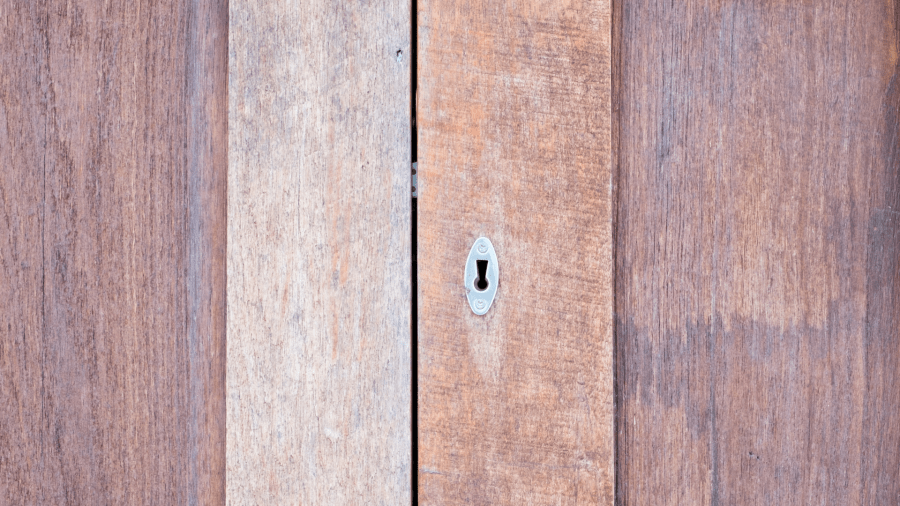
I dream of a closed door with a keyhole. I can hear laughter, music, glasses tinkling. I look through the keyhole and see a woman, her hair twisted and pinned to the nape of her neck, her earrings catching the light when she tosses her head back to laugh at something someone is telling her. I look closer, and I’m the someone who’s making her laugh. The room is crowded, and we have carved our little spot along a wall to share our secrets. We laugh, reminiscing about how we met standing in line all those years ago, how I tapped her on the shoulder and asked her to pick the left or the right door. How she thought I was the most interesting person she’d ever met, how there was something so familiar about me.


L Mari Harris’s work has appeared or is forthcoming in matchbook, Ponder Review, (mac)ro(mic), Bandit Lit, Pithead Chapel, Tiny Molecules, among others. She lives in central Missouri. Follow her on Twitter @LMariHarris and read more of her work at www.lmariharris.wordpress.com.

Family Monsters by Donald Illich

As Mothra, I spin around
the family room, seeking
anywhere but flames.

Mom is Rodan, screeching
at anything that makes her
angry. My father, though,

crashes through the scene
as Godzilla, the big destroyer
who burns all resistance,

leaving smoke in his wake.
He occupies the living room,
while we cry in the kitchen,

I daub Rodan’s tears with wings,
while she massages my back
with her beak. If only we could find

a way to live in peace together.
But it’s too late for that.
We’ve been exposed to radiation

our whole lives, the toxic waste
of guilt and recriminations.
We might dwell under the same sky,

soldiers might try to fire on us all,
but we must depart to separate lairs,
pledging one day to return.

In the future we will not be creatures.
We’ll turn back into human beings,
wearing a suit, a dress, a concert t-shirt,

whatever forms the fates allow,
to once again go outside in the light,
breathing nothing but clean air.


Donald Illich has published poetry in journals such as The Iowa Review, Fourteen Hills, Map Literary, Passages North, and Cold Mountain Review. He won Honorable Mention in the Washington Prize book contest. He recently published a book, Chance Bodies (The Word Works, 2018).

The Pixelated Tiger by Jack Barker-Clark

I used to dream of traveling down my own throat. I had a stammer and tripped on words, and I would close my eyes and imagine myself passing through roped-off plasma and plunging carbon. I was hoping to find the cause: a constellation of upturned chairs or a picket fence. It was 1998 and every afternoon after school we played Tomb Raider, nosedived off ramparts and swam in low-grade lagoons. I was always zip-lining into clearings where tigers generated. They were pixelated, these tigers, but insatiable, rabid, a frightening blockade of sunburst cubes, and I came to wonder if it was a pixelated tiger rooming in my throat, swallowing up all my consonants.

He always looked over-toiled, moon-starved, whenever I imagined my tiger, which made me cherish as much as revile him, and we ploughed on together, pitiably, through the class register and the English presentations and the randomized swimming galas, one or the other of us always biting my tongue. In 1999 we took a school trip, a pretty place in the Lakes, and we were, my tiger and I, assigned a third party to row with. Alex, the history buff, had not quite volunteered but was rowed out onto the bruised lake anyway, and the dappling jangled and there was flotsam and bits of outcrop reflected back in the water. The rowboat was stiff and from far out the banking’s gradient looked sheer, a bowl, as though the landscape beyond was landless, was watercolour.

Unhappy at the rocking, the pitch of things, at how far I’d insisted we row, Alex berated me in the boat. My words wouldn’t rise and we faced each other in silence, eventually turning to watch the blue noise on the shore, its abstract brightness. Did he stand up or was the boat disturbed? they later asked, and I didn’t know. He was suddenly in the water, gulping, trying to sift the lake out from under him, and I sat with my tiger in the pale light and watched Alex thrashing until he wasn’t. The pixelated tiger rowed me back softly to the shingle beach.

In my late teens the stammer became less pronounced, was dimmer now. I had attended speech therapy, learned to tap my foot, sang in the choir. After such surges in confidence, I found, pixelated tigers often vacate the throat. At first I extolled this miracle. But I was only abbreviated in other ways. He sank into my core and knocked at my chest. Behind the fists of my lungs he hollowed out his den, prowling, unblinking. The pressure on my wide-tracked ribs was concentrated and I longed for my stammer back. At night I performed squat thrusts, my limbs as string, willed him to roll upwards: fundus, adrenal, thymus, trachea, cortex, thick pate, into sky, a ream of ash. But he never rose, he only sank. Did he stand up or was the boat disturbed? I still don’t know. Now here I go. I put myself in the bath, down flat under the skim. My body moves like a gondola. The words crawl all over me.


Jack Barker-Clark is a writer and artist from a passé valley in the North of England. He is the founder of Pale Books, a reading project, and writes primarily on literature and ornamental grasses. He tweets occasionally at @jackbarkerclark.

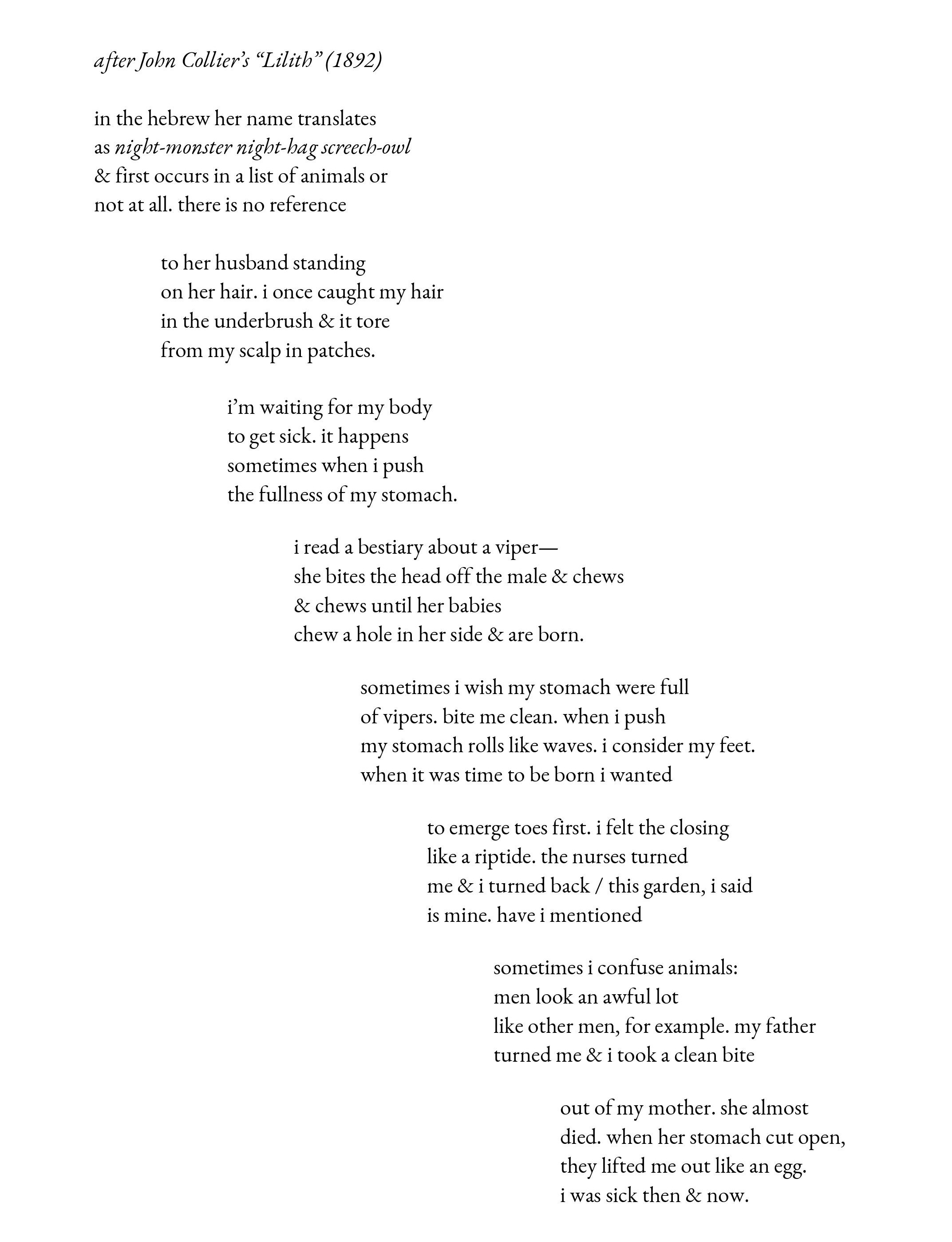
Lilith with Snake, with Body by Kathryne David Gargano

lilith with snake
 
Link to text readable PDF here: poetry lilith with snake gargano


Kathryne David Gargano (she/her) hails from the Pacific Northwest, but isn’t very good at climbing trees. She is a queer poet and fiction writer currently pursuing a PhD in Creative Writing from the University of Wisconsin – Milwaukee. Her work has been published in Pithead Chapel, Salt Hill, Phoebe, minnesota review, Tahoma Review, and others. She can be found on Twitter @doubtfulljoy.

Sleeping Beauties by Tiffany Promise

The Land of Trazodonia is a hidden chamber within the walls of Slumberland Psychiatric Hospital. It both exists and doesn’t exist at the same time. This is where we Sleeping Beauties tell our secrets. We all wear masks of each other’s faces.

Instead of swallowing, we let our pills dissolve on our tongues, sending them straight into our mucous membranes. Straight into our bloodstream. We don’t have time for them to dilly-dally through our digestive systems, to fight with whatever thawed-out muck was supposed to pass for Sup. The oblong blue bars that keep our brains from quaking; the tacky, sunshine-colored globules that keep our hearts from over-beating; the chalky, white tabs as big and round as moons. They taste a little bit like Clorox and a little bit like licking frogs. A lotta bit like love.

While waiting patiently for our Meds to kick in, we sit Duck-Duck-Goose-style while gentle technicians re-attach electrodes and sensors to our mottled chests and scalps. Their gloved fingers move across our skin like tiny sparks of hope.

We are so thankful to have ended up here. So far away from Rhinestone, Texas, the Pear Tree Trailer Palace, dead Maxine’s partially-deflated balloon-head. From the grit-grime of spanged change, from Johnny’s calloused hands. His sweet, sweet, sweet till sour breath. From under Pepper Jack’s thumb, the bruised knees & missing gag reflex. Broke-the-fuck-open face. From mother’s dusty attic, the clumps of hair & fingernail clippings. Rotten apple cores. From the fifty-one-fifty-one-fifty-one-fifty. Their bughouse rubber rooms ever-blooming with red storybook roses. From that quiet spot in the library. Backpack full of binge, diuretics, lax tabs & Philip K. Dick.

Far from everything……
                                              everything……
                                                                            everything……
                                                                                                          that hurt us……

Twenty hours of sleep might seem like a lot, but when you’re a sloppy, messy, useless thing—more mercury than blood—twenty hours ain’t peanuts.

So, safely snuggled by seven, we finger the starched sheets as the sleep-tingles slowly creep and we let ourselves sink deep into the deep. That sweet, dark spot where we’ve got whole ribcages of defenses to protect us.

We sleep……
                            we sleep……
                                                        we slee……


Tiffany Promise (she/her) is a writer, poet, chronic migraineur, and the mother of two wildlings. She holds an MFA from CalArts, and her work has appeared in Brevity, Black Clock, tiny journal, Every Day Fiction, Blanket Sea, Sunspot, and is forthcoming in Peculiar and Creative Nonfiction. Though she now lives in Austin, Texas, Tiffany is originally from the mudbug-ridden swelter of the Gulf Coast, which is the setting of her recently-completed first novel, Eggs.

Anarchic Sight Theory by Luke Burton

Each Sunday I play pool with eyeballs for billiard balls
at the Other Place & envision what it might be like to be touched
by felt & fluorescence in alternation. The light of passing cars
filters occasionally through our pitchers of PBR. I know no metaphor
for sight, yet the beams protrude, pint shaped,
from the sockets of anonymous angels. Lines sharp as axe blades
gently part the trees, then brush away before the fall.
You ask where the terror is located—
Is it in the horse yet to be broken or the broken horse?

I’m embarrassed by my telos,
a stance of cue balls awaiting sticks. The future
perfect will be an ongoing breeze. I have no theory
for dream without waking. Falling from the lake onto the shore,
I wanted to know how you felt about the hurricane
hoarding air above the Atlantic, the one that shares a name
with your lover. Instead, I zipped my coat against the wind —
whose breath? A thin horse swept up from the South
and kicked my eyeballs back into their dark pockets.


Luke Burton is a poet and artist writing from Burlington, Vermont. His work has appeared in Crossroads Magazine, The Redlands Review, Pomeroy Poets Anthology, Bard Papers, and more. He is a senior Editor at GENERAL SUBJECT and NO SUBJECT Press.


Painting Birds by Jennifer Todhunter

Sometimes, when we caught the birds, we’d dip their tails in our fingerpaint, their tiny wings struggling against our clumsy hands, their miniature beaks gasping for breath or a worm, we were never sure which one. Sometimes, we’d sneak up trees toward their nests, shove their fragile shells in our pockets and scale back down, our feet barely hitting the trunk, our hands sticky with sap, our never-brushed hair full of pine needles, and we’d place the eggs in a shoebox underneath our bedside lamp, cushion it on some grass and sticks and we’d die at any sort of movement. Die. 

Sometimes, when a baby hatched in the wild, we’d sit on the windowsill in our bedroom and listen to it cry out for its mum, the frantic chirp of a newborn, and we’d think how familiar that was, how we’d be making the same noise if we weren’t so distracted by this perfection. 

One time, we caught a finch and we painted its tail yellow and after that it perched in the tree outside the kitchen where we scrambled eggs by ourselves every morning and sometimes it sang to us, a warbling lilt.

One time, we watched an eagle swoop down and carry a baby with a blue head away in its giant claws, while its mum flew around like she was on fire, and we looked at each, our hearts stuffed with envy. 

One time, we heard a yellow-tailed bird fly into our bedroom window and drop dead on our deck, and we put it in the freezer because we wanted to preserve its beauty, the contrast of yellow against black feathers, its delicate softness against the stiffness of death, so we nestled its body against frozen rib roasts and bags of blanched spinach, and we left it there until we didn’t remember it was there any longer.


Jennifer Todhunter’s stories have appeared in The ForgeHobartCHEAP POP, and elsewhere. Her work has been selected for Best Small Fictions, Best Microfiction, and Wigleaf´s Top 50 Very Short Fictions. She is the Editor-in-Chief of Pidgeonholes and founder of Trash Mag. Find her at www.foxbane.ca or @JenTod_.