Chickens by Harsimran Kaur

Before: I see grief speeding past my black Toyota Camry on the 29th intersection in the funny, stupid little town called Poppy. I have been living in Poppy for the past twenty-five years—this is where I met my chickens. There are twelve of them—all so ripe—I like them so much that I always want to adorn them. Neat. Put glitter under their eyes, pierce their strong hands (you’re supposed to pierce your hands, and not the softies on your body, left wasted like an ugly Christmas sweater, driven out of existence, lost into the cabaret.) The wolves in my backyard are in love with my chickens. I guess, everyone in Poppy is in love with my chickens—it’s as if their bodies are a magnet. It’s natural for anyone to fall in love with them. When I turn my neck back once again, I don’t see grief disappearing like a cloud of smoke, I don’t see it running in the opposite way anymore—not jolting itself into a corner. I see it turning back. When it’s eighty meters away, I sigh. My first thought is chickens. Perhaps grief is in love with them, too.

After: I come back home, and drop to my knees. The chickens are gone. All twelve of them. Not even a trace. I ask the wolves. I call the cops. I thought grief wouldn’t do anything. But it did. It took my chickens away, I say to Mr. Brad, the detective. A year goes by, I wait, wait, wait. I am so hungry… and they were so ripe. I wonder if they wouldn’t have disappeared without a trace if I fed them to the wolves in the backyard. At least I would have gotten something out of them—a ribcage, for example. A void in my living room—the ribcage. I am so sad. I wish they would come back to me. I would cut them into pieces. They were so ripe. They were like chemtrails over a country club. So present. I really would have eaten them—made them a part of me I would have always adored.


Harsimran Kaur (she/her) is a recent high school grad from Punjab, India. Her writing appears or is forthcoming in Jellyfish Review, BULL, Big Windows Review, Milk Candy Review, JMWW, and elsewhere. An alumna of The Adroit Journal Summer Mentorship Program, her work has been recognized by The New York Times. She loves clementines and Lana Del Rey, and works as an editor-in-chief for The Creative Zine. She tweets @harsimranwrites.

On the night my uncle dies i sing a little song by Alyssandra Tobin

I dance a little dance. I let the Jersey Devil talk me down. I listen for the sound of that big voice in my head and find it loud. I pray before the altar of see you laters. I scoop poison out of our rivers. I plant trees in our cities. I think it is no small thing to die and yet it’s also the most ordinary. And what of it. I click my heels and I’m in a smaller world again. One where fewer people who loved me as a child are still here to love me as a bigger child. It’s the vanishing I can’t stand. The sudden jolt of empty stair. The switchback to nowhere. All of it’s got to mean something. What if I told you I had an uncle once named Harry Tacelli? You don’t care. And why should you. I care tho. I’m gonna care until they finally get me. You know, the ones who get everybody, in the end.


Alyssandra Tobin is the author of PUT EYES ON ME NOT LIKE A CURSE published by Quarterly West in 2022. Her poetry can be found in Poetry Northwest, Bennington Review, Puerto del Sol, and elsewhere.

The Dar-Ron Motel by Julia Strayer

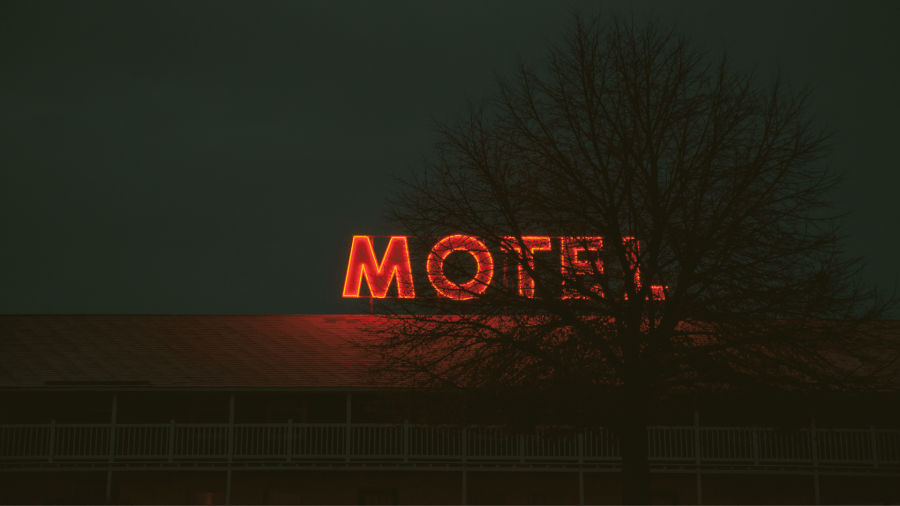
The doctor says I should spend the night nearby, just in case, and now I think I’m crazy for doing this so far from home. I find a cheap motel with free TV. It looks better at night when sunlight can’t get to it. Or in a fog when the edges are blurry. But by the light of day, it’s the kind of place I’d drive by without turning my head.

The sign says Dar-Ron Motel and I know a couple named Darla and Ron run it without even asking. Or maybe Darren and Ronda—without an H, because her mother wanted her to be special, the kind of person who wouldn’t grow up to own a rundown motel. Either way, Dar and Ron probably aren’t even together anymore. Maybe it’s just one of them—Darla with a new man who now helps her keep up the place, even though the sign still says some other guy’s name. Maybe the new man resents Ron. Maybe he’s grateful. Or maybe it’s just Darla because no man will stick around long enough to make changing the sign worthwhile.

The night clerk’s a gum chewing teen with red lipstick and hair that’s black on one side, white on the other. I wonder how much thought went into deciding which color would look best on which side. That’s the sort of thing that would prevent me from doing that sort of thing. I envy her. She’s probably the kind of person who’d never change herself for some guy making promises he’ll never keep just to get in her pants, eventually saddling her with a smaller, needier version of himself, unless she’s the one who finds a doctor far from home.

If I owned the motel, I’d name it The Francine because it’d be all mine. I wouldn’t cut up my name and share it with some guy, because that only leads to heartache and dead unicorns. At Halloween, I’d go all out decorating the place, and people would come from all over to see it. Halloween makes everyone equal—visible and invisible at the same time. I’m safe because I can see the masks. It’s easy to tell who’s pretending.

My motel would have a lounge where the lonely people who are missing persons from their own lives could feel like they’re part of something and like they have a home. Maybe they’d rent a room and maybe they’d even meet someone. And they wouldn’t care if the room came with free TV, at least not right away.

Julia Strayer has stories in Glimmer Train, Kenyon Review Online, SmokeLong Quarterly, The Cincinnati Review, Jellyfish Review, Wigleaf, and Atticus Review, among others, including the Best Small Fictions anthology. She teaches creative writing at New York University.

rabbit’s foot harvest by Robin Gow

we must take control
of our own luck. in the graveyard
we look for rabbits recently returned
from their convening with the dead.
pick a set of rules & believe in it.
slaughter on fridays. on fridays
when it rains. on friday the 13ths.
i had a friend once who had a purple rabbit’s foot.
she wore it as a keychain on her backpack
& told me there was a rabbit limping
in the yard, watching her, waiting
to steal the charm back. aren’t we all
waiting to take a limb back?
soon it will be a full moon or
a new moon. soon there will be
a cross-eyed man to do the deed.
shape-shifting witch who walks
along the edge of the cornfields
with only one hand. what does it mean
to steal from another’s body to keep our own?
all i want is assurance that tonight
the world will not swallow me.
i want to eat oranges. i want to sleep heavy
& easy so i create a ceremony from which luck
will fall like a dead tree.
shot with a silver bullet. the rabbit
always running from the meanings
of her skeleton. hiding in her hollow
& counting her legs. one, two, three, four.
sometimes my eyes fill with fingers
& i am also a rabbit with four feet
for the taking. then, limping in my friend’s
front yard. once bones are taken they are
never our own again. i put my finger bones
in a box & set it on a porch.
the house was full of rabbits.
apologies almost always come
too late. it is not a friday. the moon is
thin & haggard. we buried the purple foot.
did not cry in front of each other
but later wept in our homes
thinking of the animal circling the house
craving the body she once had.
maybe luck is always something taken.


Robin Gow (they/he/ze) is a trans poet and YA/MG author. They are the author of several poetry collections, an essay collection, and a YA novel in verse, A Million Quiet Revolutions. Gow’s poetry has recently been published in POETRY, New Delta Review, and Washington Square Review.

Nails by Julia Kenny

I finally stop biting my nails when my seven-year-old shames me into it. Don’t bite, stop doing that, a gentle slap against the back of my hand. Are you embarrassed by my hands? I ask her, and she kind of shrugs me off. Her silence speaks volumes. So I dig out the clear polish and get to work. I wince as I paint over a broken cuticle. For the first day or so I marvel at how much worse they look with the shiny lacquer, at their vulgarity. If my daughter notices, she stays quiet. I worry about what she’ll find next. My chipped tooth, mottled skin. I try with all my might not to talk about my body in front of her, not to obsess. But she’s always listening when I least expect it. The other day, I hissed fuck under my breath and she called out from the other room, is everything okay?

Friends come over for dinner. She watches them kiss and races up to them. I saw you, I saw you! You saw us kiss? the woman says. We kiss all the time. My daughter giggles and does a dance. I’d bury my face in my hands if I wasn’t trying so hard not to bite my fingernails. My husband arrives home from work with a bag of groceries and we say hello. I went shopping in the morning but I’d forgotten nearly half of what he needed. I help him unpack the bag in our tiny kitchen. Almost immediately, the counter is again a wreck. I rub his back and feel him tense up ever so slightly.

All during dinner, I see my daughter’s eyes darting back and forth between us and the other couple. The other woman smiles a lot. She’s in a very good mood. Her laugh is light and comes easily. Her nails are short and tidy, a subtle crescent of white hovering just past her fingertips. I look down at my own hands, clutching my glass, so much fingertip exposed. I’m distracted and I try to reinsert myself into the conversation. They’re talking about politics while I was sure they were still on TV, and I make a joke that confuses everyone. My husband gives me a sheepish smile and shrugs and my ears go hot. I refill everyone’s drinks and let their chatter swirl around me, nodding along when it seems appropriate, grateful that no one brought dessert.

They finally go home and my daughter heads to bed. Once she falls asleep, I devour her. Her room is just barely lit up by a nightlight, and I study her in all her sleepy perfection. Gone are any angles, her face now slack, all eyelashes and tufts of unruly hair. Later that night, when she inevitably shuffles into our room, I’ll sneak back into hers. I’ll spread my limbs out across her tiny mattress, no one else to knock up against. I tell myself that if I get enough sleep, tomorrow will come easily. I’ll be light, I’ll smile and laugh. 

In the morning, she wakes up like a whirling dervish, full of questions and jokes and stories. I grimace. I’m tired. My husband makes breakfast while I brush her hair, beg her to get dressed a little quicker. I could take her, he offers, when I snap at her to get her shoes on. I glare at him. I’ve got this. I show her how to tie her laces, but she can’t seem to grasp the first step. She gets frustrated and asks for daddy, who swoops in. I move toward the front door, waiting. I check my phone. Within minutes she’s beaming with pride. She’s tied them herself. They hug and I tap my foot impatiently, loud enough that they both turn to look at me, disappointed. I overdo it on our way out the door, embrace him and give her a cookie for the walk, her eyes wide, watching.

Don’t bite, she says, on our way to school. With her backpack on my shoulder, I bring one hand to my mouth, while the other holds her cold hand, her gloves once again misplaced. I pull her soft fingers to my lips and kiss the dimples on her knuckles. For a moment, I feel a weight come off. Then I worry that the teachers will admonish me at the end of the day. We’ve also forgotten her hat. I bring my longest nail, my right ring finger, to my teeth and bite down, relishing in the familiar sting. I start again.


Julia Kenny’s fiction has appeared in The Greensboro Review. She lives with her family in Brooklyn, New York.

Poem in Dismemberment by Marina Greenfeld

Late morning again, and I haven’t bloodied
the grass, haven’t said I miss you. I search

for clover, though I’ve yet to see any
in this new yard. Hunting not out of hope
of preservation, to seal my own mutated luck

between pages, but for the release of a spring
after struggle. Ever have I popped the heads

gone to seed, slung them into fertile afterlives
with a noose of their own necks. My mother calls
and thinks she wakes me, but I was waiting

for the clover. I cannot hear her over windchimes
and her whining dog, survivor of eight hours

in the cab of a truck with a dead man. She came out
like the rest of us, clean but missing pieces. Cries
at a shut door, barks when we hug. She bites me,

but her teeth hit only my ringed finger. Off my hand,
the silver pinched into a crooked heart. She knows

I didn’t want to keep her, that I sold the truck.
Let me show you how to shoot the clover. Let me
tell you while we plan our next move, a city

with no clover, a city you’ll change your mind about
after I’ve already arrived. Clover won’t scatter

when you ask; it waits, then launches whole—
catapult, weapon, nothing to be wished upon.


Marina Greenfeld is a poet and editor from southwest Florida and North Carolina. Her work has been published by 86 Logic, Brooklyn Poets, Plainsongs, Product Magazine, and The South Carolina Review. She is a poetry student in the MFA program at the University of Mississippi.

The Deaths of the Great Lakes by Jeffrey Hermann

The Death of Lake Michigan

First we took one last, long swim. Someone fished and yelled when he pulled up a walleye. I was given the honor of turning up the sun. God, the heat! By shading our eyes we could see it all turn to vapor. We were packing up towels and folding chairs when the fisherman approached me.

“Take this fish,” he told me.

“Take this fish,” he begged.

“Take it.”


The Death of Lake Erie 

We led a giant to the edge of the lake. The ground shook with his walloping stomps. His giant daughter walked beside him, holding his big hand. Using a sewer pipe like a straw, he sucked and drank until it was dry. The lakebed was like an endless barren planet. The giant’s daughter was the only one who cried. And this you won’t believe: A woman found the necklace she’d lost as a child, there in the stinking mud. When the giant told the story to his girl, she opened her mouth in awe.


The Death of Lake Ontario 

We kicked it full of sand and lawn clippings, boxes, clothes, bricks—anything we could drag over there. On top of that we built a beautiful pretend lake. It was made of tinted glass. Children were allowed to draw fish and beavers and boats on the panes. One made a mistake and drew a giraffe. Some people complained, saying it was unrealistic. I liked it. I liked how it seemed happy down there, not realizing it needed air. I liked that it was smiling.


The Death of Lake Superior

It hung itself.


The Death of Lake Huron

Some men came offering to buy it, but they only wanted the liquid, nothing living or dead in there. We filtered everything out the best we could. After the men hauled it all away we found the souls of everyone who had ever drowned. They wanted to go back to their old lives now—school children, wives, hotel managers, etc. We said it can’t work like that. They sank back into the sand and rocks, their apparitions like a thick, gray muck. That was surprising. All this time we’d dreamed them a watery blue.


Jeffrey Hermann’s poetry and prose has appeared in Rejection Letters, Lost Balloon, UCity Review, trampset, and JMWW, among other publications. Though less publicized, he finds his work as a father and husband to be rewarding beyond measure.

Medicinal by Jingyu Li

“Maybe I did treat everything in the world as though it was a medicine.”
Henderson the Rain King, Saul Bellow

What entered me
        as prayer:     soft globes
                    of chokecherry bunched
            in the buds of late aster     the dark-
                    eyed junco     a mess of
                                          eggshell & nest
The skin is the largest
                organ in the body
    meaning     what is outside
                                is inside too     meaning
              there are always two ways
                          to poison a person     from
Skin to shivering
                bone     love
                          is the color of cough
                syrup soaked in straw
                                          & sun:
Between the shadows
          I fold gold into a body
                                hungry for prescription.


Jingyu Li immigrated to the United States from Beijing at age three, and grew up in Wyoming with her younger brother. She went to university in Boston and is interested in myth in her poetry. Her work has appeared in Humble Pie Mag, and her self-published zine, Lunar New Year, explores Chinese language and diaspora and can be found at Bluestockings Cooperative, Dog Eared Books, and Silver Sprocket.

New Forever by Rebekah Morgan

I watched as she moved around the kitchen, arms filling up with fruit. She’d been sick for so long, I’d been the one making us breakfast. Toast usually, all that she could stomach, sometimes pancakes, plain, not even buttered.

But, the day before, we’d seen the elderly man with his banged up farm truck on the side of the road selling oranges when we were heading home from another bad appointment. He’d cut one in half right there in front of us and when he opened it up, the insides looked like the sun, they were almost perfect. “In the morning,” she’d said “I’ll make us some juice.”

I pulled the step stool from behind the trashcan and took the thick green glass juicer down from its perch. She sat at the wooden table, still wrapped in her white robe, and started slicing the oranges, digging her nails into the skin, little drops of juice running down the palms of her hands. Her nail polish was chipped a bit, little red flakes.

I watched her cut and twist the halves upon the juicer, the juice gathering in the cup below. I breathed in deep, smelling the memory of eating oranges on the beach in Georgia last summer. The wind mixed the scent of citrus and salted air as the storm came in and we’d run so fast back to our shitty hotel. I exhaled slowly, feeling my heart pound in my chest, my feet still bare on the floor.

She moved so slowly now. I handed her two purple glasses and she filled them with the freshly squeezed juice. “I’m tired,” she said “I need to lay down.” I followed her to the couch with our glasses, setting hers on the coffee table.

I stared out the window and watched the mountains evaporate and turn to oceans of blue. All the birds fell out of the sky, diving beneath the sea and reappearing at the surface with a small fish. I thought about her swimming. Her beautiful arms moving through the water, her body, so gracefully being carried out to sea, her strength bringing her back to land against all the currents. When she got to shore, her nose was bleeding. “I’m gonna shut my eyes, just for a few minutes,” she said. I took a sip of the juice she had used so much of her energy to make. It tasted like some kind of new forever.

It’s been so long since I’ve had something good to drink. I can’t drink orange juice anymore and I can’t eat oranges either. Just the thought makes tears come out of my eyes and people tell me I look like I’m crying. Sometimes at night I can hear a man sobbing, but when I look around he is gone.

I watch for the elderly man with the banged up farm truck. I miss her so much, I want the old farm man to cut one in half for me and I want it to look like the sun and I just wanna say they’re almost perfect.


Rebekah Morgan is a writer living in good ol’ Eastern Tennessee. Previous work can be found in Fence, Hobart, Joyland, Maudlin House, and Tyrant Books, among others places.

Honey, Toasty, Marshmallow by Sara Potocsny

My mother bought my son three fish then fled the state.
Black Mollies. Nothing special. I was angry about them,
until I scooped the first from the bubbling tank, limp. I turned
the net and shut my eyes until he plopped into the porcelain bowl,
afraid I might never get good at this. The others went too,
all within a day. The store confirmed our lethal water,
then asked if I’d brought them in for a refund. Still,
they were loved enough to be named: Honey, Toasty, Marshmallow,
in that order according to Sol, who cried once for each
and then a whole lot more when I said “No” to a cat, instead.
I don’t know what lesson he’s learning other than things die,
and I was hoping he’d get a little more from a first pet than that.
We weren’t ready then and probably aren’t now, either. For tonight,
the tank is just a fountain in the dark, water rushing water into place.


Sara Potocsny is a writer in Syracuse, NY, where she lives with her son, Sol. She has an MFA in Creative Writing from Syracuse University and a chapbook called The Circle Room, published by Lover Books. Her work has appeared or is forthcoming in HAD, Hobart, Juked, Los Angeles Review, The Racket, Radar, Rejection Letters, and others. You can find her on twitter at @sarapotocsny and IG at @spotocsny.