
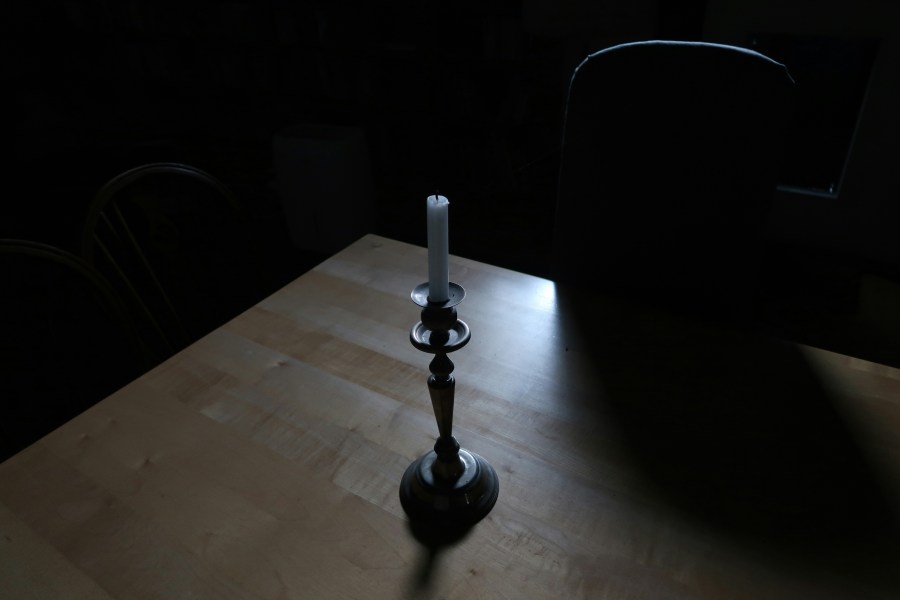
A Sunny Day
Can you hear me? Rachel? Rachel, why aren’t you saying anything?
Yeah, I’m still here.
—
Wait, Mom? Now all I hear is rustling. Is the phone by your ear?
Oh, yes, sorry. I’m just outside with Dad on the porch.
Okay.
—
Mom, I’m just thinking about what you said. That’s why I was quiet.
—
I just—I can make that payment for you this month. Of course I can do that—I just—
Oh, but honey—okay. Here, I’m going inside. Just—yes, yes if you really could, that would be—.
No, of course.
You know, I’m just going to send you a picture. The fence, after that windstorm. Did I tell you it crashed that old table right into the fence? It went through it.
—
Rachel?
But—hey, did you say Dad was there? Can all three of us talk about things?
—
Mom?
—
Mom, I get that you’re mad at him. But I need—
If we can’t make that payment, I’m just not sure, honey. I’m—well.
—
—
It’s okay.
I’ll try to get him on. But you know he won’t have much to say.
Okay.
—
What are you doing—are you crying?
No, I’m fine. I’ve just stepped back outside. But there are acorns everywhere. They fall onto the porch all the time. They’ve been scaring me at night—they sound like there’s a person there.
Hmm.
—
—
Honey, can I call you back when Dad’s chattier? I’ve been saying to him—oh, he’s got a few of the acorns on him. Let me go brush those off.
Sure, Mom.
—
No, but, Mom, I’m sorry I couldn’t get to the phone yesterday. I didn’t see you’d called until late.
—
Mom, are you still there?
I’m here. But it’s just the sunniest day here, Rachel. Sun, sun, sun.
Armchair
At the end of the day, I leave essays ungraded, the plans for my lessons unfinished and dry. I stumble up when the night cleaners look in—they flicker, aggravated, away down the hall, chatting together, leaving delicate silence. One more glance at my desk, swimming with disemboweled stories I’m trying to help these young people find something true in. Today each one seems blank as an unwritten page. I blink, cross the room to the chair, press my spine into its cushions until I feel the buttons that cinch in its upholstery. I hold my body there, squeezed against the chairback till my breath suspends, suck my ribs back so my front and back fold together, like I’m contentless paper, without air or organs in me. Arms crease over chest. Legs hunch in. When another person sits down in the armchair I have emptied of myself, I brace my toes. Their back flattens against my knees, their scalp my whole vision. They complain about upholstery wearing thin, the bony arms. And it’s something I should mind, but I no longer do. They shift for comfort, pinch the fat of my belly, press back and back until another person sits in us now, folding together like butter in dough. On my neck, I feel breath, someone I have sat down on too. Thin layers. Leather skin, scalps thinly threaded. I feel light and so warm, the most beautiful thing, unexpectedly so, and I let out the breath I’ve been clenching. A little dust spouts into the air. Light flashes through it.
Lamp
Sometimes my mother drives up to see me at work, wanders in along the tall, brimming shelves with her duffel and her scavenging eyes. She asks about the week’s acquisitions, and we wander together through unclaimed things from estate sales, consigned furniture in great piles, castoffs from office renovations north in the city, those kinds of things.
Today, she rapped her knuckles on an old table—“Skinny little legs,” she said. “Are you eating enough?” Warped veneer on an armoire—“I’ll just peel that off.” It slid into her bag. She opened drawers, felt into the corners, and sly questions eased in, just like each time she comes, about dating, about old friends she seemed to remember better than I did. I parried, asked her prying things in return, till her hand shot out, lifted my wrist as if checking for cracks, and I stiffened.
I stalked back to my desk, while deep in the warehouse she kept shuffling and poking. I heard her hefting things down and turning them over. Then a gasp. A call of my name. I found her with an old armchair, whose upholstery she had begun snipping off. Somehow, it had started to bleed. Red was seeping through cloth, and inside my chest, something fractured. Looking embarrassed, my mother stitched the fabric back closed. She whispered apologies out there to no one until her voice blended into the HVAC. I completed an incident report on my phone. When she had gone, I crouched next to the chair, and I felt the new seam, softly as I could. My eyes somehow were wet. I spent a while rubbing the fabric over its back.
I thought a long time. At home I flipped on the lamp, and I listened closer than I had before. It started to sing. I tightened the bulb, and a pocket of memory sprouted out from that little gap at the edge of the switch, which I dabbed up with a towel and brought to my nose. It smelled sweet. And I called a friend I hadn’t talked to in a long time. I told her the story of the long, swollen day, and my mom, what things meant, until the sharp things in my chest unlatched, like many opening hinges. My friend said she also had found something like that once—it was a French press coffee maker, whose handle had a pulse like the skin over a person’s inner wrist.
This Morning
This morning it was supposed to be rainy. When I woke up it was sunny instead. The colors all brightened, gem-green and sky-brimming. I had eyes where yesterday I’d had upholstery buttons. I blinked them, and I liked how that felt. I stretched out my legs. They’d been coiled before into little scrolls. I leaned forward then just to look at them, like a chair never does, and the stretch was wonderful—it unkinked that ache in my frame. It straightened my fabric in a way no one has ever been able to before now. And I found I could see so many things better this way, the trees out the window spreading and blending in waves, and a sea of new acorns that squirrels were harvesting up into nests. Then I made a little tea, which I’d always wanted to try, and I sat on the floor for a while just looking. Yesterday, I don’t think I knew. Moments like that, I’ve never told anyone, or never thought about them too much myself—just that, I wasn’t expecting to be who I am, or a person, a live thing. The teapot yawned a little. It let out some steam and it whispered, “Excuse me” to no one. The springs in me creaked. A heart somewhere was beating, and I had new little hands, wriggling in the carpet.
Jimmy Kindree (he/him) is a queer writer and teacher. He comes from Minnesota and now lives with his husband and daughter in western Norway. His work has appeared or is forthcoming in Ecotone, Electric Literature, Raritan, The Hopkins Review, Pleiades, and elsewhere. He also spins yarn and knits with it, makes pottery, cheese, and bread, and plays the banjo.



 Okay Donkey