Notes Toward the Month After May by Penny Wei

I have started to count the number of times the microwave
hums before I eat. The evening it was seven I told myself
that odd numbers are lucky. Like the women who wear ankle-
length skirts and read weather reports for pleasure. Like
the crow that tipped over its feet on the edge of the Walgreens
parking lot and dipped its own beak in cement. I stepped around
it and said sorry, like you do when you bump into a mannequin
that looks like your father. The news says that the bees are
leaving but I’m still getting stung by things. Not insects, but
poorly-timed entrances of gods through oven sparks explaining
why all my dreams are just variations of that one bus
I never caught in 2017. They start with guilt, composting.
Somewhere, the glaciers are crying. Somewhere, my mother
is planting begonias in the shape of the Chinese character
for enough. I’m still wearing that eelgrass wig, blinking
Morse code at the sun. Except the sky has the vague look
of a person who has said too much at a dinner party. So I
tell my dog to stop sighing like a human. It questions
why I don’t stop answering to my government name.
I then remember the crow, who later exploded. Not like
boom, but like oops. Like it had a scheduling error and
forgot it was made of muscle. I try not to name the loam anymore.

PENNY WEI is from Shanghai and Massachusetts. She can be seen on Dialogist, The Weight Journal and Inflectionist Review and has been recognized by The Word Works and Longfellow House. She also has a passion for journalism.

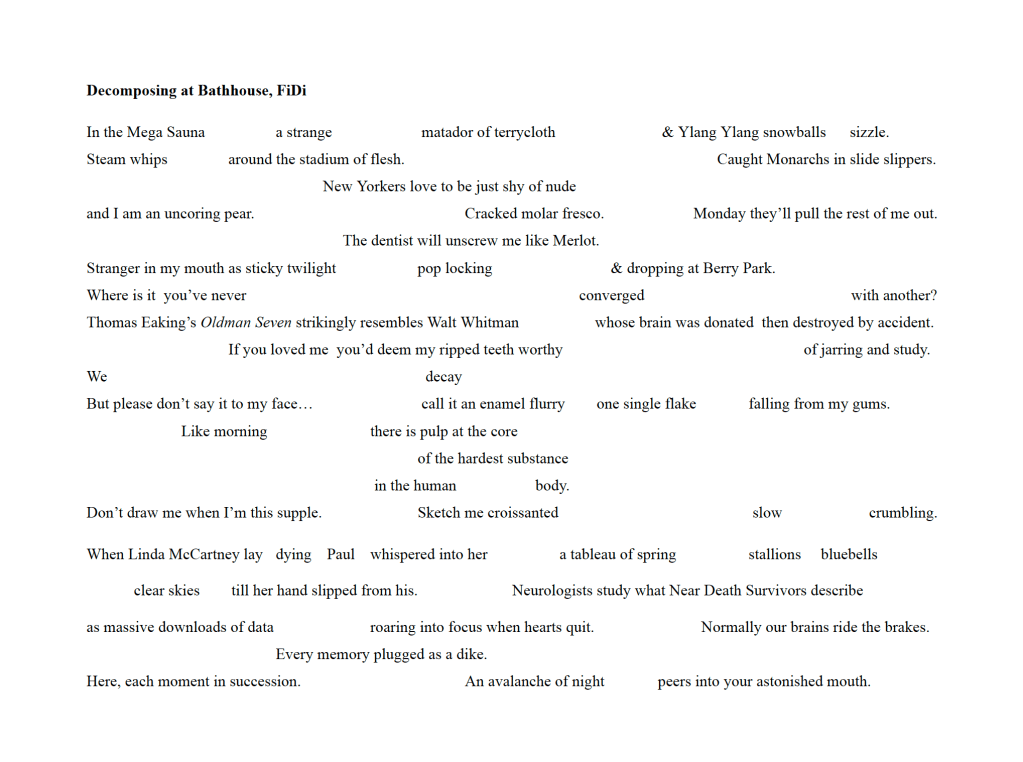
Decomposing at Bathhouse, FiDi by Grace Dilger

Link to PDF: Decomposing at Bathhouse, FiDi by Grace Dilger

GRACE DILGER is a poet and educator. Her work has been featured in Peach Fuzz Magazine, The Brooklyn Quarterly, The Southampton Review, Grody Mag, The Elevation Review, Proud to Be: Writing by American Warriors Vol. 9, Slug Mag, The Racket Journal, Yes Poetry, High Shelf Press, Defunct Magazine, The McNeese Review, Barzakh, Nonbinary Review, and The Bangalore Review. She received her MFA from Stony Brook University and teaches at Monroe University.

There was a meaning by Amelia Averis

There is a boy who speaks in rain at arrivals.
He has time in this world
where the rockpooled minnow
flashes silver seconds.
We follow the funeral and I try to say
‘I am sorry I am not afraid of you’ but I cannot lie,
or forgive the recurrent ghost;
I cannot learn his lesson.
In this dream there is guilt but not enough of it.
I will not die on this hill
but I am freezing beautiful
to an accidental death.
With the moon hanging over the park as the sea, I kissed it
and cried twice
to make it real.

AMELIA AVERIS  is a writer and journalist from Jersey, Channel Islands. She was highly commended by judges of the Passionfruit Review “Here and Now” contest, and also appears in HeimatTiger Moth Review, Palette Poetry, and Prosetrics. The organs of her poems can be found in her decade of journals, where she explores themes of longing, loss, beauty, and memory. Her chapbook as the ink birds split the sunset with Alien Buddha Press is on Amazon. You can find more Amelia at https://ameliaaveris.journoportfolio.com.

onwards and without delay by Alexandra Nwigwe

Well, I was late because I took the scenic route
to work, as in I missed my stop, too busy looking

up how to stop a fight, how to walk up to a monument
and scale him to size, how to be the kind of body that moves

like the girl on the bus who stepped in between a baby and a
man with a blowtorch. Either way, there is always a body

in front of the blowtorch. On the pucker-skinned road to Umueze,
you are the only one crying, my mother says

after a lurch pushes me out my skin, one inch closer
to the rifle in the front seat, jumping as well, maw ready

to swallow the ceiling. The soldier looks back while I make
my sobs silent in the middle and my mother smiles

through my tears. Much later, she tells me she was also scared,
that she has gotten more scared with age.

This does not bode well for me.

I imagine learning to eat a punch is akin to riding a bike,
lessons harkening back to middle school when I practiced falling,

challenged boys to races during recess, turned
myself upside down in a fast from any form of grounding.

Four years ago, I fell into traffic, flew even, and the brief gulp
of air I stole was not enough to recall any of the life I’d lived,

what I’d learnt. The pain did not set in until the mirror gifted me
with a busted lip and a torn up chin. I fended off my vanity by

holding hands with the dark.                           No, I kid. I walked
around with a swollen jaw to the tune of tire squeals.

ALEXANDRA NWIGWE is an engineer and writer based in San Francisco. She finds solace in making art with her hands and capturing her memories, whether through poetry or photography. Her photography has appeared in Lucky Jefferson, and her poetry has won MIT’s Isabelle Courtivron Award and has appeared in MIT’s Rune.

Hot-Desking by Maxwell Minckler

Happy Monday, Gary! Gary is one of the interns stuck
to the giant strip of sticky tape hanging over the snacks.
Morning full-timer! he buzzes furiously with his one free arm,
revolving away like a sad piñata, Let me know where you need me!
Always a pleasure, Gary, but I’m hot-desking today,
which means I can take any open desk, anywhere.
This desk is bolted to a treadmill, and I get to catch
all of these falling motivational weights while I work.
This desk hangs half out of a top-story window,
to keep an eye on the competition.
This desk is in a vat of coffee — a soggy one, but productive.
This desk is a ping-pong ball with something alive inside it.
This desk is in a lion’s mouth.
This desk is made of something called wood, I think.
How to choose! There’s so much opportunity here!
Then I see it. Tucked in a corner, practically sizzling.
A desk designed to perfectly match my father’s,
smoldering with unfinished novels and seventy-five years
of undiagnosed magical thinking. They’ve even baked
his stay-at-home shame into the chair just right,
nicotine-yellow and padded with burnt job applications.
Here’s his electric typewriter with the E, V, O, and L keys missing.
The Mennin-green aftershave lighting puts the iron wool
of his beard right over my shoulder again,
half an inch above my next keystroke.
Such attention to detail! Management sure knows
how to show they care, to prove we’re part of the family.
Gary is weeping quietly again as the workday
comes to an end, and his feet begin to crisp and smoke.
So beautiful, he mutters to himself,
such beautiful, beautiful hot desks.

MAXWELL MINCKLER’s poems have appeared or are forthcoming in The Atlanta Review, Ambit, Krax, Okay Donkey, The Interpreter’s House, Obsessed with Pipework, and others. He holds an MFA from Durham University UK, was honored to win Lafayette College’s MacKnight Black Poetry Prize, and placed second in the New Writers UK poetry contest.  Originally from Hawaii, Max lives, writes, and works on tech-ish things around England.

Pete the Cat: All Grown Up & Alone In His Car by Emily Dressler

with help from my daughter


At the library,
we walk past Pete the Cat
and you say it’s weird and sad
how you grow up with these books
but they don’t keep growing with you.
Like, Pete the Cat doesn’t go to 5th grade
and lose a preschool best friend,
find humiliation from a teacher,
have ALICE drills
(but you did those in kindergarten too, I
want to remind you, but don’t
because Pete the Cat never does that shit),
strategize about how to take his pads
into the bathroom.

Like, Pete the Cat Gets Braces? I ask.
You smile and say, Pete the Cat Kisses a Girl with Braces.
That’s good, I nod.
We walk past a book titled
My Parents Forgot How to be Friends.
Pete the Cat Has Two Houses Now

you say, pointing.
I laugh. Poor Pete.
We’re going to put him through a lot:

Pete the Cat Learns to Lie
Pete the Cat Becomes Lactose Intolerant

That comes later, I say,
when he cares more.
For now, he is carefree:

Pete the Cat Finds Joy,
in which he learns how to love
being alone, and eats vegetarian
crunchwrap supremes in his car. He’s
happy, he really is. He doesn’t tell
anyone about the parking lot meals
even though they feel like the most
real part of him.

EMILY DRESSLER lives and works in Northeast Ohio. She works as a proofreader for a global ad agency. Her flash fiction has recently appeared in Villain Era Lit.

Vanishing Twin by Jessica Ballen

dear sister with the disappearing yolk, had I been less
starved, perhaps you’d have survived the utero scramble.
who were you before I absorbed your gobbledygoo?
would we have grown sitting at the same table, watching
grandma’s slippers shuffle to the kitchen before dawn?
her birdlike wrist, swift like a woman who has always
been bird, winding up a fork for a good whipping,
two eggs whirling into one. you and I
eyeing the tidal wave, that summersault and undertow,
our mouths cracking for the carved challah soak, the wet

before the burning, the dry. were you someone
who fried whole bodies, learning to eat
yourself? I lent you my ear as a parting gift; it was only fair.
did you swallow that part of me? me? I’m always inhaling—
but you already knew that, my copycat. never mind
the mother bird who chewed and spat. were we not the same
swallow splitting the same cracked house, fork tail,
sad song, yoked together before the beak sliced
our cord? I eat things that flit outside myself.
digest them hard. I don’t make the rules.

a greyhound and her owner walk outside
the windows of my life. on the porch, while I fill
feeders and baths, I wonder if the hound is you,
skinny legs reborn. stringy like a sprinkled fawn.
when I look again, the seeds spill.
one time I spotted a red-tail clawing a rabbit,
but it didn’t seem real. so I did a double-take
from my passing car, but the field was a sea of grass,
silent. that’s when I turned to the passenger’s seat
and said that’s you, dear sister. that’s us.

JESSICA BALLEN, MFA, is a disabled poet who serves as Editor in Chief of Lunch Ticket, Managing Editor of Defunkt Magazine, Senior Editor at Small Harbor Publishing, and guest editor for Frontier Poetry. Their work can be found or is forthcoming in RHINO Poetry, Harbor Review, and Ghost City Review (among others). You can find them compulsively posting on their Instagram stories @_j___esus, listening to dream pop with their four cats, and dancing in the Willamette River with their writer husband, SHT.

Blue Persons by Emily Wittenhagen

I act like a train should be sleep and sleep
should be easy but sleep is only on the far
side of this conundrum, producing a world
in which snowplows scoop up our lamplit
remains after and push us into piles.
I felt like asking you, do you own all the
planets? Or are you just this one? In my
sleep you felt like the whole earth. Like you
were borrowing it for the night like a rental
suit or had always been all along the
whole earth. At the time it made sense that
a planet could be around me, and roughly
the same size, that a planet could fit into a
bed. Easy sleep like rain sleep, sex like
rain sex, rain smoke. Opening the window
during X-Files to let in the rain. The
lightning from the stoop at intermission
turning the fields blue and the fence pink
and the trees where the chickens meander
a yellow fever and up above it comes
down like it’ll never stop coming down and
neither will we. The narcotic of our planet
as long as we are together and you are
beside me on this stoop will never leave
the bloodstream. Sleep on the drug, sleep
with the drug beside you. Sleep if there
must be a place between needing, and
read if you can’t, or imagine a slow train
taking you softly into morning.

EMILY WITTENHAGEN is a writer living in Maine, fascinated by the natural and the supernatural. She studied creative writing at UMaine Farmington where she was honored to work with Beloit Poetry Journal and be granted an Excellence in Poetry award. In Seattle, she co-created the poetry journal HOARSE which was shortlisted for a Stranger Genius Award. She is a long-time writer and editor, and also practices nutrition, hypnotherapy, and herbal medicine. She embraces herself as queer and lives with her sweetheart and their daughter who asks compelling questions like, do butterflies sit in chairs to eat lunch? Most recently, her work appears or is forthcoming in Anodyne Magazine, the Champagne Room, and Mutha Magazine.

feelings come & go but teeth are forever by Kristin Lueke

bring me lord a herd of teeth big as buffalo to wrap around this apple.
i ask so little, really—eight hours for sleep, eight hours outside, eight hours
for what i will. what i will is water, mostly hot, to sit in til i’m decent.
what i won’t is die working. i won’t shut up about solace, starlings,
what i read on wikipedia. i won’t give my body to science, just birds,
if i’m lucky. if anyone’s listening. i won’t listen to barbarous bullshit
churned out by chickenshit senators paid by a body count so high it chased
god from the room, i’d rather kiss a caterpillar, kick a cop, marry moonshine.
i won’t make promises i can’t keep, i can’t promise i’ll be more patient.
wouldn’t you know i won’t stay up past midnight if i can help it,
you wouldn’t believe what i can help. i can’t help that i won’t wait
for what i have to beg for. i won’t tell my body give me up, give me
quiet but no more hells. there is no better devil. i choose nothing
but us & by us i mean all of it, everything i won’t call anything but holy,
bring me what i want.

KRISTIN LUEKE is a Chicana poet and author of the chapbooks (in)different math and here i show you a human heart. Her work appears in Sixth FinchWildnessHADAlways CrashingBirdcoat Quarterly and elsewhere. She writes and reads poems at www.theanimaleats.com

Time Only Looks Human by Lynne Jensen Lampe

Everything starts with a start. You emerge from the lake in August, a toddler covered with silt. The neighbor’s mastiff cleans your face and noses you to the glass of cold milk on the porch. An hour later you’re nine, wearing a Scout uniform and no longer thirsty. In the crook of a linden tree you find a small package wrapped in brown paper. Inside is a matchbook and a diagram of a log cabin fire. You gather kindling. The wood flames. You turn thirteen. After eating a salad of dandelion greens, nettles, and wild violets, you sprout breasts and begin to bleed. The mastiff teaches you the word estrus, tells you to go to the c-store for tampons. It’s almost noon. You’re almost twenty, clad in t-shirt and jeans. A car stops. The driver wants to sleep with you. A paper in your pocket reads Sleep = Sex = Death. You think of the lake and sunfish darting in and out of pelvic bones, yellow perch laying opalescent roe along strands of hair. The sun shifts in the sky. You’re thirty-two and ache for motherhood, hike back to the lakeshore. If you wade into the water, you must remain. You decide against this sacrificial birth. The mastiff drops a pup at your feet. You feed the campfire. Before blue spruce can hide the sun, you reach fifty, t-shirt now a fair isle sweater. By the time Ursa Major emerges, you’re seventy-four. Arms empty woolen sleeves, then cross your breasts. Skin heats skin. Fire dies.

LYNNE JENSEN LAMPE’s poetry appears in journals such as The Inflectionist Review, Journal of Compressed Creative Arts, and THRUSH and anthologies in the US, UK, and Germany. Her debut collection, Talk Smack to a Hurricane (Ice Floe Press, 2022), an Eric Hoffer Book Award winner and finalist for the McMath Book Award, concerns motherhood, mental illness, and antisemitism. A Red Wheelbarrow Poetry Prize finalist, she edits academic writing, reads for Tinderbox Poetry Journal, and lives with her husband and two dogs in Columbia, MO. You can find her online at https://lynnejensenlampe.com; Instagram @lynnejensenlampe; or Bluesky @ljensenlampe.