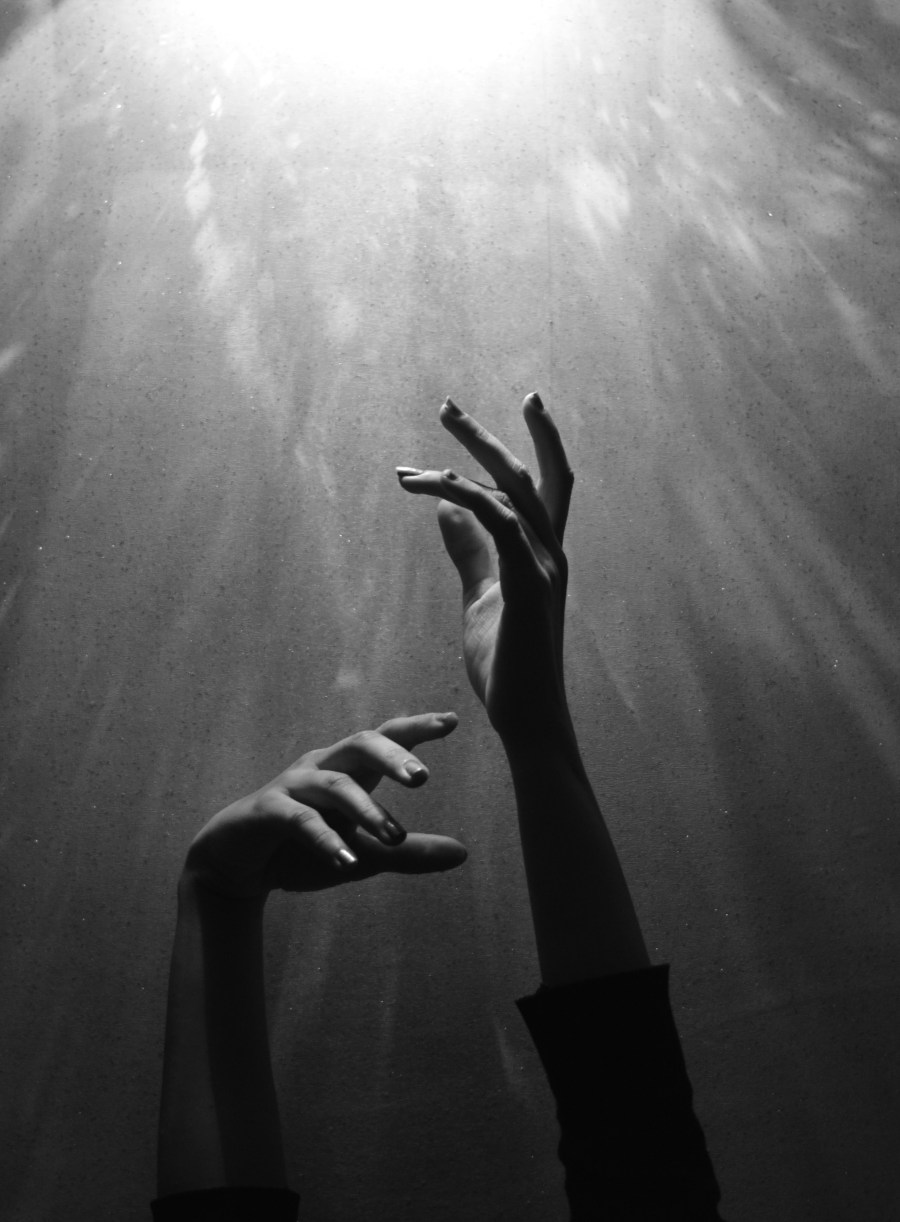
Breakfast, 3 a.m. by Dawn Macdonald

(In the dream) my mother wasn’t angry and she made a sort
of breakfast out of photographs. I went out through the window
and set my toes to the slope of the roof. The sound of frying
felt at any rate neutral. In the (dream) three bears were accompanied
by a fourth of greater ferocity. In the dream (I) had never known
about shoes. My feet could read and found ways of winding up earth
into sensible chunks, or dollops. No lump could truly be called
identical. The sound of frying was indicative of compression.
A photograph, already flat, flips easily upon the application
of a spatula. My (mother) kept her back turned. To ensure safety,
I used all my senses except for sight.

DAWN MACDONALD lives in Canada’s Yukon Territory, where she grew up without electricity or running water. She won the 2025 Canadian First Book Prize for her poetry collection Northerny (University of Alberta Press).

蝴蝶梦 Butterfly Dream by Emily Anna King

in a dream, i perform the butterfly concerto with the silhouette of a man
familiar, but not yet known.

in a dream, a white rabbit with a mouthful of jade approaches
and asks if i remember the story of how he found the moon.

i only hear the music, and i am swept away.

when zhuangzi dreamed he was a butterfly, did he want to stay?

when he returned, was he fearful of living as the man he is after meeting another world?

was he awestruck by the movement of things, the displacement of consciousness?

this afternoon, i left my keys on the kitchen counter
and forgot my best friend’s address.

pine trees shed their leaves.
wandering off, i followed a trail made of dust and gold.

i opened my arms to a fox made of jewels
and it leaned its chin against my shoulder.

we saw a vision of the sunset reversed;
time continued forward.

i stand before a mirror as mere mortal.
cracks in the wall stretch across yellow paint.

bottles of medicine remain behind cabinets unused,
no elixir, no change.

in the living room, the story of the rabbit recites itself in ink:
selflessness ignited over flame

the rabbit throwing his body forward
the jade emperor disguised as a poor man

rabbit sent to the moon with honor.

in a dream, zhunagzi plays the butterfly concerto
with the silhouette of a woman

familiar, but not yet known.

in a dream, a woman tells him the story of how the rabbit found the moon,
how the fox became jewels, and the woman wrote of a story she is still too young to live—

how the music is the space between sleep and wake, a falling of piano keys, a falling of rain,

like wingbeat after wingbeat generations later,
                                                                                              generations more

Click here to view a pdf of the poem with its original lineation.

EMILY ANNA KING (锡萍芳) completed her MA in Creative Writing at UCC in Ireland and is currently teaching writing at an international high school in Massachusetts. Her debut poetry collection, The Dog with the Flute in its Mouth, was published by Finishing Line Press last fall. 

Leaving the Wedding in a Fever by Cassandra Whitaker

Streets cobbled together from where? Rooftops leaning
from where earth grew its longing toward sea
winding –drunk—all the way up the mountain’s snake
The streets open up closer to sea—which is a dime
to enter and bathe—noisy of gulls—children–sweets gobbled up
in the ocean’s insistent i am god i am god i am god i am
I find myself in the sink with a threat to my temple
—forgiveness discovers I am only an old woman
My feet carry me out of danger into danger—
I remember —I know no one My name tells me
no one will believe me—there is nothing to believe
but the sky’s own tellings– I have learned all the wrong lessons
Here comes a bender again- a sack over my head
All leaning roofs lead inward There is only one way

CASSANDRA WHITAKER (she/they) is a trans writer living in rural Virginia. Whit’s work has been published in Michigan Quarterly Review, Gulf Coast, Conjunctions, The Mississippi Review, and other places. Wolf Devouring A Wolf Devouring A Wolf is forthcoming from Jackleg Press in 2025. They are a member of the National Book Critics Circle. Wolfs-den.page

Double Dutch by Jasmine Khaliq

It sounds like gibberish, I said. It’s Double Dutch,
they said, and their grandma invented it.

A boy my age, a girl my sister’s. I wasn’t sure;
they lied about plenty—they were royalty

on a faraway island, their father was an astronaut,
their names were not their real names.

But the language I could hear was real as any.
Pattern I could attain. If I listened closely. If

I really tried. A lot of B’s, a lot of I’s. In his voice
my own name like an alien’s. I surprised them

after two weeks, sauntered into conversation
leaning blasé against their house, air

hot as any Western midday, mid-July.
A door unbolted. Talking in plain sight.

Selves and syllables doubling.
Secret language with the boy

across the street. We talked
about everything, nothing.

I wish I had a dog.
My dad is going to Mars.

They fought last night. I don’t want school to begin—

Anything. Just to speak.

We had never been so close
and we would never be so close again.

The differences between our lives closing
soon over our heads. Jordan’s rabbit died.

Summer is coming to an end.
What’s your favorite color, again?

Jasmine Khaliq is a Pakistani Mexican American poet born and raised in Northern California. Her work is found in Poetry Northwest, Poet Lore, The Rumpus, Bennington Review, Best New Poets 2023, and elsewhere. She holds an MFA from University of Washington, Seattle. Currently, Jasmine is a Ph.D. student at the University of Utah. She can be found at jasminekhaliq.com.

Bikini Atoll by Rowan Pollard

A wild driver, her feather coat flying in the wind,
Cadillac convertible southwards out of town but again
I found her half-sunken into the reservoir.
I’ve had enough, she said, I’ve done everything twice.
I’ve been a storm chaser, I shot Kennedy, twelve years
I spent in Vegas drinking gold and winning. My
velvet’s all worn out and I’m stuck here and I can’t
remember my own name.
I made one up for her, something American, Arizona
Castle, Georgia Crossroads, Mississippi Bravo.
I entertained her for a while until the shock wore off,
and once home a hurricane stuck the tower block and kept us
stuck. Some days, I was sick of tracing a trail of ash. I was sick
of extravagance. Where were my pearls to swallow? My
untruthful movie star carpets and gunshot near-misses?
I didn’t miss a word of lies but I got sick anyway.
Last night, under the low moon, I said I loved her. She told me
I like Mississippi best. Like the river always moving through the land.
The dam burst that morning, and I looked for her in the clear
dull water. I thought I’d find some goodbye note and
more, but beside our front door was her feather coat like a snakeskin.
The Cadillac drove toward the sun.
Mississippi, bravo.

Rowan Pollard is a writer and poet living in a nowhere town somewhere in the UK. He has been published in Apocalypse Confidential.

Emily Jarred by Toni Leonetti

A poet’s X post argued
for art apart from artist.
His example?
We love Dickinson’s verse,
even though she killed kittens,
drowning them in pickle jars.
Look it up, he said.
What?
I checked.
Everyone but me knew.

Hope is the thing with feathers—
Unlike cats who can’t fly away

Because I could not stop for Death—
I tossed him softer fur to hug
Fresh eyes to blind in brine
Purrs to choke

My Life had stood—a Loaded Gun—
Until blasted in helpless corners

My letter to the World
Met no reply—
After I tore it into tuna
Crammed down one hungry last meow—

Toni Juliette Leonetti lives in the San Francisco Bay Area and has written short stories, poetry, plays, and a mystery novel. Her work appears in publications including DarkWinter Literary MagazineLiterally StoriesElegant Literature, and Soul Forte.

The Signs by Gabe Montesanti

Backtracking is a rigged poker game, and yet, I still play. I bake backtracking on the top rack of the oven and scatter its crumbs through the forest. Like a bait dog, backtracking still growls at its own reflection. Backtracking and I steal every No U-Turn sign in the city of St. Louis, Missouri. Mounted on the wall like a moose head, backtracking stares at me through empty eyes. I bite into the poisonous pit of a backtracking plum because I’ve survived those juices before. Sometimes, backtracking pitches a tent in the wilderness. What’s the difference between me and nostalgia? backtracking wants to know. Mirrors reflect backtracking like a set of circular footprints in the sand, the hump of a question mark. Backtracking is the frozen tundra in the arctic onto which I can’t help but keep my cheek pressed. Like sandpaper, backtracking wants to use mindless repetition to make smooth what was once rough. Backtracking is disiecta membra, limbs of a scattered poet, Latin from Horace’s Satires. At the 7-Eleven soda machine, between the root beer and the cherry cola, backtracking induces nausea. Extraterrestrials don’t buy into backtracking because their aircrafts only move forward. Beam me up, I scream from a barren field of corn. Don’t let me track back into myself what I have collected by running away.

Gabe Montesanti is the author of BRACE FOR IMPACT: A MEMOIR, which chronicles her time skating for Arch Rival Roller Derby. She earned her MFA at Washington University in St. Louis. Her work has been published in Huff Post, LA Times, Lit Hub, and elsewhere. She is currently at work on a second memoir. 

Animal Relief by Rachel Becker

We’re sitting on our first adult couch
to which the cat has already done his worst,
fabric pilling. It’s from Jordan’s.
We spent real money.

From here, the crooked chandelier jangles
on its chain. Mismatched bulbs flicker
like filmstrips, our dinner table,
paint-stained, pocked—again, the cat.

Sometimes I clear plates too soon.
Evil waitress, my husband jokes, fork raised.

So different from how my father ate,
hunched over and full of complaint,
the meat, too dry, and beans, over-boiled.

He left the table, still chewing,
like a child, who had soiled himself.

Rachel Becker’s poetry appears or is forthcoming in journals including North American Review, Post Road, Crab Orchard Review, Poetry South, and RHINO. She is also an assistant poetry editor for Porcupine Literary: A journal by and for teachers. She lives in Boston. 

Breaking News: Barbie Eats Trump During Baltimore Pride Fest by Chrissy Stegman

What else was left for her to do? Giant in pink,
her laughter clanging down Charles Street
like bells rung wild to the dystopian melody.

She was a blaze in glorious sequins. Swirls
through the crowd, her skirt sliced the air
like ribbons of rampage, her manicured hands filled
with noise and want. She saw him, glitterless,
small in the gold chair he made for himself.
A throne as yellow as piss. The crowd parted
like the sound of rain. She moved toward him,
her shadow a blossom of organza fire in the setting sun.
She plucked him like feral lint from a coat lapel.
She flicked him, a spinning trinket tossed
to gravity’s obsequious gamble & caught him
mid-fall. Her mouth opened into a cave of cherry
and fuchsia, a holler of lipstick

When he fell, she swallowed him whole.

Love did this: the riot of it. Love
for the smashing, the making,
the breaking. Love
for our country and the streets
lit like a sky of teeth.

Chrissy Stegman is a poet/writer from Baltimore, Maryland. Recent work has appeared in: UCity Review, Rejection Letters, Gone Lawn, Gargoyle Magazine, Anti-Heroin Chic, Stone Circle Review, Fictive Dream, Inkfish, 5 Minutes, Libre, and BULL. She is a 2x BOTN and Pushcart Prize nominee. www.chrissystegman.com.

[When a man and a] by Jason Fraley

When a man and a woman love each other, they can opt (i) for sexual
relations or (ii) to memorialize their feelings in a securities contract.

English makes it difficult to gender a piece of paper.

Even though I babble Latin, the doctor assuages my parents’ fears,
assures them I’m indeed living.

My parents, perhaps biased, repeat that I’m the most beautiful legal
document in the whole world.

After leaving the hospital, they take me to the exchange.

My crib is a plastic sheet tucked into a writing desk drawer.

A bespeckled man with a milky beard gazes from atop a wooden
crate. He predicts that, one day, I will be worth 30 pearls, an entire
bundle of flax, or six counterfeit rubies.

My parents are keen on those three outcomes.

What my parents learn is that securities contracts are not
circumcised. They are sliced into tranches.

Some price my finest details: a stylized T to start a paragraph, an
anachronistic diagram of a human skeleton.

Some speculate that a thumb-smudged page number or struck-
through drafting error will solicit a turquoise shaving or heron
feather at some later date.

Bidders disperse when they must pay more than quail eggshells for
my errata.

My parents are aghast as I’m confettied to the highest bidder.

Think of tranches like trenches.

A trench may be a rut, channel, furrow, or cut depending on when a
shovel breaks or Orion hides his bicep behind cloud cover.

A trench doesn’t become an excavation just because that’s where
the wind hides confetti squares appraised as worthless.

But that is one reason.

Jason Fraley is a native West Virginian who lives, works, and periodically writes in Columbus, OH. Current and prior publications include Salamander Magazine, Barrow Street, Jet Fuel Review, Quarter After Eight, West Trade Review, and Pine Hills Review.