Master of My Domain by Marissa Glover

I do what I want. I’m an American—
no asking if he’s happy, not caring
if she’s satisfied. I make my own way
in the world: Kick off the bed covers
or hide under sheets; stay silent or
scream. Maybe all of this. Maybe none.
In America, we’re taught finishing first
is all that matters. Here, selfishness is
not a crime. You can’t depend on anyone
to make you feel good—this is a fact
you learned early, when your parents split,
when Marc Bowman’s ambition
got him caught in a kickball double-play
to end the inning. So you learned to please
yourself—now both explorer and native
land. Discover what you love most
about creation. It is good. It is good. It is—
Say your own name instead of God’s
as you finish.


Marissa Glover teaches and writes in Florida, where she is co-editor of Orange Blossom Review and a senior editor at The Lascaux Review. Marissa’s work recently appeared in Mothers Always Write, Whale Road Review, Fresh Air Poetry, The Cabinet of Heed, and Sweet. Her debut poetry collection, Let Go of the Hands You Hold, is forthcoming from Mercer University Press in 2021. Follow Marissa on Twitter @_MarissaGlover_.

Emily, Don’t by Kelsey Ipsen

Imagine if I licked your entire body. I said.

Emily, don’t. Said Steve. I’m working.

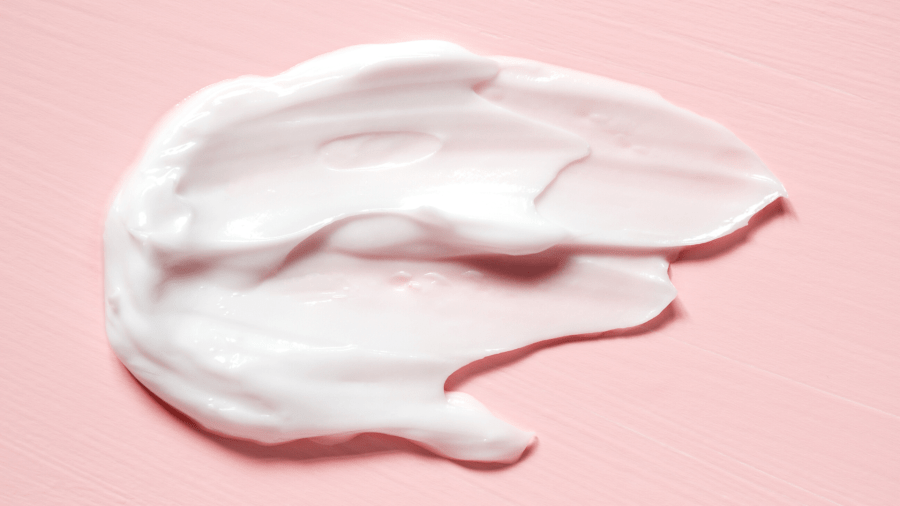
I did not want to lick his body, I wanted to be in love. I thought about the different parts of his body and what they would be like to lick. I thought about my tongue in his armpit or on his big toe with its 5 coarse, black hairs standing out against the pale of his foot skin that never sees the sun because exposed toe shoes are for children, Emily. I decided these areas of him repulsed me. I wondered if it was normal for me to be repulsed by them. Maybe licking someone’s armpit and not being grossed out meant that you really loved them. Steve was typing which meant I could watch his hands move, which I liked. His hands were large and soft from an expensive cream he used which I sometimes also used without asking or explicitly not asking. This is all to say that he was very well groomed, it’s not like I would be licking an unwashed armpit, for instance.

Would you lick my armpit? I asked, even though I knew he got annoyed when I talked while he was working.

Could you not? That’s not even a sensible question.

I sort of wanted to leave, then, even though I mostly agreed that the question wasn’t sensible. Instead I scrolled through my phone while actually looking around the room to think about all the things I hated in it, until Steve clicked his laptop shut. Right, another day done. He said. He sounded even older than he was when he said things like that.

What would you like for dinner?

We could order something, it’s pretty late. I imagined the grease from a burger glistening. I imagined salt from fries glittering across my fingers.

No, no, I’m sure I can find something.

I’m pretty sure Steve frowned upon ordering out. He’s never exactly told me this but I have noticed that he never gets takeaway. Sometimes I feel an urge to get something delivered and act like I’ve cooked it, slaved away at it for hours, especially for him. I will never actually do this, though I enjoy thinking about it.

* * * *

We made carbonara. While the water boiled I watched his reflection in the darkness of the window and admired his beauty. I was jealous of his eyelashes, his cheekbones, his skin that was prone to neither oiliness nor dryness. He touched my back and it thrilled me. I leaned in to him. We had plated the food. We left it on the bench steaming. We fucked on the couch. How do you want it? His voice sounded like it was coming from a much deeper space within him. I felt his hands light upon my body and wished I felt them more, I was sick of feeling like I was disappearing. Put your hands around my neck. I said. Really? He asked. Just do it. His hands felt hotter and heavier the longer they were on me. I imagined him squeezing tighter. I looked into his eyes then changed my mind and focused my eyes on his cheeks. Die, I thought as I came. When he shuddered above me I noticed the outline of the couch button, red on his thigh.

* * * *

The carbonara was cold and felt like glue. Steve groaned with pleasure at it. I thought I’m 22, what am I doing here. I had had this thought so much it was no longer a question, just a mantra of sorts. I imagined my best friend telling me that just because something looks like what you want, it doesn’t mean it is what you want. I did not have a best friend. I sat at the table until Steve was finished.

We can watch that movie you’ve been going on about.

I’ve got to go home. I told him.

You know I don’t like sleeping alone, Em.

I shrugged. I picked up my things and also slipped Steve’s hand cream into my bag. The jar was the perfect weight, it was so beautiful it made everything else in my bag look beautiful too.

* * * *

When I arrived at my apartment it felt small and like I didn’t hate anything in it. I needed to vacuum but I kept putting it off for one more day, every day. A few months ago I had downloaded a dating app just to see if anyone would match with me. For my description I wrote that I liked takeaway and movies. It took me 30 minutes to come up with that. There was one girl on there that I had been messaging. I told her right away that I didn’t actually like girls like that, I was just lonely. She was funny. Her name was Laura and she lived within 1km of me. She had curly hair like I’d always wanted. I brushed some old crumbs off my couch/bed and sent her a message.

I tried to do something different with my boyfriend, like you said.

Good girl, did it work?

Not really.

😦

Do you want to come over and watch a movie?

* * * *

I picked at some fluff on my cardigan and hoped Laura wasn’t actually an old, pervy man. When my doorbell rang I wondered if I needed to puke. I hadn’t ever had a friend over, all my friends were not actually my friends but Steve’s friends. They made jokes about me being still in university as if it were comparable to kindergarten and I pretended they were witty like ha ha yeah silly me being my age instead of yours. Laura’s hair looked even better in real life. Laura had bought a gigantic pack of popcorn with her. You’re fucking cute. She said. I felt happy and not weird. I have wine. I offered. The movie wasn’t that great. It took itself too seriously but that meant we got to giggle over it which made it enjoyable anyway. We quoted the worst bits of it back to each other, adjusted the lines slightly. I couldn’t possibly live without a man, said Laura. As I laughed I spilled some wine on the carpet, I rubbed it in with my big toe. I love you. Said the man on screen. I felt a dumb tear roll down my face so I lifted my hand to it like I was itching my cheek. I needed something to say to distract me from whatever was happening to me. Have you ever licked anyone? I asked Laura.

Sure I have, it’s basically all I do. Hey are you crying?

Sorry. I said. I felt sure she would go home and I wouldn’t have any friends again.

Laura paused the movie.

You can leave if you want.

Laura leaned forward and licked up the trail of my gross tears starting from my jaw right up to under my eye.

I don’t need to leave.

I touched my face where she had licked me. Laura unpaused the movie and let her knee bump against mine like a drumbeat, like we were in a marching band that was going to walk all over the world. I thought about all the times I had imagined hanging out with some one cool who actually gave a shit about me.

When she left I gave her Steve’s hand cream.


Kelsey Ipsen lives in France with her husband and half-wild cat. She can be found working on her first novel or at cargocollective.com/kelseyipsen. She has been nominated for the Pushcart Prize and Best Small Fictions, and some of her other stories have been published in or are forthcoming from wigleaf, PANK, Hobart, and jmww.

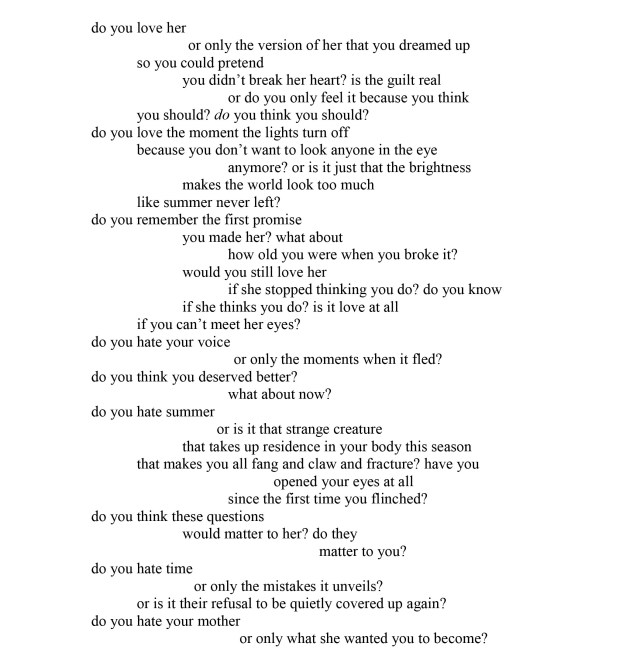
playing twenty questions with past lifetimes by Quinn Lui

20 Questions

Quinn Lui is a Chinese-Canadian student who has a tendency to collect too many mugs, then dry too many flowers, and then run out of mugs to store them in. Their work has appeared in Occulum, Synaesthesia Magazine, Augur Magazine, and elsewhere, and they are the author of the micro-chapbook teething season for new skin (L’Éphémère Review, 2018). You can find them @flowercryptid on Tumblr, Twitter, and Instagram, or wherever the moon is brightest.

A Rupturing of Light by Suzanne Grove

He reads: A glass of orange juice after a glass of water, hospital ice, peas, two (only two) green olives, Polish vodka chilled in the freezer.

We are playing a game for adults with our maybe-friends who live in the planned community two-hundred yards from the sunken curve of our backyard. We own the renovated farmhouse. Outside, our Norwegian dogs stretch the long tendons of their rabbit-like hind legs. From our back porch, shaded and silent save the slow scooping of ceiling fan against August air, we can see the interstate run its horizontal line towards West Virginia. Twenty miles in the distance, it forks away, dips low into a coal-gutted town near the Ohio River.

These maybe-friends, six in total, own homes with alternating shutter colors. Navy, tan, red. But with names like Oxford Glacier and Tawny Hide and Midnight Vermillion. They selected them from decks of alternating shades at the home design studio. They repave their driveways every five years, build thick brick and slatestone mailboxes. Hang wreaths that change with the seasons.

For this round of the game—for the list that has just been announced—we were told to write down five things we like to consume. We were welcome, the instructions said, to get naughty.

We take turns guessing who owns each list. Nearly everyone’s list contains booze. Someone wrote nipple. We discuss the word consume. What does it mean, exactly? Someone mentions the Oxford English Dictionary. We think we’re smart. Their kids will go to college. We don’t have any kids, just the dogs.

Orange juice. Olives. Vodka. I look at my husband.  He does not like olives. He eats them in salads I make to accompany our dinners on most nights. But he does not stand in the kitchen like I do, plucking them out of the jar with my fingers. And, peas? No. He orders Manhattans when we go out, likes bourbon and not vodka.

But, Amanda—Amanda with autumn tones burnt into her hair, a soft gloss over the strands, a chemical resuscitation of the follicles she purchases for an additional $45 (she’s offered me a referral to the salon; suggested I try the treatment); Amanda with her hard little knuckles and slim fingers and real gold chains doubled up and crossed and doubled again high and low on her neck—she guesses Adam right away.

Yes, my husband exclaims.

They high-five.

I have a sad score, second to last. We pause to refill drinks. Adam turns on the television mounted high in the corner of this room the other women call a Florida room, but I call a covered porch. Someone changes the channel to a baseball game. I call the dogs inside with me for water, for rest.

When I return, I think about how this summer, our second summer here, the wood surrounding our exterior doors hasn’t bloated so that every open and close necessitates a slamming that echoes throughout the house.

At night, sometimes, I hear the bending of grass blades beneath feet through the window of the guest room where I often sleep because Adam snores.

Out in the direction of the interstate, we have an additional detached garage, four stalls. A workshop where Adam plans to start wood working. Maybe, he tells me at dinner, he’ll take up blacksmithing, too. Inside the fourth stall is an old plaid couch my mother gave me when she redesigned her living room. And a lamp I’ve had since college.

Most nights when I hear the bending grass, I wait. I go to the bathroom and drink water over the sink. Before I shut out the lights, before I climb back into the twin day bed with its brassy frame, I peel the blinds apart and see that fourth stall shining at me, a rupturing of light.


Suzanne Grove is a graduate of the University of Pittsburgh and received the J. Stanton Carson Grant for Excellence in Writing while studying at Robert Morris University. Her poetry and prose have appeared or are forthcoming in The Adirondack ReviewThe Carolina QuarterlyThe Penn ReviewPorter House ReviewThe Raleigh Review, and elsewhere. She received honorable mention in Farrar, Straus, & Giroux’s June contest for her short fiction piece “Shift Work” and was recently a finalist for the SmokeLong Quarterly flash fiction fellowship. She currently serves as the short fiction editor for CRAFT literary magazine.

tell me i’m prettier when i smile by Danielle Rose

because i do not desire to be a road pocked with potholes / but these scowls gouge the path ahead like too many pecking crows / & this is entirely a dream i can wake from if i can just find the right phrase / like i am a kiln & i become a burnt orange / the sounds stretch & yet i am still dreaming / & this stretching does not decide for me it is a lesson in constraint / like when gps coordinates turn out to be wrong / or how i want to build rhetorical arguments from childrens’ balloons / i want to watch them soar & disappear & become just another dot of clear sky / tell me i am like the sky / & lie to me / tell me i am expansive & clear / i need to hear that joyful clouds reach their hands into my chest / because i can feel them inside of me / storming / telling me i am pretty when i smile / i want to be a set of cascading conditions / like a logical proof or the way i am always sneaking away from my fear / tell me i am prettier when i smile / tell me / become a cloud & tell me that when i am pretty / it is impossible to be so empty


Danielle Rose lives in Massachusetts with her partner & their two cats. She is the managing editor of Dovecote Magazine & her work can be found or is forthcoming in The Shallow Ends, Barren Magazine, Luna Luna Magazine, Empty Mirror, Homology Lit, Turnpike Magazine, Kissing Dynamite & elsewhere.

Underwater Cabbage is Happy by Sean Pravica

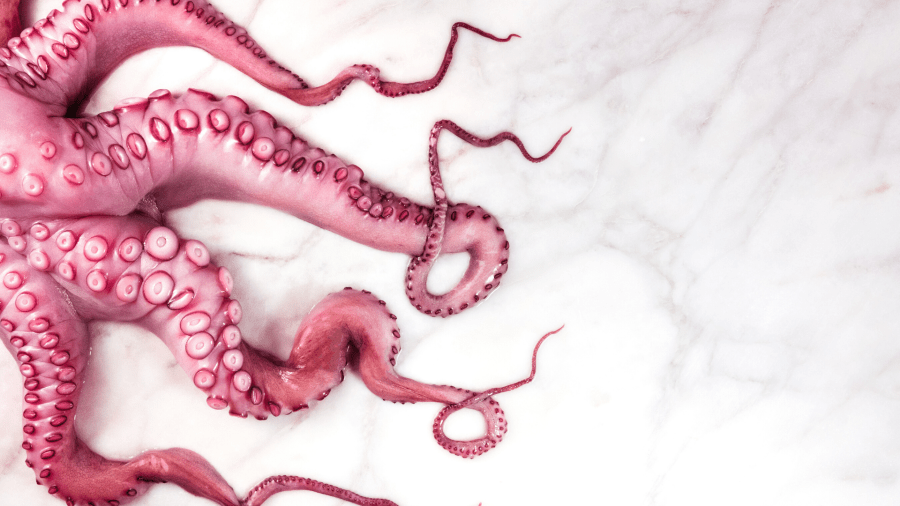
She drew an octopus. It had a bulbous body/head. The innermost legs were thin and curled up around the body/head. It had a red smile.

Another low art grade. According to her teacher, it lacked proportion. Also, octopuses are not purple.

She must have liked the smile, though.


Sean Pravica is a Californian writer and author of Stumbling Out the Stable, a story about mischief, authority, and occasional intoxication. His next book, Hold Still Fast, is a collection of 200 stories 50 words and under and is due out in May by Pelekinesis. He also enjoys climbing rocks and spending time in the desert with his life partner.

Don’t worry about returning it by Devaki Devay

I’ll lose everything, eventually.
I’ll leave my phone on a restaurant table
the night before I fly out. Someday
I won’t recognize the number. Listen,
I left my notebook full of secrets under
one of the chairs in the lecture hall. Now
someone’s heels are brushing against
my newest molestation. It doesn’t bother me,
I lost my headband between the cushions
of a bus, I fell asleep chest up, once I managed
to imagine it was the Earth moving fast
and not our wheels. I’ll lose my wisdom teeth
without ever realizing; I’ll wake up
with pulsing memories of metals at my jaw,
fingers in my mouth,
blood seeping soft in cotton balls.


Devaki is a community college transfer at UC Berkeley studying rhetoric, as well as a reporter for the student paper. Their writing, which has appeared in Entropy and Royal Rose Magazine, centers around childhood trauma, loss, and the South Asian diaspora.

B is for Balls by Kara Vernor

In high school, when a boy threw a ball and another boy caught it, I banged two pom-poms together a few times.

When a boy caught a ball behind the end zone’s white line, I banged two pom-poms and kicked a leg. My crotch was wrapped in blue.

There were thirteen of us who bounced and banged.

When the boys gathered on a field mowed for Friday night, the townspeople mobbed the border. These watchers sat on seats called bleachers because boys could throw balls for three hours with the break they took halfway through. When the throwing of balls exhausted the boys, they resorted to their butts like watchers on bleachers, but not we. We stood and shouted and danced and banged for three hours, sometimes more.

On days when boys threw balls, we covered our butts in mini skirts. We recognized the relationship between our nakedness and their confidence, and it was said frostbite was not worse than Nair. While our legs encouraged boys to throw their balls, the townspeople enjoyed the school-sanctioned opportunity to see the whole lengths of our allegiant legs. They appreciated our legs for their service.

School officials otherwise required taller skirts. Short skirts were a violation and declaration unless worn for ball-throwing boys and the townspeople who ran their eyes up our flagpole limbs. It was true, townspeople needed more than strictly boys and the balls that flew between them, but not we. We had never been served by need.


Kara Vernor’s fiction has appeared in Vol. 1 Brooklyn, Ninth Letter, The Los Angeles Review, and elsewhere. She was the recipient of an Elizabeth George Foundation scholarship, and her writing has been included in Wigleaf’s Top 50 Very Short Fictions, Best Small Fictions 2019, and Golden State 2017: Best New Writing from California. Her flash fiction chapbook, Because I Wanted to Write You a Pop Song, is available from Split Lip Press.

On the Dendrochronology of Gastropod-Shells by Kunjana Parashar

I like it when groups of children visit the river bank
looking for ammonites, echinoids and belemnites:
their ears like a sharp, open-mouthed whelk. To find
lexicon for the old Cretaceous worlds we originated
from, is to find a key to mapping the strange histories
of our bodies: clavicle/drumstick/femur/tendon.
My history has deep gulfs in its narratives, and often
while recounting my traumas I forget how they came
to be. Like a giant whale belly-flopping in my mind,
scattering the rings of data that dendrochronologize
my familial pain: was it the desiccated sap of my mother
that shrunk our house into a stump or was it the towering
girth of my father growing on our backs like an epiphyte.
But what I never forget is that at nights, I would watch them
slipping into that otherness of sleep: grief wrapping their
ancient-bodies like the exoskeletal shells of gastropods.


Kunjana Parashar is a poet from Mumbai whose work appears or is forthcoming in Lammergeier, UCity Review, Riggwelter, The Hellebore, Barren Magazine, The Rumpus (ENOUGH Section), and elsewhere. You can find her on Twitter @wolfwasp.

Bob Ciano by Hugh Behm-Steinberg

Each day I reach into our wardrobe to get dressed, all my shirts jostle. Some of them move forward; jealous of my favorites, they try to jump in line. They argue that if only I’d actually see them, they could finally unrumple and be touched by sunlight. They could pick up the scent of my body, soften (even if only slightly), be complimented by everyone who sees me. They crave flattery, the complete stranger saying, “Is that new?” or “Where did you get that?” or “That’s so gorgeous!” I’m drawn to paisleys, pearl buttons, designer labels on the sleeve so anyone shaking my hand would know someone’s spent money (even if it wasn’t me), rich colors, headache inducing patterns. “Change your life, wear a different shirt for once!” the frustrated shirts all cry.

Other shirts hide. They’re ashamed: they think I’ll notice their missing buttons, the memory I no longer wish to remember, the little hole where the decal meets my breastbone, the way they strain a little since I’ve gained weight. Maybe I’ll put one on and my wife Mary will laugh, and that will be that, straight to Goodwill. Or else they’re just as beautiful as the ones I always wear, but they’re afraid of this world, the marks and stains that come from living in it.

The wardrobe rocks back and forth; neither of us can sleep. So Mary says, very loudly, “Your friend Bob, he only wears black button down shirts, right?”

“That’s right,” I say, “and he only needs five of them.”

“I bet he sleeps like a baby because he never has to wonder what he will wear,” Mary says.

“Perhaps we would be happier if we followed his example?” I say.

The wardrobe settles down immediately. But when I reach inside the next morning to get dressed, all my shirts are damp with tears.

It takes three loads to wash the salt out of them and get them dry, and they squirm as we try to fold them. Eventually we put them all back in the wardrobe, more or less neatly folded.

I make promises to treat my clothes more fairly, to rotate my outfits and not wear the same favorites all the time. We’ll repair the shirts with missing buttons; the shirts with holes will be saved until we have use for them in art projects.

I feel terrible because I never keep those sorts of promises. I am lazy: I grab the shirt on top; I play favorites, I’m always on the lookout for the next beautiful shirt whenever we go shopping, and who has time to sew? We initiate cycles of sin, guilt and forgiveness; we think we’re enlightened people, but we’re always doing laundry. Rinse, lather, and repeat.

I think of the cruelty Bob Ciano practiced when he chose to only have five black buttoned down shirts, and got rid of everything else; I wonder if it’s better to just do one terrible thing, or to perform the same awful little actions over and over again.


Hugh Behm-Steinberg’s prose can be found in Gravel, Sand, Grimoire, Joyland, Jellyfish Review, Atticus Review, and Pank. His short story “Taylor Swift” won the 2015 Barthelme Prize from Gulf Coast. A collection of prose poems and microfiction, Animal Children, is forthcoming from Nomadic Press in 2019. He is the chief steward of the adjunct faculty union at California College of the Arts, SEIU 1021.