Sleeping Beauties by Tiffany Promise

The Land of Trazodonia is a hidden chamber within the walls of Slumberland Psychiatric Hospital. It both exists and doesn’t exist at the same time. This is where we Sleeping Beauties tell our secrets. We all wear masks of each other’s faces.

Instead of swallowing, we let our pills dissolve on our tongues, sending them straight into our mucous membranes. Straight into our bloodstream. We don’t have time for them to dilly-dally through our digestive systems, to fight with whatever thawed-out muck was supposed to pass for Sup. The oblong blue bars that keep our brains from quaking; the tacky, sunshine-colored globules that keep our hearts from over-beating; the chalky, white tabs as big and round as moons. They taste a little bit like Clorox and a little bit like licking frogs. A lotta bit like love.

While waiting patiently for our Meds to kick in, we sit Duck-Duck-Goose-style while gentle technicians re-attach electrodes and sensors to our mottled chests and scalps. Their gloved fingers move across our skin like tiny sparks of hope.

We are so thankful to have ended up here. So far away from Rhinestone, Texas, the Pear Tree Trailer Palace, dead Maxine’s partially-deflated balloon-head. From the grit-grime of spanged change, from Johnny’s calloused hands. His sweet, sweet, sweet till sour breath. From under Pepper Jack’s thumb, the bruised knees & missing gag reflex. Broke-the-fuck-open face. From mother’s dusty attic, the clumps of hair & fingernail clippings. Rotten apple cores. From the fifty-one-fifty-one-fifty-one-fifty. Their bughouse rubber rooms ever-blooming with red storybook roses. From that quiet spot in the library. Backpack full of binge, diuretics, lax tabs & Philip K. Dick.

Far from everything……
                                              everything……
                                                                            everything……
                                                                                                          that hurt us……

Twenty hours of sleep might seem like a lot, but when you’re a sloppy, messy, useless thing—more mercury than blood—twenty hours ain’t peanuts.

So, safely snuggled by seven, we finger the starched sheets as the sleep-tingles slowly creep and we let ourselves sink deep into the deep. That sweet, dark spot where we’ve got whole ribcages of defenses to protect us.

We sleep……
                            we sleep……
                                                        we slee……


Tiffany Promise (she/her) is a writer, poet, chronic migraineur, and the mother of two wildlings. She holds an MFA from CalArts, and her work has appeared in Brevity, Black Clock, tiny journal, Every Day Fiction, Blanket Sea, Sunspot, and is forthcoming in Peculiar and Creative Nonfiction. Though she now lives in Austin, Texas, Tiffany is originally from the mudbug-ridden swelter of the Gulf Coast, which is the setting of her recently-completed first novel, Eggs.

Anarchic Sight Theory by Luke Burton

Each Sunday I play pool with eyeballs for billiard balls
at the Other Place & envision what it might be like to be touched
by felt & fluorescence in alternation. The light of passing cars
filters occasionally through our pitchers of PBR. I know no metaphor
for sight, yet the beams protrude, pint shaped,
from the sockets of anonymous angels. Lines sharp as axe blades
gently part the trees, then brush away before the fall.
You ask where the terror is located—
Is it in the horse yet to be broken or the broken horse?

I’m embarrassed by my telos,
a stance of cue balls awaiting sticks. The future
perfect will be an ongoing breeze. I have no theory
for dream without waking. Falling from the lake onto the shore,
I wanted to know how you felt about the hurricane
hoarding air above the Atlantic, the one that shares a name
with your lover. Instead, I zipped my coat against the wind —
whose breath? A thin horse swept up from the South
and kicked my eyeballs back into their dark pockets.


Luke Burton is a poet and artist writing from Burlington, Vermont. His work has appeared in Crossroads Magazine, The Redlands Review, Pomeroy Poets Anthology, Bard Papers, and more. He is a senior Editor at GENERAL SUBJECT and NO SUBJECT Press.


Painting Birds by Jennifer Todhunter

Sometimes, when we caught the birds, we’d dip their tails in our fingerpaint, their tiny wings struggling against our clumsy hands, their miniature beaks gasping for breath or a worm, we were never sure which one. Sometimes, we’d sneak up trees toward their nests, shove their fragile shells in our pockets and scale back down, our feet barely hitting the trunk, our hands sticky with sap, our never-brushed hair full of pine needles, and we’d place the eggs in a shoebox underneath our bedside lamp, cushion it on some grass and sticks and we’d die at any sort of movement. Die. 

Sometimes, when a baby hatched in the wild, we’d sit on the windowsill in our bedroom and listen to it cry out for its mum, the frantic chirp of a newborn, and we’d think how familiar that was, how we’d be making the same noise if we weren’t so distracted by this perfection. 

One time, we caught a finch and we painted its tail yellow and after that it perched in the tree outside the kitchen where we scrambled eggs by ourselves every morning and sometimes it sang to us, a warbling lilt.

One time, we watched an eagle swoop down and carry a baby with a blue head away in its giant claws, while its mum flew around like she was on fire, and we looked at each, our hearts stuffed with envy. 

One time, we heard a yellow-tailed bird fly into our bedroom window and drop dead on our deck, and we put it in the freezer because we wanted to preserve its beauty, the contrast of yellow against black feathers, its delicate softness against the stiffness of death, so we nestled its body against frozen rib roasts and bags of blanched spinach, and we left it there until we didn’t remember it was there any longer.


Jennifer Todhunter’s stories have appeared in The ForgeHobartCHEAP POP, and elsewhere. Her work has been selected for Best Small Fictions, Best Microfiction, and Wigleaf´s Top 50 Very Short Fictions. She is the Editor-in-Chief of Pidgeonholes and founder of Trash Mag. Find her at www.foxbane.ca or @JenTod_.


Cruelties by Richelle Sushil

A newspaper page. Mothwing thin. Translucent, in your grandfather’s shaking hands. The way the streetlight watches him through the window, never saying a thing.

The first tooth you ever lost. Swallowed.

Photographs laminated in yellowed scotchtape. The way the little cobweb faces smile from yesterday, ignoring you completely.

The lines under your mother’s eyes. How you drew them the same way you drew on the wallpaper at five years old, while she slept.

The first boy you ever loved – how he ran his hands over you like he was at the supermarket, trying to work out The Good Fruit.

The way anything, at any time, could so easily tear a seam in the night.

How all of life is punctuated by the pairing and unpairing of socks.

The worry that some of them are bound to get sucked up into the machinery of the washing machine.

The thought that you might be the washing machine.


Richelle Sushil is an Indian-Indonesian poet and literature student from Jakarta currently pursuing her MA at UCL. Her poetry has recently won the Cosmo Davenport-Hines Prize 2020, and is featured or forthcoming in Hobart, Wild Court, and Honey Literary, amongst other publications. She tweets @RichelleSushil.

Fly Fishing with God by Andrew Bertaina

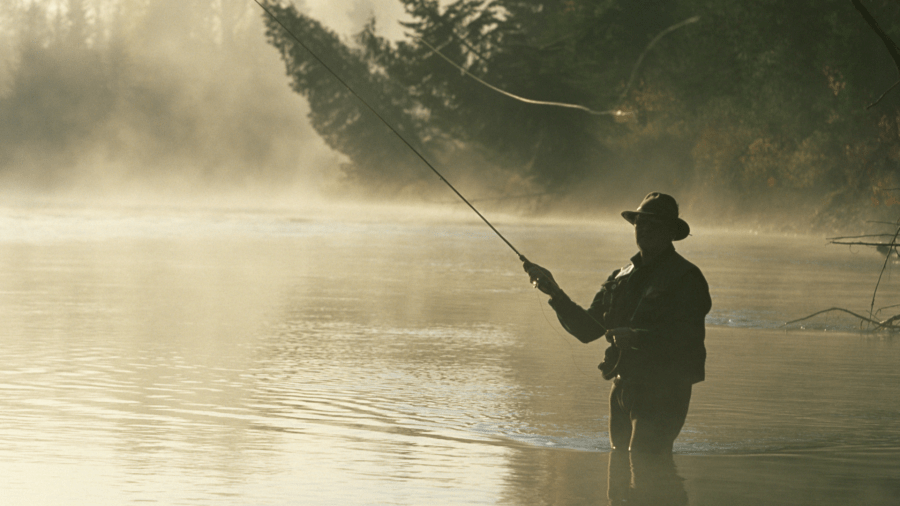
In the first lonesome years after college, the man used to fly fish with God. They’d met through a friend of a friend, a mutual interest sort of thing. God didn’t have a car, and the man did. God wasn’t a freeloader. He just didn’t have an interest in learning to drive. Sometimes the man wanted to ask if God was a New Yorker, but the accent didn’t fit. 

On days they fished, the man awoke early, careful not to disturb his wife; her hair splayed across the pillow. She stayed awake late, staring into her phone, in the way of contemporary unhappily married couples. Sometimes she kept the lamp on late, read poems by a local author she’d met at the library. The man kissed her quietly and left.

God usually waited at the bus stop, smoking a cigarette and staring pensively into the middle distance, coins of light flickering on the underside of leaves, low slung clouds, pigeons bobbing about like buoys. 

The rides were strangely silent. God wasn’t much of a morning person. 

Let there be light, He said, But not so goddamn early. 

The man turned up the radio.  

Eventually, they climbed into the mountains and up an old road, which crossed, via a series of bridges, the raging torrent of the river, glittering blue green below. The sun arrived through the skinny trunks of lodgepole pines—diagonal strips of light, the sort of thing Vermeer would have really nailed. At road’s end, was a waterfall and a small pool, where they’d unload the cooler, sandwiches, beer, and gear. 

In the few months that these trips took place, the man and his wife started to fight. At first, they’d been small fights, but now they were saying unforgivable things to one another. Lately, after the fights, she’d drive her car off into the night, and he’d stand outside, watching the fireflies seemingly flicker in and out of existence.  

As they fished, he found himself wanting to ask God about heaven or what his wife thought of him. But God seemed exhausted, distant.

The mornings after fights, she’d always be there, breathing heavily in the clean linen sheets. The man loved her tenderly, as deeply as he’d thought possible.

Do you need anything, today?

She pretended to sleep.

He drank coffee in the kitchen, waited for her to wake. Squirrels dare-deviled through oaks in the yard. She was a locket, and he had lost the key. Sometimes he dreamed himself in search of the key, swimming through rivers, prying open the mouths of fish, looking for that glittering piece of metal that would free them both.

God frowned and cast again. The man felt lonely and sad, a child lost on the playground.

At least I brought the loaves, God said. I’ll make a million of them, and we can feed the ducks.

The man didn’t know whether to laugh. He was thinking of his wife, of how much she held him in disdain. The wind bent the leaves, ran through the grass. An hour passed.

Fuck all, God said, and walked across the water, feet dimpling the surface. He plunged His fist into the white rapids and pulled out a wriggling salmon. As they cooked the fish over the camp stove, neither of them mentioned the feat. God seemed embarrassed as though he’d made platypuses again.

When the man returned with fish and desperately tired, his wife would ask if the trips were worth it. He could hear the admonishment, time they weren’t spending. Sometimes he stayed awake, bleary eyed, to ask after her day. Once, he’d picked up the poems she read, mostly nonsense about old lovers reincarnated as dogs, geese, pebbles of light, train sounds in the distance. The poems were like koans whose answer was sadness.

In this dream-like state, he thought of his father, who had been incredibly loving, so smothering in his love that the man had been desperate to leave. Now he understood that he was searching for someone like his father, now dead, a soul to love him fiercely. He thought about telling his wife, but her brow was knit tightly, foreclosing questions.

Eventually, God told him He was no longer interested in fishing. He said He wanted to work on a low crossover dribble that flowed into a step-back jumper. Like James Harden, God said, but with a longer beard. 

The man was home every Saturday now, mowing the lawn and watching college football. His wife stayed in the kitchen, reading poems, voraciously now. Sometimes, he swore he saw her slip scraps of paper into her mouth.

Late at night, when he thought she was sleeping, sometimes he’d catch her reciting the poems she’d surreptitiously eaten, scraps of lines floating in the air above them. He shook her awake.

What are you doing?

You were reciting poetry.

Don’t be silly, she answered, rolling over.

He looked at the crease where hip met thigh, longed for her. He stood at the window. The moon lay on the grass in the yard. He prayed.

* * * *

Months later, long after his wife had moved in with the writer across town, the man ran into God at the gas station. God tried hiding behind a row of candy bars. The man stood behind God in line, staring at Him intently. Finally, God turned and said, I couldn’t take all the damned silence. 

The man nodded, understanding he’d missed the opportunity to ask questions about meaning, love, the shape of the universe, time’s flow, questions that would plague him for the rest of his life. The same kinds of questions, he understood now, his wife so desperately wanted him to ask. 

At the register, a middle-aged man with a wrinkled brow rang him up and asked if he wanted anything else. The man looked up at the row of cigarettes behind the counter, the bits of amber colored whiskey. He wanted so many goddamn things he didn’t know how to ask for.


Andrew Bertaina received his MFA in creative writing from American University. His work has appeared in many publications including: The ThreePenny Review, Witness Magazine, Redivider, Orion, and The Best American Poetry 2018. More of his work is available on his website at www.andrewbertaina.com.

Remedy by Emily Pérez

Yesterday I mixed the past and egg whites
in the kitchen. Yesterday the Kitchen Aid
aided all my measures, churning. Yesterday I split
the crew and forced them to assimilate in bowls.
I sugared rims. I salted wounds. Yesterday I made enough
to batter over all protests. I lorded over cupcake cups.
I force fed yellow mix to polka dotted folds:
those upsidedowny skirts. I shoved it in the oven,
prayed. My efforts puffed, then puffed again,
resulting in collapse. My molten offering. Yesterday
I made the same mistake as days before but faster,
yesterday I read how long you beat the batter:
beat until it’s quick. Beat until it’s just mixed.
Beat until your arm is stiff and you forget.
Beat until it beats you back, bubbled up, refusing
proper form. Today the dog licks shrapnel from the floor.


Emily Pérez is the author of House of Sugar, House of Stone, and the co-editor of the forthcoming anthology, The Long Devotion: Poets Writing Motherhood. A CantoMundo fellow and Ledbury Emerging Critic, her work has appeared in RHINOPoetry, Prairie SchoonerCopper Nickel, and Fairy Tale Review. She is a high school teacher in Denver where she lives with her family.


Three Short Tales by Joshua Jones

Something New

One day, in a park surrounded by skyscrapers, a woman began to float. This was midway through the ceremony. The guests were shuffling and coughing and sneaking glances at their phones. By the time anyone noticed, she was thirty feet up, flexing her toes, paddling the air, kicking until the imitation-glass heels went sailing. One hit the groom, the other the cassocked minister, his face still in his book. The sole made a satisfying clonk against his shiny scalp. The groom—her groom, she had to remind herself—mouthed Why? but she no longer looked at him, no longer looked down at all. From across the park, another white-trimmed figure moved skyward, then another, then another. The brides saw each other and waved, did little twirls. Some pulled their veils free, others ripped at their trains. One by one, they tossed their bouquets to the spectators below. There was a mad scramble.


Biology Lessons

It happened when Ms. Robishaw was at the blackboard. The girl, that is, and the frog, a bulbous looking thing that barely fit in the glass jar. It didn’t struggle in its chloroformed stupor but gazed liquidly at the girl. Then came the wet, smacking sound followed by a flurry of giggles and more kisses as the rest of the class took out their specimens and puckered up. By the time Ms. Robishaw turned around it was too late: where once there were frogs, there now slumped the sagging bodies of men and women, all naked. She recognized them all. There was Tony, who once taught PE the next county over, but now was sprawled across the desk closest to Ms. Robishaw. She prodded his belly; it had doubled in size since she’d stopped answering his texts. Two desks over lay either Brad or Brandon, or was it Braydon? He worked downtown, she was sure of that. Was big in something or other, though now he looked, sadly, rather small. And Giselle, who looked so peaceful that Ms. Robishaw felt a twinge of regret until she remembered the yelling, the cutting remarks, the actual cutting, the scars still visible along her thighs. There were no princes, no princesses. At the back of the class, a man began to flutter his eyelids. Garth. He always wrote such earnest poetry. Then threatened to share her nudes on Reddit. He looked better as a frog. Ms. Robishaw clapped her hands, louder and louder, until the class’s twittering quieted. Class, she announced, we’re going to need more chloroform.


One Hundred Years

It was over one hundred years ago. The Spindlers’ Guild couldn’t keep up. Prices doubled, trebled, and still people bought the green-tipped spindles—first those bourgeois fawners, you know the type: the ones who doted over the young Aurora, who bought sleeping dresses to match her repose, who outlined strict guidelines as to who could revive them (at least a minor duke; great kisser; no baldies)—but next came the fishwives, the ones who couldn’t give a tit about the royals and some spoiled, sleep-sick princess; they dreamt of a decent night’s sleep, a decent year/decade/century of sleep without grubby hands prodding them for food or favors. Is it any wonder that fights erupted over the last spindle? Or that, to meet demand, the factory foremen mandated fourteen-hour shifts? They threatened the slowest Spindlers with flogging, the prettiest ones with worse. After the Shop Steward complained and was beaten into a coma, half the Spindlers pricked their fingers and swooned right there on the factory floor. The rest walked out, wielding spindles like spears, threatening to jab any foreman who stepped in their way. They picketed day and night while orders mounted up. To Persia, to India, to the Empress of China herself. The town guard was brought in, scattering the picketers with clubs and pikes, cracking ribs, breaking skulls. That night, the empty cobblestones glistened red in the light of the burning factory. Where were the guard, the foremen? Perhaps they nodded off, the strikers said. A prick of the finger is all it’d take. The fire raged higher, engulfing the night. The town slept through it all.


Joshua Jones lives in Maryland, and his writing has appeared in The Best Microfictions 2020, The Best Small Fictions 2019The Cincinnati Review, CRAFT, Paper DartsSmokeLong QuarterlySplit Lip Magazine, and elsewhere. Find him on Twitter @jnjoneswriter or visit his website: www.jnjoneswriter.wordpress.com.

Cavity by Hanna Lauerman

One thing I miss is
losing teeth. It tasted good
somehow. Did you like to yank
it out as soon as it wiggled?
I always waited until it hung
by a thread, so a nudge
of my tongue set it clacking
against its neighbors
in my mouth. Dangling
enough I could twist it
to feel the warm throb
of dying nerve.

After, there was the
tender spit-flooded gap,
impossible to keep my tongue
off, somehow tasting
so much more raw and alive
than the rest of my own mouth.

Now that I’m older, it isn’t so easy
to grow a pearl alongside my body
and then rip it away,

to bury it under a pillow or in a
velvet pouch in the lowest
layer of the jewelry box,

to let something stronger
grow in its place.


Hanna Lauerman writes both poetry and fiction and has been published in Longleaf Review, Folklore, and Grlsquash. Her short fiction has been nominated for the Best American Short Stories anthology. She lives in Boston with her supportive girlfriend and unsupportive cat.

Three Fictions by Sara Nović

Hearing Paired

I turn around too fast and quickly we’re laughing; in a room of low-tide silence, our eyes ignite with the insight that they’ve told us all the same can’ts, though you’ve heard them differently, and not at all.

From Peru you bring Español, a little Quechua, Amaya, the Lengua de Señas Peruana, de Inmaculada, de Sivia, though all that gets you nothing except a seat in the special needs work program. Beside you I’m inspiringly bilingual, but English crushes fat atop everything here—not quality nor quantity, just specificity.

Your hands say mouth-tap-W, with agua on your lips, mine answer back water, mouth-tap-W.

Alone at night on the #66 home, my eyelids start open by another’s hot breath. The man is angry that I haven’t listened, but when he hears my voice, his changes. Sorry, his mouth says, hiss of sympathy. I push the color from my self-conscious cheeks, and think about the morning we spoke three languages at once, understood one perfectly.


Hunger Games

Sticks and stones may break her bones, but words make easy work of it: thigh gap, wristbone, collarbone necklace, and other lessons she learned at school. That body would be perfect with a little less body, conscious uncoupling, brittle by design.

She is to be seen not heard, unless she says what we need to hear: she already ate, she ate a late lunch, she’ll eat later, she’s not herself. She’ll feel more herself with a little less self. Mind over matter, matter discarded.

Self-inflicted (if you don’t count the ones who cheered the infliction, nursed the affliction).

Detoxed, flushed, returned to the soil, splay of twigs on the forest floor.


Kaddish

“There is no mourning on Shabbat,” the Rabbi said, and a feeling like a laugh came up in my throat. I tucked a stray hair behind my ear; I had not seen myself in a week. The Rabbi didn’t look away, superior the partitionHe strode the aisle between our benches and said it with such certainty all I could think was the nerve, to walk across the shul and lie to our faces like that. As if grief could be governed by calendar squares.

I began to fear the ease with which the words fell from his lips. History of falsehood latticed through the floorboards, or running beneath them like a subterranean river, contaminated wellspring. I wondered what other lies we’d built ourselves upon. But, of course, that’s how I’d ended up here—there was no one on earth left to ask. 

The realization sent the room back underwater: chandeliers’ refractions white-hot and writhing, temple contained in the globe of a tear, the tears that do not exist on Shabbat.

So I fought flood with flood. And there was evening and there was morning on the eighth day.


Sara Nović is the author of the novel Girl at War, nonfiction anthology America is Immigrants, and another novel forthcoming in 2022, all from Random House. She has an MFA in fiction and literary translation, and lives in Philly. 

The Goblin King’s Love Language by Rita Feinstein

is gift-giving, and I don’t have room for all this crap.
Psilocybic peaches rotting in the crisper,
crystal balls sticky with grime.

The black snake shriveled to onionskin,
the wedding dress sulking unworn
at the very back of the walk-in closet.

Goodwill stops taking my donations.
My free boxes overflow onto the sidewalk.
There’s a landfill named after me,

a whole shuttle full of glitter-drenched
padded jackets and danger-red lipsticks
to be incinerated in the vacuum of space.

But I accept the love he gives, and I build
more shelving units for it, just as he accepts
my affection has no physical dimensions.

My love language is language itself.
I incant his name into my vanity mirror,
lie that he has no power over me,

then watching him jigsaw the stars
into brand new horoscopes
just to prove me wrong.


Rita Feinstein is the author of Life on Dodge (Brain Mill Press, 2018). Her work has appeared in Sugar HouseGrist, and Willow Springs, among other publications, and has been nominated for Best of the Net and Best New Poets. She is a graduate of Oregon State University’s MFA program.