The Females of Some Species are Larger by L Favicchia

My instinct is not to bite.
Instead I’ll show you all
my little square teeth,
point them out to you
one by one name them
then leave my mouth open
and breathe.

Enamel speaks a thing you can’t
understand—the grain of sand
churning in the oyster
who layers thick saliva
over and over until pearl
to numb the gnawing and is still
left with a tender lump inside—
one she is torn apart for.

Why isn’t the female larger
and more colorful? Give me
the terrified red veins
of the albino raven,
the deep flush and large forearms
of the orchid mantis, also afraid.
Let me have fiery long hair that stings
with the smell of burning oak.

When I skin myself, I skin myself
in front of a mirror to see
all that pretty muscle.

I rehearse what crying looks like,
in my wardrobe keep buttons
that close soft bobbled sweaters
and feel an increasing desire
to become mud, to lie

beneath leaf litter and hide
from grabbing hands
that would put themselves inside me,
playing dead to save myself
from the salt of their fingertips
that craves a wound.


L Favicchia is a PhD student in creative writing at the University of Kansas and is the editor in chief of LandLocked. Their work has appeared or is forthcoming in Hobart, Post Road, and Glass: A Journal of Poetry, among others.

Folding by Emma Smith-Stevens

Extra women were brought into the gift-wrap department for the holiday rush. Although they’d be gone after New Year’s, Mrs. Kay showed them the ins and outs just as meticulously as she had with us—the year-round staff, bustling in a stuffy rectangular booth in the back of Bloomingdale’s first floor, inside a mall in Boca Raton, Florida. She scratched her French manicure over the white underbelly of the colorful paper hanging from reels on the wall, demonstrating necessary lengths for various boxes. The crucial role of double-sided tape was divulged in a tense whisper, and the seamlessness of the wrap-job could not be emphasized enough. “You want it to look,” she’d say, “like it was dipped. Dipped like a caramel apple.” Mrs. Kay was generally loathed, but she seemed not to care. She’d twice been a finalist in The Orange Blossom, Florida’s most prestigious origami competition.

It was a few days before Christmas, and someone had brought in pastries. They were too sweet, glistening with a wet sugary glaze. The craters at their centers held fruit-filling the color and consistency of congealing blood. By 11:00 a.m., there’d been countless arguments, a customer had fainted, and we were running dangerously low on tape. At noon, I quickly ate my bagged lunch in the breakroom. With a few minutes to spare, I went back to my station to finish my gifts.

I wrapped a leather wallet I could see in my father’s back pocket, a plush white robe for my mother, a jersey with my 15-year-old brother’s favorite basketball player—at least, last I’d known—stamped on the back. I hadn’t seen my family in almost two years. The gifts were the kind you give to people whose tastes you don’t know anymore, people who have become more like ideas. The truth is that all my life in New York, up until age 19, I just hadn’t been paying much attention—to a lot of things, including my family. Two years ago, I’d bombed out of college my second semester and gotten arrested for driving under the influence of Xanax and cocaine. I voluntarily attended a rehab in Delray Beach, Florida, a city I hated, yet in which I remained as my parents had cut me off financially, waiting, it seemed, for me to become something better than a young woman who no longer does drugs. I was creasing the edges of stiff, holographic red paper with my thumbnail when Mrs. Kay emerged from the back.

“This is a personal wrap-job?” Her voice smacked the air, and customers turned to look. “You don’t see this line? We’ve got lines all the way to kitchenware. No personal wrapping today.”

Mrs. Kay didn’t seem bothered that none of us shared her reverence for what she had clearly elevated to an art, probably because she didn’t want any of us to be artists. She wanted us to be soldier ants, anonymous and durable.

During the week before Christmas, our store stayed open until midnight. Only once I’d been waiting outside for fifteen minutes did I realize that I’d missed the last bus. The other employees had already left with their clear, plastic theft-protection purses slung over their shoulders. The metal gates were being lowered when I got back to the entrance. A security guard let me duck under.

I was surprised to find Mrs. Kay still at gift-wrap, standing at the counter eating string bean salad out of Tupperware. She speared one bean at a time with a plastic fork, slowly, under the dim red glow of the exit sign. She bristled and glared at me, still chewing. She chewed for a long time before she swallowed. “You should go home.”

“The buses stopped running.”

“I’ll finish my dinner,” she said. “Then I’ll take you.”

Mrs. Kay drove a small tan hatchback. The inside smelled like astringent and potpourri. Although she didn’t smoke, there were cigarette burn marks in the fabric above the driver’s side window. Hanging from the rearview mirror was an origami crane, weightless on its thread.

I told her my address and we drove across the empty parking lot, out onto Federal Highway. We passed gas stations and apartment complexes, grocery stores and drive-thrus. Sex workers lingered by strip-malls like flightless tropical birds. Fast cars pulled long shadows across the road. At a red light, Mrs. Kay and I watched an SUV pull to the curb by a carwash. A tall, broad-shouldered woman lifted her leg like a flamingo. She lowered it into the SUV, pulling the other leg in by the thigh with her hands. “I share this car with my husband,” said Mrs. Kay. “One percent his, ninety-nine percent mine.”

We turned off Federal Highway and began traveling numbered streets. I was used to bus routes, but I could tell by the clotted, sour air that we were driving towards the ocean. I was about to say that we were going the wrong way when she spoke again.

“In our old house,” she said, “I had an origami room. Perfect for folding.”

The streets narrowed as the houses got larger, all of them decorated with Christmas lights. The primary colors of festivity gnashed against the Floridian pastels. Her face was slack, chalky under the streetlights.

“It was a simple house,” she continued. “Not like these. But in my room, there was a skylight, true natural light. Deep drawers for paper that slid right into the wall.”

The car slowed to a crawl. We were now passing mansions. House after house, there was clearly a competition being played out. Oversized nativity scenes towered over spot-lit lawns. Shrubbery was carved into snowmen. Palm trees glowed white, wrapped in crystalline illumination. “If a man loves you enough to buy a whole house, just because of one perfect room, wouldn’t you trust him?” she asked.

She turned a corner, pulled to the curb, and shifted into park. In front of us was a four-story mansion, awash in the light of halogen bulbs, surrounded by trimmed, black grass. The lights speared diagonally upward, through the mist. They projected harshly upon the massive home, which was exactly square. From top to bottom, it was encased seamlessly in pale blue fabric. Hugging the entire width of the building, between the second and third floor, was a broad yellow ribbon. At the center of the house, probably stiffened with hidden wires, the ribbon arched into a bow.

Mrs. Kay fingered one of the burn holes in the car roof. She took my hand out of my lap and laid it on the center console. Then she placed her hand over mine, intertwining our fingers with a firmness that hurt. The smell of astringent grew stronger and I breathed through my mouth. Our sweat mingled, the bones in my hand shifting under the pressure.

I could have been anyone. Anyone’s hand would have been good enough.

Finally, Mrs. Kay released her grip. She removed a tissue packet from her purse, wiped her eyes and blew her nose. Clearing her throat, she shifted the car into drive. The ocean got farther away, the distance thinning the air. When we arrived at my apartment complex, she reminded me to be early on December 26th. “Sales day,” she said. “Fifteen percent, whole store.” The origami crane quivered on its string, swayed by our breathing. “You’re the best of all my gift-wrappers,” she said.

I opened the car-door and stepped onto the pavement. In the darkness, a lizard flitted across my shoe. My fingers dragged along the bottom of my purse, searching for keys. As the wheels of Mrs. Kay’s car rolled over the gritty asphalt, I realized that I’d forgotten my gifts at work, the ones she’d scolded me for wrapping. After she’d reprimanded me, I’d stowed them beneath the counter. Between the seasonal employees and the security guards, they might already be gone. They were unlabeled and just anyone could lay claim to them.


Emma Smith-Stevens is the author of The Australian (Dzanc Books). She lives with her husband and two dogs in Brooklyn, NY. For more of her writing visit her author website and subscribe to her tiny letter, Notes From the Wonderground.

A Small, Private Sadness by Amorak Huey

Dusk dense with pending rain
& a cold front shoving its way across the water,

I want to believe
anything is possible

or I just want to be handsome.
I know how shallow

desire is & still
I want & want

& open the window
to let in the cooling sky

& this breeze hums your name
& the clouds slide over

& pat a space next to them on the bed
& the temperature falls

& out beyond the pines
a great lake churns & churns.


Amorak Huey’s fourth book of poems is Dad Jokes from Late in the Patriarchy (Sundress Publications, 2021). Co-author with W. Todd Kaneko of the textbook Poetry: A Writer’s Guide and Anthology (Bloomsbury, 2018) and the chapbook Slash/Slash (Diode, 2021), Huey teaches writing at Grand Valley State University in Michigan.

One Night in November by Kathryn Atwood

Alice sits cross legged on the hardwood floor and lays out another game of solitaire. It is already dark outside. November is like that. The night drops earlier and earlier. The air is cooler; leaves start to turn. If she looks to the side, she can see her reflection in the sliding glass door that leads out to the pool. It makes her feel like she is being watched. She tries to see beyond her reflection, out into the night, but she only sees herself staring back. She bends back over the cards.

Lately, she can play for hours, losing track of time. Winning a game goes unnoticed. She will simply gather the cards up into a pile, swiftly arrange them and shuffle. Deal them out again. Alice likes the rhythm of the shuffling, the sound of the cards as they fall into order in her hands. Sometimes she realizes that she has shuffled the cards at least a dozen times and forgotten to lay them out. The movement distracts her.

Tonight, though, she cannot be distracted. Something that had been lingering just at the edge of her mind touches her on the back of her shoulder, brushes the small of her back, whispers against her ear. She picks up the phone and searches for his number. Dials it. He answers.

“Hello?”

She hadn’t expected him to answer. She hesitates.

“Hi.”

“It’s you,” he says. She can’t tell anything from his voice. Is he pleased that it’s her? Surprised?

“I shouldn’t have called.”

“But you did.”

“Yes,” she says. “I didn’t think you’d be home. You said you were going out of town.”

“I changed my mind.”

“Ah.” Alice says, as if that explained everything.

“So, if you thought I would be gone, why did you call?”

“Honestly? I thought I’d get your voicemail. I wanted to hear your voice.” Alice swears softly under her breath and rolls her eyes at her reflection. So stupid, she thinks. So pathetic. She needs to learn how to lie, how to think fast on her feet, cover her tracks. Her reflection stares back at her.

“Hmm,” he says, and his voice resonates through the phone. It’s true, she thinks. She loves the sound of his voice. It’s deep and comes from a secret place inside of him, a place so very male. This man is all male. He is so different from her husband, who is small and wiry. Her husband moves quickly. If she were to stumble, he would be right there, at her elbow, before she even knew she was going to fall. This man moves slowly. He would watch her fall. She has never noticed other men since getting married. Not really. Not the way she notices this one. This is dangerous, she thinks.

“What are you doing?” she asks.

“Painting. I had an idea.”

“Ah,” she says again. He’s an artist. A beautiful artist. His work is thick paint and bold brush strokes. He would never paint her, she thinks.

“And what are you doing?”

She looks at her reflection, frowning. She thinks of her husband. How much she loves him. How true that is. She shakes her head. “I don’t know.”

“Well,” he asks, “what is your husband doing?”

“He’s on a night shoot.”

“So,” – and she can hear everything in his voice, his arrogance, his humor, his thinking he has her all figured out – “he’s out for the night and you’re bored.”

“No,” she says. “I’m not bored.”

He is silent for a moment. “Don’t come over here,” he says. “Stay at home. Wait for him to come back. You’re not the type of girl who can have an affair. I know. I’ve had affairs with lots of married women. They always go back to their husbands. It’s understood from the beginning. That’s what they are supposed to do. But you. You’re different. You won’t know how to go back. And whatever you’re looking for, you won’t find it here.”

Alice doesn’t answer. She holds the phone to her ear as she gets up and goes over to the sliding glass door. The door is heavy and yet slides easily open. She walks out onto the deck. The first cool breeze of fall swirls through the trees overhead. The water in the pool ripples gently. It’s a November evening, already dark, and for the rest of her life she will feel restless on nights like these, like anything could happen.

“Well,” he finally asks, “are you coming?”

Alice looks back through the glass into the house. From outside, she can see everything so clearly, the cards, abandoned mid-game, in disarray on the floor of the living room, and behind that the black leather Wassily chairs that her husband loves, but she finds too uncomfortable to sit in, lined up just so facing the black leather sofa, a glass coffee table between them.

Alice raises her phone and the screen lights up. She can see that the man is still on the line. She clears her throat.


Kathryn Atwood grew up in Tulsa, Oklahoma, and graduated from Cornell with an English degree. She lives in the Hollywood Hills, and if she hangs out far enough over her balcony, just to the point where she thinks she might fall, she can see the “OOD” of the Hollywood sign. Her work has appeared in or is forthcoming from The Sycamore Review and Chautauqua, and one of her stories was long-listed for Smokelong Quarterly‘s Award for Flash Fiction.

Any Other Person by Arielle McManus

sometimes I like to go on real estate sites & look at apartments for sale in cities other than my own & imagine the kind of person I’d be if I lived there like if I lived in Stockholm I’d have a red bicycle with a silver bell & short hair bleached white-blonde & I’d have a terrace to grow berry bushes & Queen Anne’s lace on & I’d either only smile or frown I haven’t decided which yet & if I lived in Berlin I’d have a neck tattoo & would sleep under a skylight always at the mercy of the weather always at the mercy of something bigger than myself & I wouldn’t think twice about the number of calories in a pint of beer but I’d still be so thin & god you’d be so jealous & if I lived in Paris I’d smoke Gauloises on an ivy-covered balcony & I’d look like some tragic heroine in a novel rated 3.7 stars by people on the internet who don’t know the difference between a prose poem & a lyric essay & I’d have a study full of philosophical books in languages I don’t speak & never will & I’d wear glasses even though I have 20/20 vision & if I lived in Porto I’d drink black coffee standing up in my kitchen tiled with the white & azure azulejos that I stole from the Porto São Bento railway station in the cover of night just me & a chisel & a masonic hammer under the star-needled sky I think I could hear the ocean if I stopped the clash of metal to ceramic long enough to really listen only I’m never quiet enough to hear the waves heed the warnings just skating by on whispered promises & maybe tomorrows mustering up just enough strength to see myself through each acrid dawn


Arielle McManus is a dual Swedish-American citizen, learning as she goes and writing from a tiny, sunlit room in Brooklyn. She is an assistant editor at Atlas & Alice, and her writing has been published by a variety of literary publications including Passages North, Entropy Magazine, and Cabinet of Heed, among others.

Wasp Dreams by Molly Andrea-Ryan

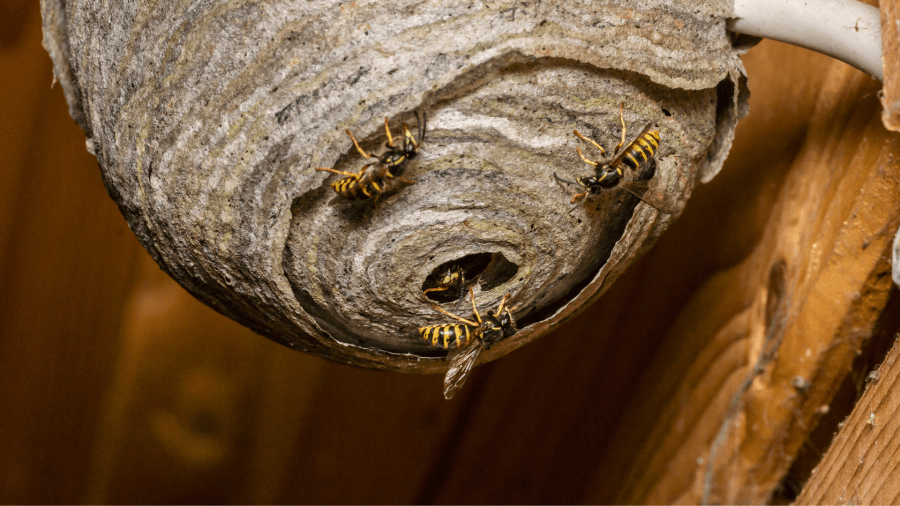
She’d taken to entering her home through the garage door even when she wasn’t traveling by car. The nest, greyish like wet cardboard, was growing. They were taking over the underside of the gutter and she watched them work from the windows flanking the front door. It was impressive, the way their jaws worked all the time, spitting and building clusters of combs.

Her next-door neighbor, an older man from the south (Alabama or Louisiana, she could never remember which) kept telling her to exterminate. “They’ll attack you,” he would say, staring at the hanging nest. “Soon’s you disturb them in the slightest, they’ll attack you, all of ‘em together.” She knew that he was probably right, but she also knew that moving quietly, undetected, was a strength of hers.

She put a sign in her front yard. Do NOT approach front door, it read. Go around back.

They were, she would learn from dated field books of Virginia wildlife, some type of paper wasp. Hers (and this is how she thought of them by now) were a reddish color. Their wings were darker, such a deep brown that they were almost black. There were no show-offy stripes, no traffic violation yellows, as though they had evolved to anticipate fear from predators, rather than demand it.

When the wasps came, she stopped having nightmares. There was the one she’d had for decades: a stranger entered the home she grew up in without permission and followed her from room to room until she wound up in spaces she’d never seen before. The architecture in her dreams never stayed still. Hallways never converged the way they ought to. Stairs never led up or down as one would expect. In the dream she’d had for decades, she would wander and wander, trying to escape the stranger, trying to get back to the part of her house she recognized, but neither relief ever came. There was no gruesome outcome. It just went on and on. And finally, it stopped for good.

Just after Thanksgiving, she noticed that her paper wasps were thinning out. Quietly, she searched the yard for bodies, finding none. They were simply leaving her.

By the first week of December, the nest was still and silent. There were no mouths chewing up dead wood and spitting up paper walls. No life cycles for her to observe from behind the protection of windows. The nightmare was coming back in pieces: first the house from her childhood but with windows in the wrong place; then the stairs started climbing up walls and snaking down drains; then the stranger arrived.

Finally, the woman pulled the nest down from the gutter. She turned it over in her hands, sensing the life that was once contained within, discovering the single life that remained. It took mere seconds to recognize this wasp for who she was: the queen.

The woman set the nest on the mantle. The queen was in a sort of daze, preparing for a long sleep before tasked once again with birthing a colony. The woman placed a mesh colander over the nest and waited until the ground thawed.

In late March, the woman woke to the sound of humming coming from the colander and the nest beneath it. It was soothing at first, as if the queen were singing a lullaby to the eggs she was surely beginning to lay inside each comb. By the time the woman was cleaning up her breakfast dishes, the humming had changed into an angry droning. Soon, a rattling joined in with the humming, and the woman abandoned her plate and bowl in the soapy sink.

Fifty paper wasps, perhaps even a hundred, swarmed furiously around the nest, battering against the colander that trapped them. The woman found herself frozen in space as the colander tipped to the floor. The swarm moved like a cyclone, like a single gust of wind, flying straight toward her and encapsulating her in their whirl. She closed her eyes.

The first few wasps landed on her cheeks and hair and the sound of buzzing filled her head. She felt the grazing of stingers against her flesh and clenched her jaw to keep from screaming. The thought of dying from wasp stings passed wildly through her mind but she remained still, afraid to anger them further.

Then, they started to back off. She felt the whispers of air from their beating wings grow softer. The thread-like feet on her skin slipped away. She opened her eyes and realized that the entire swarm was filing, one by one, back to the nest. The queen hovered inches from her nose and the woman understood: the queen had ordered her offspring to leave the woman alone.

Wearing thick rubber kitchen gloves, the woman picked up the nest. It vibrated softly in her hands as she, following the queen’s lead, took it out back and placed it at the foot of a tall tree. Once the woman was at a safe distance, the queen returned to her offspring to direct the construction of a new nest. Her young worked quickly, fanning out in search of materials, chewing and spitting and forming new walls along the bottom of a tree branch.

The nightmare returned to the woman each night, transformed into something far less frightening. Just as the stranger entered through the front door, the queen wasp appeared, inches from her nose, guiding her to the back of the house and into a grove of trees. The queen tucked the woman into a large comb at the heart of her nest, building a cocoon around her body. The woman would rest and wake to discover that she’d shed her human form.

Her body was a reddish color, her wings darker, almost black, and her jaw worked and worked, occupied with the single responsibility of protecting her queen. She no longer moved in fear or became lost. She was fearsome. She was home.


Molly Andrea-Ryan is a poet and prose writer living in Pittsburgh, PA. Her work has recently appeared in Barren Magazine, Glassworks Magazine, and elsewhere.

Greetings from Somewhere in Spacetime by Adam Gianforcaro

The greens are brighter somehow. The grass
not grass but a speaker for soundscapes,

yard songs like forcefields, pulsing
with peace and purpose, sermon-like,

the way cool air fills the lungs
with both rest and waking. Every day

is today if one considers physics. Or
think instead in terms of reflectance curves.

Yes, today is glowing green, hedge-like,
untrimmed because it’s a wild hedge

without ties to property or pension, waving
in the wind like ceremony, like couplets

printed on glassine paper
then gently placed atop pool water,

which is to say, we are outside again:
the mating song of crickets

bowing wings with wings, an orchestral movement
under the guise of question, wondering

if today is actually today, as in
the moment one thinks of as now. Nevertheless,

time goes on with its many shades of green—
lime and pickle and pear—and so many sounds:

crickets and cicadas, the buzzing of bees,
but man-made things too: motors, machines

of all types. One could call it a symphony
if they were kind, but the world is never kind.

A cricket dies of old age after ten weeks.
The earth swallows everything.

A hideous, hungry caterpillar the earth is, until again
it is leafy and green, blissful in its budding.

Time passes and then it’s the sun’s turn to swallow.
More time and then there is something else.

A cosmic flower, dark with pull. A black hole
that never covers its mouth when it yawns.


Adam Gianforcaro is a writer living in Wilmington, Delaware. His poems and stories can be found in Poet Lore, Third Coast, RHINO, Bending Genres, HAD, Maudlin House, and elsewhere.

A Hole Widens Slightly by Hanan Farouk (translated from the Arabic by Essam M. Al-Jassim)

My vacation had come to an end, and my return to the office was a reluctant one. I harbored no desire to resume work. Indeed, the thought of falling once more into the monotonous routine, weighed on me like a thick, unshakeable fog.

Conversely, part of me longed for the warmth and familiarity of my office. When I opened the door on that first morning back, I felt a sense of belonging, even a welcoming vibe. I then became content to occupy myself with the same old administrative tasks before heading out, as usual, for a cup of tea with my colleagues.

In the foyer, I met a workmate—a good friend—and we quickly fell into comfortable conversation. While we were talking, her gaze lingered on my dress, and my eyes veered instinctively toward that part of my attire. There was a small, irregular hole near the hem of the skirt. Surprised, my friend asked what could have caused such a hole; it hadn’t been there that morning when we’d punched our time cards.

Genuinely clueless, I didn’t know what to say and began to dread the rest of the day ahead. My face flushed with potential embarrassment. She reassured me it was hardly visible and advised me to ignore it; until it was time to go home.

Thoroughly preoccupied, I returned to my office, reluctant to spend any more time with anyone. A while later, the phone rang, snapping me back to reality. The manager was asking for me, so I forced myself to stand again and took a deep breath as I headed her way.

The manager greeted me with a warm smile and requested that I perform an urgent task. I agreed and was ready to leave when her eyes zeroed in on the very direction I feared. When she brought the hole to my attention, I feigned confusion, as if I’d been taken by surprise. I pretended to look for it—an endeavor that didn’t take long.  My jaw dropped in dismay, embarrassment seeping into the core of my being.

The hole had become considerably larger since I’d last looked. The manager shrugged and gave me a questioning look I couldn’t decipher. Beet red and beyond mortified, I went back to my office next door, hugging the wall so no one would notice me, and decided not to leave my desk again until the end of the working day. I kept myself busy within my four walls and tried to soothe the distress that was rapidly overwhelming me.

Engrossed in a mountain of paperwork, I was startled when I heard my colleagues’ voices outside, announcing the end of the day had arrived. Quickly but carefully, I stacked my scattered papers, placed them in my bag, and turned off the lights.

Impatient with my delay, my co-workers raised their voices in a great chorus, calling out for me.

“I’m coming!” I answered.

Their voices rose higher still, and I could hear accelerated footsteps heading toward my office.

What is wrong with them?

“I’m coming!” I repeated.

Faces appeared at the door of my office as I took my keys from my purse, ready to lock up and leave.

Suddenly, their calls faded to a stunned silence. My friend pushed past the others and reached out to hug me, her tears wetting my face.

“What’s the matter with all of you?” I asked, taken aback.

Without saying a word, my friend took off her coat and wrapped it around me.


Hanan Farouk is an Egyptian poet and short-story writer. She is a doctor by profession. Hanan earned her master’s degree in internal medicine from Alexandria University. Her poems and short stories are held in high esteem by writers and critics. She has published a collection of poetry and three collections of short stories. Hanan lives with her family in Saudi Arabia.


Essam M. Al-Jassim is a writer and translator based in Hofuf, Saudi Arabia. He’s taught English for many years at Royal Commission schools in Jubail. Mr. Al-Jassim received his bachelor’s degree in foreign languages and education from King Faisal University, Hofuf. His translations have appeared in a variety of print and online literary Arabic and English-language journals.

When there was nothing but darkness we ate darkness by Jeremy Radin

When there was nothing but darkness we ate darkness
When darkness was nothing but darkness we ate
When we ate nothing there was darkness but
darkness was nothing & we were nothing
In the darkness we ate our hunger
We grew & harvested darkness
We darknessed in nothing
We ate & were happy
The darkness our
nothing & then
there was salt
& the wars


Jeremy Radin is a writer, actor, teacher, and extremely amateur gardener. His poems have appeared or are forthcoming in Ploughshares, The Colorado Review, Crazyhorse, Gulf Coast, The Journal, and elsewhere. He’s the author of two collections of poetry: Slow Dance with Sasquatch (Write Bloody Publishing, 2012) and Dear Sal (Not A Cult, 2017/2021). He lives in Los Angeles. Follow him @germyradin.

Leftovers by Brenda Wolfenbarger

Julianne Perkins stared at the contents of her refrigerator. Leftover turkey, leftover stuffing. Leftover mashed potatoes and gravy. Lots of leftover homemade cranberry sauce with chopped pecans. There was even still leftover pumpkin pie with real whipped cream. She didn’t know what inspired her to make an entire Thanksgiving dinner for herself, but she was regretting the impulse now. How was she going to eat an entire turkey? Goodness, she still felt full from yesterday!

Some of it could be frozen, she guessed. She would put it into partitioned glass containers and make little microwave or oven re-heatable “TV dinners.” Or maybe she’d take some leftovers to her neighbors. That guy in 2C – what was his name? – looked like he could use a turkey dinner or three. Mmm, she’d like to watch him eat it, too. He was delicious looking all on his own, dark wavy hair, pale skin, slender hands. She guessed he didn’t work with his hands; they were so delicate looking. Perhaps he played an instrument, although she’d never heard it.

Julianne wasted a couple of minutes imagining Mr. 2C picking up a piece of pumpkin pie topped with whipped cream and eating it slowly, enjoying every morsel. His eyes would meet hers over the pie and he’d lick the whipped cream off the top with clever curls of his tongue, like a cat. “Good pie,” he’d say, in a husky, rumbling voice. He’d open the door to his apartment and invite her in for a cup of coffee as thanks. Fade to black…

She shook her head to rid it of the fantasy. More likely he’d look at the plate she’d brought, look at her like she was crazy, and inform her that he was a vegetarian, thank you very much. In fact, that might be why he was so pale and slender, he was a malnourished vegetarian! She regretfully decided that Mr. 2C – Andrew, that was it! – would probably not appreciate a plate of leftovers, in that case.

Having settled that she thought of the older couple across the hall. Mr. and Mrs. Stillman. They might like some food; it would save Mrs. Stillman some trouble. They were a bit old fashioned. Mrs. Stillman still cooked every meal except for weekend breakfasts. Often dinner was a tin of fish and crackers eaten while watching Jeopardy! But it was still Mrs. Stillman who brought it to Mr. Stillman while he sat in his recliner with a TV tray. Julianne knew this because she had strategically brought the Stillman’s misdelivered mail at different times of day and had glimpsed their apartment through the door. She found their flocked wallpaper hideous, but it wouldn’t do to say so. Once Mrs. Stillman even invited her in for a late afternoon glass of iced tea, which was nice. Julianne appreciated hospitality; it was sorely lacking these days.

Julianne set about making plates of leftovers for her immediate neighbors. She didn’t use her good plates, of course, but the cheap plastic ones she’d bought for serving burgers on the patio of her apartment. She covered each plate carefully with Saran wrap, which naturally stuck to everything but the plates. She tried to decide which neighbor would receive her largesse first. Her careful decision-making was interrupted by a knock at the door.

Peering out the peephole cautiously, Julianne saw her neighbor from 2A fidgeting in the hallway. What could she possibly want? Did she have mail? Could she want to chat? Miss 2A – Ashley, she thought, but wasn’t sure – never stopped to talk. She always bustled by in the hallway, busy as only the young can be, on her way to Very Important Things.

“Yes?” Julianne opened the door, curious.

“Hi, Julianne, sorry if I’m bothering you. My parents sent me home with so much food yesterday I really don’t know how I’m going to eat it all. I thought you might appreciate some. My mom’s a really good cook.” Miss 2A thrust a large, foil-wrapped plate at Julianne proudly.


Brenda Wolfenbarger is a 53-year-old returning student studying English at the Central New Mexico Community College. She enjoys writing and has had her previous work published in the CNM Literary Arts Magazine, Leonardo. She lives in Central New Mexico with her family and pets.