One Night in November by Kathryn Atwood

Alice sits cross legged on the hardwood floor and lays out another game of solitaire. It is already dark outside. November is like that. The night drops earlier and earlier. The air is cooler; leaves start to turn. If she looks to the side, she can see her reflection in the sliding glass door that leads out to the pool. It makes her feel like she is being watched. She tries to see beyond her reflection, out into the night, but she only sees herself staring back. She bends back over the cards.

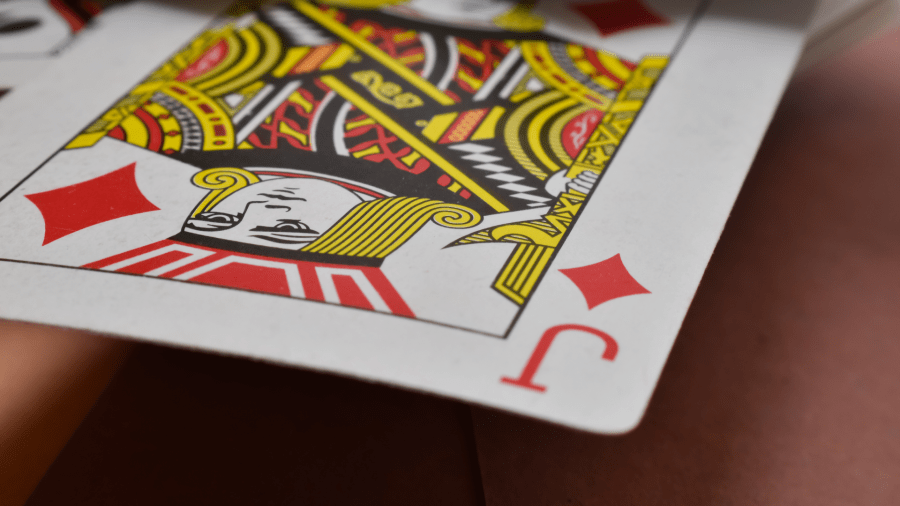
Lately, she can play for hours, losing track of time. Winning a game goes unnoticed. She will simply gather the cards up into a pile, swiftly arrange them and shuffle. Deal them out again. Alice likes the rhythm of the shuffling, the sound of the cards as they fall into order in her hands. Sometimes she realizes that she has shuffled the cards at least a dozen times and forgotten to lay them out. The movement distracts her.

Tonight, though, she cannot be distracted. Something that had been lingering just at the edge of her mind touches her on the back of her shoulder, brushes the small of her back, whispers against her ear. She picks up the phone and searches for his number. Dials it. He answers.

“Hello?”

She hadn’t expected him to answer. She hesitates.

“Hi.”

“It’s you,” he says. She can’t tell anything from his voice. Is he pleased that it’s her? Surprised?

“I shouldn’t have called.”

“But you did.”

“Yes,” she says. “I didn’t think you’d be home. You said you were going out of town.”

“I changed my mind.”

“Ah.” Alice says, as if that explained everything.

“So, if you thought I would be gone, why did you call?”

“Honestly? I thought I’d get your voicemail. I wanted to hear your voice.” Alice swears softly under her breath and rolls her eyes at her reflection. So stupid, she thinks. So pathetic. She needs to learn how to lie, how to think fast on her feet, cover her tracks. Her reflection stares back at her.

“Hmm,” he says, and his voice resonates through the phone. It’s true, she thinks. She loves the sound of his voice. It’s deep and comes from a secret place inside of him, a place so very male. This man is all male. He is so different from her husband, who is small and wiry. Her husband moves quickly. If she were to stumble, he would be right there, at her elbow, before she even knew she was going to fall. This man moves slowly. He would watch her fall. She has never noticed other men since getting married. Not really. Not the way she notices this one. This is dangerous, she thinks.

“What are you doing?” she asks.

“Painting. I had an idea.”

“Ah,” she says again. He’s an artist. A beautiful artist. His work is thick paint and bold brush strokes. He would never paint her, she thinks.

“And what are you doing?”

She looks at her reflection, frowning. She thinks of her husband. How much she loves him. How true that is. She shakes her head. “I don’t know.”

“Well,” he asks, “what is your husband doing?”

“He’s on a night shoot.”

“So,” – and she can hear everything in his voice, his arrogance, his humor, his thinking he has her all figured out – “he’s out for the night and you’re bored.”

“No,” she says. “I’m not bored.”

He is silent for a moment. “Don’t come over here,” he says. “Stay at home. Wait for him to come back. You’re not the type of girl who can have an affair. I know. I’ve had affairs with lots of married women. They always go back to their husbands. It’s understood from the beginning. That’s what they are supposed to do. But you. You’re different. You won’t know how to go back. And whatever you’re looking for, you won’t find it here.”

Alice doesn’t answer. She holds the phone to her ear as she gets up and goes over to the sliding glass door. The door is heavy and yet slides easily open. She walks out onto the deck. The first cool breeze of fall swirls through the trees overhead. The water in the pool ripples gently. It’s a November evening, already dark, and for the rest of her life she will feel restless on nights like these, like anything could happen.

“Well,” he finally asks, “are you coming?”

Alice looks back through the glass into the house. From outside, she can see everything so clearly, the cards, abandoned mid-game, in disarray on the floor of the living room, and behind that the black leather Wassily chairs that her husband loves, but she finds too uncomfortable to sit in, lined up just so facing the black leather sofa, a glass coffee table between them.

Alice raises her phone and the screen lights up. She can see that the man is still on the line. She clears her throat.


Kathryn Atwood grew up in Tulsa, Oklahoma, and graduated from Cornell with an English degree. She lives in the Hollywood Hills, and if she hangs out far enough over her balcony, just to the point where she thinks she might fall, she can see the “OOD” of the Hollywood sign. Her work has appeared in or is forthcoming from The Sycamore Review and Chautauqua, and one of her stories was long-listed for Smokelong Quarterly‘s Award for Flash Fiction.

Any Other Person by Arielle McManus

sometimes I like to go on real estate sites & look at apartments for sale in cities other than my own & imagine the kind of person I’d be if I lived there like if I lived in Stockholm I’d have a red bicycle with a silver bell & short hair bleached white-blonde & I’d have a terrace to grow berry bushes & Queen Anne’s lace on & I’d either only smile or frown I haven’t decided which yet & if I lived in Berlin I’d have a neck tattoo & would sleep under a skylight always at the mercy of the weather always at the mercy of something bigger than myself & I wouldn’t think twice about the number of calories in a pint of beer but I’d still be so thin & god you’d be so jealous & if I lived in Paris I’d smoke Gauloises on an ivy-covered balcony & I’d look like some tragic heroine in a novel rated 3.7 stars by people on the internet who don’t know the difference between a prose poem & a lyric essay & I’d have a study full of philosophical books in languages I don’t speak & never will & I’d wear glasses even though I have 20/20 vision & if I lived in Porto I’d drink black coffee standing up in my kitchen tiled with the white & azure azulejos that I stole from the Porto São Bento railway station in the cover of night just me & a chisel & a masonic hammer under the star-needled sky I think I could hear the ocean if I stopped the clash of metal to ceramic long enough to really listen only I’m never quiet enough to hear the waves heed the warnings just skating by on whispered promises & maybe tomorrows mustering up just enough strength to see myself through each acrid dawn


Arielle McManus is a dual Swedish-American citizen, learning as she goes and writing from a tiny, sunlit room in Brooklyn. She is an assistant editor at Atlas & Alice, and her writing has been published by a variety of literary publications including Passages North, Entropy Magazine, and Cabinet of Heed, among others.

Wasp Dreams by Molly Andrea-Ryan

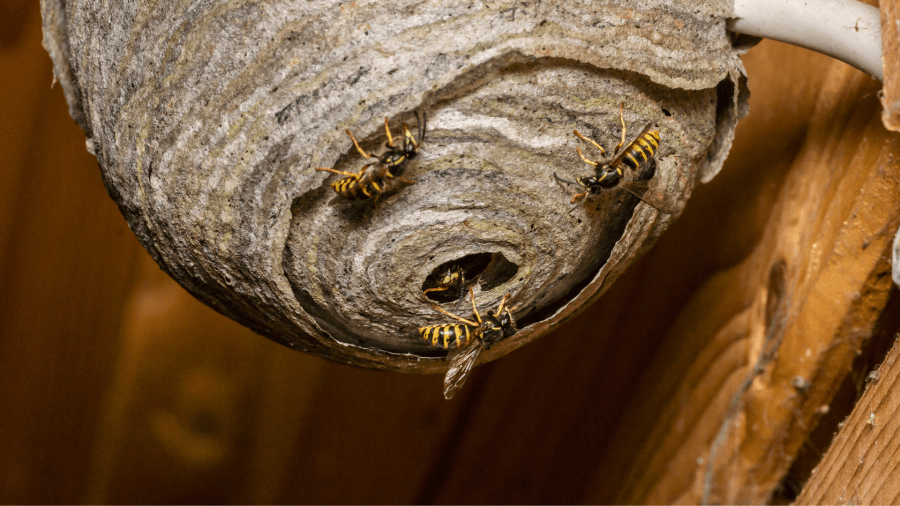
She’d taken to entering her home through the garage door even when she wasn’t traveling by car. The nest, greyish like wet cardboard, was growing. They were taking over the underside of the gutter and she watched them work from the windows flanking the front door. It was impressive, the way their jaws worked all the time, spitting and building clusters of combs.

Her next-door neighbor, an older man from the south (Alabama or Louisiana, she could never remember which) kept telling her to exterminate. “They’ll attack you,” he would say, staring at the hanging nest. “Soon’s you disturb them in the slightest, they’ll attack you, all of ‘em together.” She knew that he was probably right, but she also knew that moving quietly, undetected, was a strength of hers.

She put a sign in her front yard. Do NOT approach front door, it read. Go around back.

They were, she would learn from dated field books of Virginia wildlife, some type of paper wasp. Hers (and this is how she thought of them by now) were a reddish color. Their wings were darker, such a deep brown that they were almost black. There were no show-offy stripes, no traffic violation yellows, as though they had evolved to anticipate fear from predators, rather than demand it.

When the wasps came, she stopped having nightmares. There was the one she’d had for decades: a stranger entered the home she grew up in without permission and followed her from room to room until she wound up in spaces she’d never seen before. The architecture in her dreams never stayed still. Hallways never converged the way they ought to. Stairs never led up or down as one would expect. In the dream she’d had for decades, she would wander and wander, trying to escape the stranger, trying to get back to the part of her house she recognized, but neither relief ever came. There was no gruesome outcome. It just went on and on. And finally, it stopped for good.

Just after Thanksgiving, she noticed that her paper wasps were thinning out. Quietly, she searched the yard for bodies, finding none. They were simply leaving her.

By the first week of December, the nest was still and silent. There were no mouths chewing up dead wood and spitting up paper walls. No life cycles for her to observe from behind the protection of windows. The nightmare was coming back in pieces: first the house from her childhood but with windows in the wrong place; then the stairs started climbing up walls and snaking down drains; then the stranger arrived.

Finally, the woman pulled the nest down from the gutter. She turned it over in her hands, sensing the life that was once contained within, discovering the single life that remained. It took mere seconds to recognize this wasp for who she was: the queen.

The woman set the nest on the mantle. The queen was in a sort of daze, preparing for a long sleep before tasked once again with birthing a colony. The woman placed a mesh colander over the nest and waited until the ground thawed.

In late March, the woman woke to the sound of humming coming from the colander and the nest beneath it. It was soothing at first, as if the queen were singing a lullaby to the eggs she was surely beginning to lay inside each comb. By the time the woman was cleaning up her breakfast dishes, the humming had changed into an angry droning. Soon, a rattling joined in with the humming, and the woman abandoned her plate and bowl in the soapy sink.

Fifty paper wasps, perhaps even a hundred, swarmed furiously around the nest, battering against the colander that trapped them. The woman found herself frozen in space as the colander tipped to the floor. The swarm moved like a cyclone, like a single gust of wind, flying straight toward her and encapsulating her in their whirl. She closed her eyes.

The first few wasps landed on her cheeks and hair and the sound of buzzing filled her head. She felt the grazing of stingers against her flesh and clenched her jaw to keep from screaming. The thought of dying from wasp stings passed wildly through her mind but she remained still, afraid to anger them further.

Then, they started to back off. She felt the whispers of air from their beating wings grow softer. The thread-like feet on her skin slipped away. She opened her eyes and realized that the entire swarm was filing, one by one, back to the nest. The queen hovered inches from her nose and the woman understood: the queen had ordered her offspring to leave the woman alone.

Wearing thick rubber kitchen gloves, the woman picked up the nest. It vibrated softly in her hands as she, following the queen’s lead, took it out back and placed it at the foot of a tall tree. Once the woman was at a safe distance, the queen returned to her offspring to direct the construction of a new nest. Her young worked quickly, fanning out in search of materials, chewing and spitting and forming new walls along the bottom of a tree branch.

The nightmare returned to the woman each night, transformed into something far less frightening. Just as the stranger entered through the front door, the queen wasp appeared, inches from her nose, guiding her to the back of the house and into a grove of trees. The queen tucked the woman into a large comb at the heart of her nest, building a cocoon around her body. The woman would rest and wake to discover that she’d shed her human form.

Her body was a reddish color, her wings darker, almost black, and her jaw worked and worked, occupied with the single responsibility of protecting her queen. She no longer moved in fear or became lost. She was fearsome. She was home.


Molly Andrea-Ryan is a poet and prose writer living in Pittsburgh, PA. Her work has recently appeared in Barren Magazine, Glassworks Magazine, and elsewhere.

Greetings from Somewhere in Spacetime by Adam Gianforcaro

The greens are brighter somehow. The grass
not grass but a speaker for soundscapes,

yard songs like forcefields, pulsing
with peace and purpose, sermon-like,

the way cool air fills the lungs
with both rest and waking. Every day

is today if one considers physics. Or
think instead in terms of reflectance curves.

Yes, today is glowing green, hedge-like,
untrimmed because it’s a wild hedge

without ties to property or pension, waving
in the wind like ceremony, like couplets

printed on glassine paper
then gently placed atop pool water,

which is to say, we are outside again:
the mating song of crickets

bowing wings with wings, an orchestral movement
under the guise of question, wondering

if today is actually today, as in
the moment one thinks of as now. Nevertheless,

time goes on with its many shades of green—
lime and pickle and pear—and so many sounds:

crickets and cicadas, the buzzing of bees,
but man-made things too: motors, machines

of all types. One could call it a symphony
if they were kind, but the world is never kind.

A cricket dies of old age after ten weeks.
The earth swallows everything.

A hideous, hungry caterpillar the earth is, until again
it is leafy and green, blissful in its budding.

Time passes and then it’s the sun’s turn to swallow.
More time and then there is something else.

A cosmic flower, dark with pull. A black hole
that never covers its mouth when it yawns.


Adam Gianforcaro is a writer living in Wilmington, Delaware. His poems and stories can be found in Poet Lore, Third Coast, RHINO, Bending Genres, HAD, Maudlin House, and elsewhere.

A Hole Widens Slightly by Hanan Farouk (translated from the Arabic by Essam M. Al-Jassim)

My vacation had come to an end, and my return to the office was a reluctant one. I harbored no desire to resume work. Indeed, the thought of falling once more into the monotonous routine, weighed on me like a thick, unshakeable fog.

Conversely, part of me longed for the warmth and familiarity of my office. When I opened the door on that first morning back, I felt a sense of belonging, even a welcoming vibe. I then became content to occupy myself with the same old administrative tasks before heading out, as usual, for a cup of tea with my colleagues.

In the foyer, I met a workmate—a good friend—and we quickly fell into comfortable conversation. While we were talking, her gaze lingered on my dress, and my eyes veered instinctively toward that part of my attire. There was a small, irregular hole near the hem of the skirt. Surprised, my friend asked what could have caused such a hole; it hadn’t been there that morning when we’d punched our time cards.

Genuinely clueless, I didn’t know what to say and began to dread the rest of the day ahead. My face flushed with potential embarrassment. She reassured me it was hardly visible and advised me to ignore it; until it was time to go home.

Thoroughly preoccupied, I returned to my office, reluctant to spend any more time with anyone. A while later, the phone rang, snapping me back to reality. The manager was asking for me, so I forced myself to stand again and took a deep breath as I headed her way.

The manager greeted me with a warm smile and requested that I perform an urgent task. I agreed and was ready to leave when her eyes zeroed in on the very direction I feared. When she brought the hole to my attention, I feigned confusion, as if I’d been taken by surprise. I pretended to look for it—an endeavor that didn’t take long.  My jaw dropped in dismay, embarrassment seeping into the core of my being.

The hole had become considerably larger since I’d last looked. The manager shrugged and gave me a questioning look I couldn’t decipher. Beet red and beyond mortified, I went back to my office next door, hugging the wall so no one would notice me, and decided not to leave my desk again until the end of the working day. I kept myself busy within my four walls and tried to soothe the distress that was rapidly overwhelming me.

Engrossed in a mountain of paperwork, I was startled when I heard my colleagues’ voices outside, announcing the end of the day had arrived. Quickly but carefully, I stacked my scattered papers, placed them in my bag, and turned off the lights.

Impatient with my delay, my co-workers raised their voices in a great chorus, calling out for me.

“I’m coming!” I answered.

Their voices rose higher still, and I could hear accelerated footsteps heading toward my office.

What is wrong with them?

“I’m coming!” I repeated.

Faces appeared at the door of my office as I took my keys from my purse, ready to lock up and leave.

Suddenly, their calls faded to a stunned silence. My friend pushed past the others and reached out to hug me, her tears wetting my face.

“What’s the matter with all of you?” I asked, taken aback.

Without saying a word, my friend took off her coat and wrapped it around me.


Hanan Farouk is an Egyptian poet and short-story writer. She is a doctor by profession. Hanan earned her master’s degree in internal medicine from Alexandria University. Her poems and short stories are held in high esteem by writers and critics. She has published a collection of poetry and three collections of short stories. Hanan lives with her family in Saudi Arabia.


Essam M. Al-Jassim is a writer and translator based in Hofuf, Saudi Arabia. He’s taught English for many years at Royal Commission schools in Jubail. Mr. Al-Jassim received his bachelor’s degree in foreign languages and education from King Faisal University, Hofuf. His translations have appeared in a variety of print and online literary Arabic and English-language journals.

When there was nothing but darkness we ate darkness by Jeremy Radin

When there was nothing but darkness we ate darkness
When darkness was nothing but darkness we ate
When we ate nothing there was darkness but
darkness was nothing & we were nothing
In the darkness we ate our hunger
We grew & harvested darkness
We darknessed in nothing
We ate & were happy
The darkness our
nothing & then
there was salt
& the wars


Jeremy Radin is a writer, actor, teacher, and extremely amateur gardener. His poems have appeared or are forthcoming in Ploughshares, The Colorado Review, Crazyhorse, Gulf Coast, The Journal, and elsewhere. He’s the author of two collections of poetry: Slow Dance with Sasquatch (Write Bloody Publishing, 2012) and Dear Sal (Not A Cult, 2017/2021). He lives in Los Angeles. Follow him @germyradin.

Leftovers by Brenda Wolfenbarger

Julianne Perkins stared at the contents of her refrigerator. Leftover turkey, leftover stuffing. Leftover mashed potatoes and gravy. Lots of leftover homemade cranberry sauce with chopped pecans. There was even still leftover pumpkin pie with real whipped cream. She didn’t know what inspired her to make an entire Thanksgiving dinner for herself, but she was regretting the impulse now. How was she going to eat an entire turkey? Goodness, she still felt full from yesterday!

Some of it could be frozen, she guessed. She would put it into partitioned glass containers and make little microwave or oven re-heatable “TV dinners.” Or maybe she’d take some leftovers to her neighbors. That guy in 2C – what was his name? – looked like he could use a turkey dinner or three. Mmm, she’d like to watch him eat it, too. He was delicious looking all on his own, dark wavy hair, pale skin, slender hands. She guessed he didn’t work with his hands; they were so delicate looking. Perhaps he played an instrument, although she’d never heard it.

Julianne wasted a couple of minutes imagining Mr. 2C picking up a piece of pumpkin pie topped with whipped cream and eating it slowly, enjoying every morsel. His eyes would meet hers over the pie and he’d lick the whipped cream off the top with clever curls of his tongue, like a cat. “Good pie,” he’d say, in a husky, rumbling voice. He’d open the door to his apartment and invite her in for a cup of coffee as thanks. Fade to black…

She shook her head to rid it of the fantasy. More likely he’d look at the plate she’d brought, look at her like she was crazy, and inform her that he was a vegetarian, thank you very much. In fact, that might be why he was so pale and slender, he was a malnourished vegetarian! She regretfully decided that Mr. 2C – Andrew, that was it! – would probably not appreciate a plate of leftovers, in that case.

Having settled that she thought of the older couple across the hall. Mr. and Mrs. Stillman. They might like some food; it would save Mrs. Stillman some trouble. They were a bit old fashioned. Mrs. Stillman still cooked every meal except for weekend breakfasts. Often dinner was a tin of fish and crackers eaten while watching Jeopardy! But it was still Mrs. Stillman who brought it to Mr. Stillman while he sat in his recliner with a TV tray. Julianne knew this because she had strategically brought the Stillman’s misdelivered mail at different times of day and had glimpsed their apartment through the door. She found their flocked wallpaper hideous, but it wouldn’t do to say so. Once Mrs. Stillman even invited her in for a late afternoon glass of iced tea, which was nice. Julianne appreciated hospitality; it was sorely lacking these days.

Julianne set about making plates of leftovers for her immediate neighbors. She didn’t use her good plates, of course, but the cheap plastic ones she’d bought for serving burgers on the patio of her apartment. She covered each plate carefully with Saran wrap, which naturally stuck to everything but the plates. She tried to decide which neighbor would receive her largesse first. Her careful decision-making was interrupted by a knock at the door.

Peering out the peephole cautiously, Julianne saw her neighbor from 2A fidgeting in the hallway. What could she possibly want? Did she have mail? Could she want to chat? Miss 2A – Ashley, she thought, but wasn’t sure – never stopped to talk. She always bustled by in the hallway, busy as only the young can be, on her way to Very Important Things.

“Yes?” Julianne opened the door, curious.

“Hi, Julianne, sorry if I’m bothering you. My parents sent me home with so much food yesterday I really don’t know how I’m going to eat it all. I thought you might appreciate some. My mom’s a really good cook.” Miss 2A thrust a large, foil-wrapped plate at Julianne proudly.


Brenda Wolfenbarger is a 53-year-old returning student studying English at the Central New Mexico Community College. She enjoys writing and has had her previous work published in the CNM Literary Arts Magazine, Leonardo. She lives in Central New Mexico with her family and pets.

One of Those Days by Molly Thornton

The itch begins on my first right toe
And scrambles up my leg
And I’m sorry for whatever I’ve done

Thick scales replace skin
And I scratch furiously at what was my foot
Now green-gold and clawed

I hope again for salvation
But the change, it does not cease
Chain-link petals run up my thighs

Where once a girl I was
I turn
In the unlikeliest of places

Scanning People from the grocery magazine stand
Eyeing my still pink hands

My loose carrots and their leafy tops
Roll down the black mechanical belt
Cans and jars ride behind them

By the time the cashier asks for my ID
I’ll be unable to prove
Who I was

I react to a surge at the base of my spine
Like a cart was crashed into me
I turn around to give side eye
But there’s no one there

Instead, a tail grows fast and protrudes
Into the aisle

In my last moment of human thought
I remove my glasses
and brace for the screams

God this is embarrassing.


Molly Thornton is a queer, LA-based multi-genre writer. Her hybrid, prose poetry manuscript Proof of You was long listed by the 2020 [PANK] and Dzanc Books’ contests. Her poetry and creative nonfiction have been published in The Los Angeles Times, They Said anthology, Hippocampus Mag, Lavender Review, and more, and also has poetry forthcoming in Peach Magazine. She is a Lambda Literary Fellow and WeHo Pride Poet.

How to Escape a Time Loop by Sara Davis

Wake up to the guttural static of your clock radio. One night—you’ve lost track of how many nights ago—there was a power outage, and when the lights came on you reset all your clocks but neglected to set the tuner. Now the alarm clock bursts into a keening whine every morning, sputtering the frequency for a station that doesn’t exist.

Get up. Feed your cat. Open your laptop and shoot off a few emails; you could do this in your sleep. Once again it is a tentative spring morning. Decide to invite your neighbor for a walk. Tell her you think you may be stuck in a time loop. “Girl, me too,” she says. “Is it only Tuesday?” Across the park, a man in a yellow hoodie walks his terrier.

Wake up to the crackling wheeze of your clock radio. Once again it is a fresh spring morning. The orange pixels on the clock face blink TUESDAY. You’ve woken up on Tuesday eight times this week, or so you think. There is nothing special about this Tuesday—it is not a holiday or your birthday, and no one has died that you know of—so if there’s a lesson to be learned, you haven’t. You’ve attempted the following methods to reach Wednesday: repeating everything you did the first Tuesday, in the same way; repeating everything in a different way; repeating everything, but nicer; giving away all your money (this didn’t take long); going as far away from your apartment as you can get (you fell asleep on the train); falling in love (your neighbor did not take this kindly); and now, you simply get on with it. It’s not such a bad day to repeat. There could have been rain.

Wake up to the seething hiss of your clock radio. Notice that wherever and whenever you end the day, you always end up back here: 7:30 a.m., Tuesday, in bed with the cat curled in the crook of your arm. Consider how strange this is. The 24-hour day is a construct: from the perspective of your bed, perched on a planet whirling in space, 7:30 Tuesday does not describe a time but a relationship between celestial bodies. Wonder what would happen if you stayed awake until 7:30 a.m. Wednesday. Text your neighbor and invite her to get coffee this evening; you’re going to need a lot of it.

Wake up to the gasping drone of your clock radio. 7:30 a.m., Tuesday. Consider the bright side. Do you even want to resume the normal flow of time? Your friends and loved ones will never grow old. Your cat will never grow old. You aren’t growing old, at least externally, although your soul might as well have aged a thousand years. How many days has it been? Ten?

Wake up. Wake up. Wake up.

Or don’t wake up. Whatever. Stay in bed forever. Ignore your cat when she mews piteously to be fed—she has an entire bowl of kibble downstairs, same as every morning. Spend a few days, or what passes for days, burrowed under blankets and scrolling on your phone, emerging only to refill the kibble and your water glass. Make online purchases that will never arrive. Watch movies that don’t hold your attention. Google “how to escape a time loop.”

Surprisingly, or unsurprisingly, you find an online forum frequented by people who are currently or have previously been stuck in time loops. Mostly the latter: as the moderators explain in a pinned post, threads published within a time loop tend to disappear after a day or so. The moderators go by PhilConnors2 and RedNadia; their names appear frequently throughout numerous threads philosophizing how time gets tangled up and how to loose oneself from its knots. The moderators often have to break up strongly worded disagreements; there is nowhere near consensus.

Spend all the sunlit hours of your one wild and precious day scrolling this forum. Wake up and dive back in, feeling found and excluded at the same time. Many erstwhile loopers repeated the best or the worst day of their lives: a career turning point, a milestone birthday, a wedding, a murder. Those survivors believe wholly in the power of making good choices; they do not have much insight for navigating an ordinary day in an unremarkable life. So make it remarkable, your new time-companions type. Save a failing family business. Take risks. Travel. No money, you protest. No debt, they reply. You’re unsure: any day now, you might wake up tomorrow. Who would feed your cat if you didn’t come back?

A small but vocal subset of the forum extols the pleasures of vice without consequence: wine and dine and crime, indulge in brutal honesty, refuse compromise. Infinite resets, no hangover. You can’t quite countenance this. Newly alerted to the existence of other loopers, you realize it’s possible that the supporting cast of your infinitely repeating Tuesday might reset with you, and remember.

Wake up. Check your phone. Your last post is gone; you haven’t posted it yet. Put your phone away.

It’s an agreeable spring morning; you and your neighbor get iced coffee. “I think I’m stuck in a time loop,” you remark. “Me too, girl,” she says, trying and failing to jab her straw through the lid. You glance away and notice a child reading quietly on a bench. Ask your neighbor, “Is it only Tuesday?” It is, it always is, and yet this Tuesday seems different—or possibly you are? No, the yellow hoodie and his terrier are not in the park. But you’re hopeful: in this arc of infinite Tuesdays, variations are emerging.

Wake up to the warm hum of electromagnetic signals from space. You, too, are buzzing with potential. Decide to live this Tuesday as though it is Wednesday. Decide to live every Tuesday as if it is merely a snarl in the thread that binds you to conventional time. You must be gentle but you cannot let go.


Sara Davis (@LiterarySara) is a recovering academic and marketing writer who lives in Philadelphia. Her PhD in American literature is from Temple University. She has recently published flash in Cleaver Magazine, Toho Journal, and CRAFT Literary. She currently blogs about books and climate anxiety at literarysara.net.

Stones by Hilary Sideris

Gabriela cancels the lesson,
says she’s in agonia

sharp dolori in the lombi
Google says loins.

You don’t question her pain,
only her use of agonia,

which meant death throes
in your San Lorenzo youth.

People also ask: How do our
bodies store bile? Do we need

a gallbladder? Why does Google
Translate suck so much?

What do you know about
her dolori? A gastrointestinal

surgeon spooled my cistifellea
through my navel, sent a video.


Hilary Sideris has published poems in The American Journal of Poetry, Barrow Street, Bellevue Literary Review, Mom Egg Review, Poetry Daily, Room, Salamander, Sixth Finch, Sylvia, and Women’s Studies Quarterly, among others. Her most recent book, Animals in English, Poems after Temple Grandin, was published by Dos Madres Press in 2020. She is a co-founder of the CUNY Start program at The City University of New York, where she works as a professional developer.