Breakfast, 3 a.m. by Dawn Macdonald

(In the dream) my mother wasn’t angry and she made a sort
of breakfast out of photographs. I went out through the window
and set my toes to the slope of the roof. The sound of frying
felt at any rate neutral. In the (dream) three bears were accompanied
by a fourth of greater ferocity. In the dream (I) had never known
about shoes. My feet could read and found ways of winding up earth
into sensible chunks, or dollops. No lump could truly be called
identical. The sound of frying was indicative of compression.
A photograph, already flat, flips easily upon the application
of a spatula. My (mother) kept her back turned. To ensure safety,
I used all my senses except for sight.

DAWN MACDONALD lives in Canada’s Yukon Territory, where she grew up without electricity or running water. She won the 2025 Canadian First Book Prize for her poetry collection Northerny (University of Alberta Press).

Gallery by Jane O’Sullivan

Loie Hollowell, Two centimetres dilated, 2023

I’m telling Ben about the heist I read about, how she distracted the security guard while he went upstairs and plucked a painting off the gallery wall. ‘De Kooning!’ I crow. It still thrills me. ‘No one even knew until they died!’

It’s late. Ben watches me from the end of the couch, that pinch to his eyes. ‘Should we call the midwife?’

‘What? No.’ I wave an irritated hand. We have miles to go. Miles. I reach the end of the living room and turn. ‘But I haven’t even told you about the best bit. He—’

‘Slow down.’

‘—Wore a fake moustache. That was it, the whole disguise!’ I keep playing it over, how anyone could just stroll in like that. No real plan, just a dollar-store stick-on and a baggy coat. That’s what I marvel at. How either of them thought it could be alright. But I only manage a few more steps before I’m hissing through my teeth again. The pain is red, orange, magenta, black. Pulling me wide.

Dana Schutz, Breastfeeding, 2015

She was on a plane, long-haul flight somewhere. Her baby was crying so she fed him, like they tell you to do, to calm him. But then she fell asleep. This is what I think about, at three, four, five in the morning, whatever broken time it is, willing myself to stay awake so I don’t suffocate my child and turn into one of those mothers on the news.

The bedroom door creaks and Ben shuffles out to check on me. Also because last week at the clinic, the midwife gave him a pamphlet on postnatal depression. ‘These are the signs,’ she’d said, like she was already thinking about what kind of muffin to get on her break. ‘You should both look out for them.’ And now he is, because he’s like that, and I am pretending I can’t see the doubt in his eyes, the way he studies me. It was his idea, the baby. I thought I could. At least, I told him I could.

The tap runs in the kitchen. Ben sets the glass of water beside me and bends over the back of the couch. His breath is warm on my neck. ‘Look at him,’ he whispers, because love is no problem for him. Love comes easy. ‘Look at his little eyes, rolling back like that. He’s so bloody drunk.’ 

The glass is the only still thing in the painting.

Julie Rrap, SOMOS (Standing On My Own Shoulders), 2024 

Those mothers. The ones who are never on the news. The ones who say, Just heading down the club for a bit, there’s baked beans in the cupboard, and sort your brother while you’re at it. The ones who tell you, Don’t ever get knocked up, worst mistake of my life. The ones who, if you reach for the remote, might suddenly lance their cigarette into the back of your hand. 

‘I don’t know how to do this,’ I tell Ben, our son in my arms. A weight now. A squalling leviathan and he knows. He knows I’m failing him and it breaks me into a million tiny pieces. I do everything I’m meant to. I feed him. I change him. But it’s not enough. And maybe if I’d had a different mother, the love would flow just fine. Maybe it wouldn’t always get so tangled in the constant terror. 

Ben somehow manages to hold us both. ‘But you are,’ he says into my hair, the same thing the midwife taught him to say in the delivery room. ‘You already are. You’re doing it.’ 

Around us, the gallery creaks with other people’s footsteps. The two bronze women rise tall, the one balanced on the other’s shoulders, working together, feeling their way. My son, fifteen now, young leviathan indeed, hunches into his embarrassment. He wants to but he can’t quite face it. These two old women in their nudity.

Grace Cossington Smith, The Window, 1956

‘Oh, I don’t know,’ I say, when my son asks what I see in it all. ‘This and that.’

He’s uncomfortable here. Doesn’t like the quiet, or the feeling that he’s missing something. ‘It’s just a window,’ he says again. ‘I mean it’s pretty, but is that it?’ Like every teenager is always saying. What else is there?

He looks back at the entrance. The crowds drift past on their way to the main exhibition. He wants to be with them, not out here in the wings. No headsets. No trim explanations. I could tell him, Yes, it’s just a window. I could tell him how his father used to plant his hands on my shoulders when he caught me standing there dreaming. How rituals are made, over and over. How eventually I told him I was thinking about my mother and how I was just the same and he said, The fuck you are. Don’t even think it. 

Ben has already found a bench. I watch him across the gallery, squeezing his bad knee. ‘Maybe you could take your dad to the café?’ I say. That is, after all, why the two of them cooked up this plan. The view from the sculpture deck. The pistachio crème brûlées. A nice mother’s day treat. ‘You can get us a good table. Go on, love. I won’t be far behind.’

He is taller than his father now, has the same worry to his eyes, but the uncertainty doesn’t last long. He’s too hungry, for everything. Too eager to see what comes next. He nods at me and goes to collect his father from the bench. And I know exactly how it would feel. A small canvas, maybe. Nothing grand. The tidy weight of it tucked under one arm. The quiet surprise of making it down all those steps and out into the street.

Jane O’Sullivan is an Australian writer. Her art writing appears in Vault, Apollo, Art Monthly, Art Guide and many others. Her fiction has won the Rachel Funari Prize and joanne burns Microlit Award and also been published in Meanjin, Bull, Peatsmoke, Passages North, New Flash Fiction Review, Milk Candy Review and the Spineless Wonders anthologies Pulped Fiction and Play. She lives on Bidjigal and Gadigal Land in Sydney and is online at janeosullivan.com.au and @sightlined.

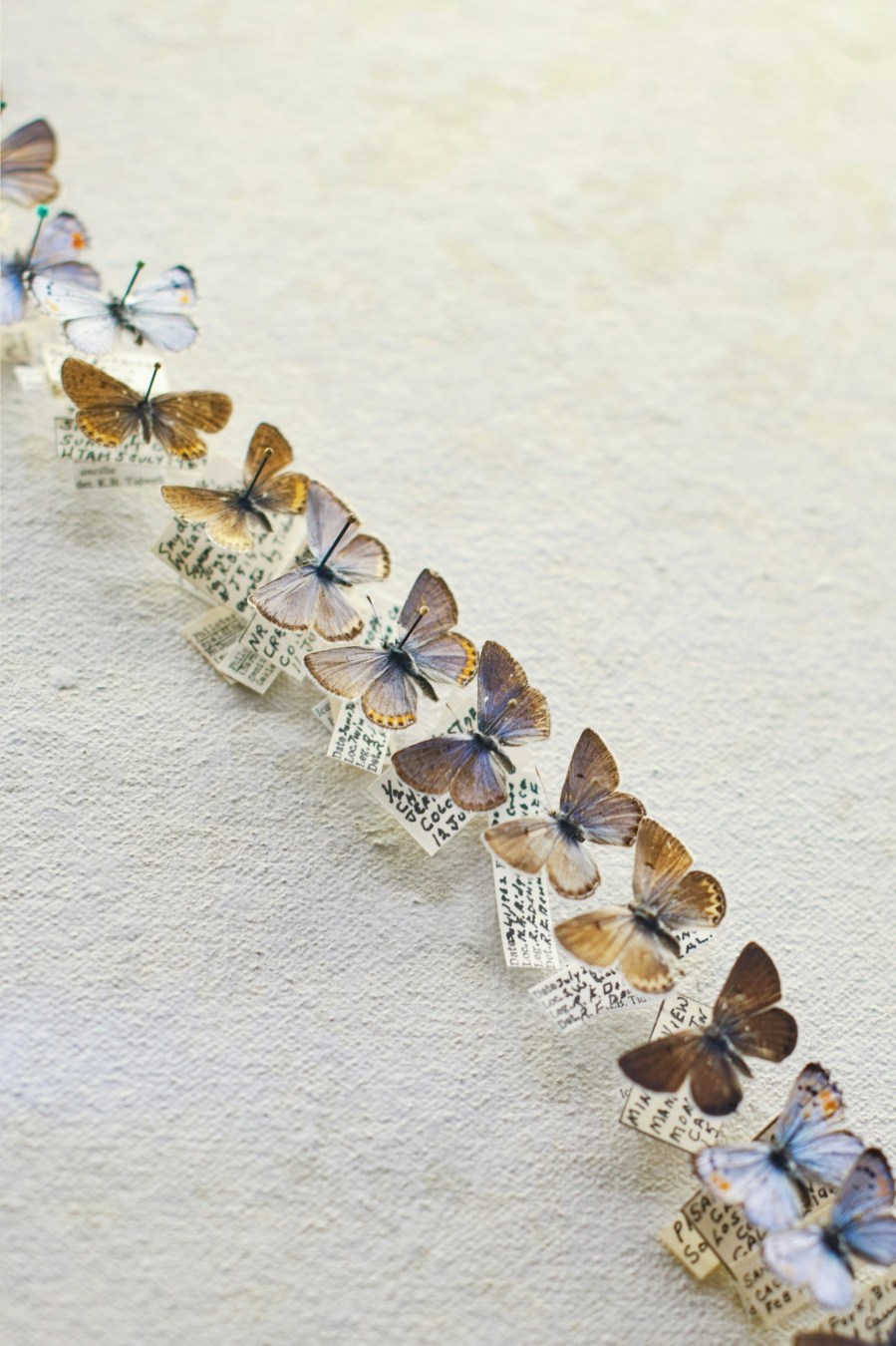
蝴蝶梦 Butterfly Dream by Emily Anna King

in a dream, i perform the butterfly concerto with the silhouette of a man
familiar, but not yet known.

in a dream, a white rabbit with a mouthful of jade approaches
and asks if i remember the story of how he found the moon.

i only hear the music, and i am swept away.

when zhuangzi dreamed he was a butterfly, did he want to stay?

when he returned, was he fearful of living as the man he is after meeting another world?

was he awestruck by the movement of things, the displacement of consciousness?

this afternoon, i left my keys on the kitchen counter
and forgot my best friend’s address.

pine trees shed their leaves.
wandering off, i followed a trail made of dust and gold.

i opened my arms to a fox made of jewels
and it leaned its chin against my shoulder.

we saw a vision of the sunset reversed;
time continued forward.

i stand before a mirror as mere mortal.
cracks in the wall stretch across yellow paint.

bottles of medicine remain behind cabinets unused,
no elixir, no change.

in the living room, the story of the rabbit recites itself in ink:
selflessness ignited over flame

the rabbit throwing his body forward
the jade emperor disguised as a poor man

rabbit sent to the moon with honor.

in a dream, zhunagzi plays the butterfly concerto
with the silhouette of a woman

familiar, but not yet known.

in a dream, a woman tells him the story of how the rabbit found the moon,
how the fox became jewels, and the woman wrote of a story she is still too young to live—

how the music is the space between sleep and wake, a falling of piano keys, a falling of rain,

like wingbeat after wingbeat generations later,
                                                                                              generations more

Click here to view a pdf of the poem with its original lineation.

EMILY ANNA KING (锡萍芳) completed her MA in Creative Writing at UCC in Ireland and is currently teaching writing at an international high school in Massachusetts. Her debut poetry collection, The Dog with the Flute in its Mouth, was published by Finishing Line Press last fall. 

Leaving the Wedding in a Fever by Cassandra Whitaker

Streets cobbled together from where? Rooftops leaning
from where earth grew its longing toward sea
winding –drunk—all the way up the mountain’s snake
The streets open up closer to sea—which is a dime
to enter and bathe—noisy of gulls—children–sweets gobbled up
in the ocean’s insistent i am god i am god i am god i am
I find myself in the sink with a threat to my temple
—forgiveness discovers I am only an old woman
My feet carry me out of danger into danger—
I remember —I know no one My name tells me
no one will believe me—there is nothing to believe
but the sky’s own tellings– I have learned all the wrong lessons
Here comes a bender again- a sack over my head
All leaning roofs lead inward There is only one way

CASSANDRA WHITAKER (she/they) is a trans writer living in rural Virginia. Whit’s work has been published in Michigan Quarterly Review, Gulf Coast, Conjunctions, The Mississippi Review, and other places. Wolf Devouring A Wolf Devouring A Wolf is forthcoming from Jackleg Press in 2025. They are a member of the National Book Critics Circle. Wolfs-den.page

Double Dutch by Jasmine Khaliq

It sounds like gibberish, I said. It’s Double Dutch,
they said, and their grandma invented it.

A boy my age, a girl my sister’s. I wasn’t sure;
they lied about plenty—they were royalty

on a faraway island, their father was an astronaut,
their names were not their real names.

But the language I could hear was real as any.
Pattern I could attain. If I listened closely. If

I really tried. A lot of B’s, a lot of I’s. In his voice
my own name like an alien’s. I surprised them

after two weeks, sauntered into conversation
leaning blasé against their house, air

hot as any Western midday, mid-July.
A door unbolted. Talking in plain sight.

Selves and syllables doubling.
Secret language with the boy

across the street. We talked
about everything, nothing.

I wish I had a dog.
My dad is going to Mars.

They fought last night. I don’t want school to begin—

Anything. Just to speak.

We had never been so close
and we would never be so close again.

The differences between our lives closing
soon over our heads. Jordan’s rabbit died.

Summer is coming to an end.
What’s your favorite color, again?

Jasmine Khaliq is a Pakistani Mexican American poet born and raised in Northern California. Her work is found in Poetry Northwest, Poet Lore, The Rumpus, Bennington Review, Best New Poets 2023, and elsewhere. She holds an MFA from University of Washington, Seattle. Currently, Jasmine is a Ph.D. student at the University of Utah. She can be found at jasminekhaliq.com.

A Reading List for the End of the World by Julia Rose Greider

Robin and I are coping well with the end of the world, by which I mean we usually wake up by eleven and agree that eleven is not bad at all. We start our day with reading: Robin prefers Plato, while I prefer Garfield. My love, ever the philosophy major, has drawn up a list of essential texts and downloaded as many as our laptops can hold, since the Internet will go out any day now. We argued for weeks over whether Garfield deserved to survive the apocalypse. Robin said everyone would hate a fat cat when they were starving, and I retorted that wrestling with Plato would burn too many calories. Eventually I pointed out that matters would likely snowball too fast anyway for starvation to be our cause of death, and if Robin wanted me to be bearable to live with until the end came in whatever way it did, they’d better stockpile some Garfield. They’ve never been able to resist me.

Once we’ve read our fill, it’s time for a late lunch. Robin insists that we discuss our respective literatures to keep our minds agile. They say we’ll need our problem-solving abilities when things get worse. This is another reason they resent my Garfield: they say it does not stimulate the brain. But I point out that, unlike Plato, Garfield is very good at procuring sustenance. While Robin descends into the cellar to make a selection from our menu of freeze-dried camping food, I go out to the yard and look up. Each day it becomes more difficult to breathe. The sky toys with the hues of an oil spill, sometimes green, or yellow, or purple. Most of the time, though, we are cloaked in a grayish-brown that shimmers vaguely, like some vengeful god changed his desktop to a color named death.

We force down our reconstituted pad thai or bun-less lentil sloppy joes or scrambled eggs which, in their freeze-dried form, are crispy like chips. For now we’re still vegetarians, but the vegetarian meals down in the cellar are getting low, and pretty soon we’ll be reverting to a more primitive carnivorous state. The idea makes Robin anxious, even though I point out that the animals we’ll be eating have already been dead and bagged for years.

After lunch, we have our nature walk. If I were in charge, I would probably take a nap instead. Doom’s approach makes me snoozy. But Robin says we have a responsibility to exist in the world while it lasts. I slip my hand into theirs, and they lead me into the woods and make me look at things. They make me look at trees and mushrooms and birds (if we’re lucky), and they call them immense rough-skinned intelligences and fleshy fruiting bodies of fungi and the ones who could still escape if there was anywhere to go. They exhort me to fix the images in my mind, and I say what good will it do for a dying beast to remember other dying beasts?

But I only say this in my head, otherwise it makes Robin pull their hand away and pat at their eyes. Robin still finds hope useful, and I try to be sympathetic.

The woods are quiet these days. When we stand still, my ears feel the fuzzy silence of earplugs, like there might be something to hear if only I could take them out. But I can’t. So we don’t stand still very often; instead, we create the illusion of life by cracking twigs under our feet. Today I nearly step on something else: a matchbook. Robin bends to pick it up. The cardboard, still dry, bears the unfamiliar insignia of a bar called Dante’s. Someone has been burning the matches; only two are left. Robin says, Who—? And I say, Don’t think about it. Robin stares at the packet in their palm, and by the time I lead us home, it’s nearly dark. The sun doesn’t set because it’s never there to begin with. The pall just dims and dims.

After dinner, Robin usually tries for something more contemporary: Hegel or Nietzsche, or Foucault if they’re feeling cheeky. But tonight they make me sit while they read Mencius aloud, and for a few minutes I admire the length of their fingers absentmindedly turning the matchbook over and over. They’re looking for answers, but I already have mine. So I excuse myself to the bathroom. They think I have a weak stomach, that the camping food doesn’t agree with me. I let them think this even though it isn’t particularly flattering. In the bathroom, I sit with my back against the tub and grope around in the depths of the cabinet under the sink. From beneath the rolls of toilet paper, I pull out a stack of small square pages that I ripped off years ago from a cartoon-a-day calendar. If we’re still alive when the toilet paper runs out, these pages will see things they never asked to see. But for now, I peruse a few of the cartoons every night. Sometimes I find one that makes me laugh even though it never did before. People used to get that worked up over a family dinner? A fender bender? A fractious boss? Ha-ha. The days are hopelessly out of order, and I never bother rearranging them.

Robin and I go to bed early. I fit myself against the soft curve of their back and nestle my nose into their neck, where the musk of wheat and lilies soothes me just the same as it did when our ends were not so imminent.

In the darkest part of the night, I wake. Robin is sitting up. They’ve lit one of the matches, and it blazes towards their fingertips. Their face is shining with silent tears. Mencius, they say, believed in the fundamental goodness of humans. Shouldn’t we be struggling towards survival like the products of evolution that we are? Shouldn’t we be devoting our time to useful pursuits, figuring out how to hunt and forage and make fire?

I hold my breath as the flame gobbles its own lifeblood. For months this question has hovered between us unspoken. Robin has tried to ask it before, and I’ve stopped them with kisses, eaten the words out of their mouth. Yes, my sage, I want to say. You and I will be the library, and the library must go on.

Just before the flame blisters their fingers, Robin extinguishes it with one sharp hiss of breath. Into the black silence, against the blue memory of fire that twitches before my eyes, I find I can only speak the truth.

I fumble the matchbook out of Robin’s hand and rip off the last match. I fold the book around the nubby tip; from it, I pull a conflagration. And to Robin’s question, I say no. Because survival—isn’t that how we got here in the first place?

Julia Rose Greider lives in New Hampshire and works in Vermont as a public librarian. Her fiction has been published in Nat. Brut, West Trade Review, and CALYX Journal, and she is an alum of the Kenyon Review Writers Workshop.

Bikini Atoll by Rowan Pollard

A wild driver, her feather coat flying in the wind,
Cadillac convertible southwards out of town but again
I found her half-sunken into the reservoir.
I’ve had enough, she said, I’ve done everything twice.
I’ve been a storm chaser, I shot Kennedy, twelve years
I spent in Vegas drinking gold and winning. My
velvet’s all worn out and I’m stuck here and I can’t
remember my own name.
I made one up for her, something American, Arizona
Castle, Georgia Crossroads, Mississippi Bravo.
I entertained her for a while until the shock wore off,
and once home a hurricane stuck the tower block and kept us
stuck. Some days, I was sick of tracing a trail of ash. I was sick
of extravagance. Where were my pearls to swallow? My
untruthful movie star carpets and gunshot near-misses?
I didn’t miss a word of lies but I got sick anyway.
Last night, under the low moon, I said I loved her. She told me
I like Mississippi best. Like the river always moving through the land.
The dam burst that morning, and I looked for her in the clear
dull water. I thought I’d find some goodbye note and
more, but beside our front door was her feather coat like a snakeskin.
The Cadillac drove toward the sun.
Mississippi, bravo.

Rowan Pollard is a writer and poet living in a nowhere town somewhere in the UK. He has been published in Apocalypse Confidential.

Emily Jarred by Toni Leonetti

A poet’s X post argued
for art apart from artist.
His example?
We love Dickinson’s verse,
even though she killed kittens,
drowning them in pickle jars.
Look it up, he said.
What?
I checked.
Everyone but me knew.

Hope is the thing with feathers—
Unlike cats who can’t fly away

Because I could not stop for Death—
I tossed him softer fur to hug
Fresh eyes to blind in brine
Purrs to choke

My Life had stood—a Loaded Gun—
Until blasted in helpless corners

My letter to the World
Met no reply—
After I tore it into tuna
Crammed down one hungry last meow—

Toni Juliette Leonetti lives in the San Francisco Bay Area and has written short stories, poetry, plays, and a mystery novel. Her work appears in publications including DarkWinter Literary MagazineLiterally StoriesElegant Literature, and Soul Forte.

The Signs by Gabe Montesanti

Backtracking is a rigged poker game, and yet, I still play. I bake backtracking on the top rack of the oven and scatter its crumbs through the forest. Like a bait dog, backtracking still growls at its own reflection. Backtracking and I steal every No U-Turn sign in the city of St. Louis, Missouri. Mounted on the wall like a moose head, backtracking stares at me through empty eyes. I bite into the poisonous pit of a backtracking plum because I’ve survived those juices before. Sometimes, backtracking pitches a tent in the wilderness. What’s the difference between me and nostalgia? backtracking wants to know. Mirrors reflect backtracking like a set of circular footprints in the sand, the hump of a question mark. Backtracking is the frozen tundra in the arctic onto which I can’t help but keep my cheek pressed. Like sandpaper, backtracking wants to use mindless repetition to make smooth what was once rough. Backtracking is disiecta membra, limbs of a scattered poet, Latin from Horace’s Satires. At the 7-Eleven soda machine, between the root beer and the cherry cola, backtracking induces nausea. Extraterrestrials don’t buy into backtracking because their aircrafts only move forward. Beam me up, I scream from a barren field of corn. Don’t let me track back into myself what I have collected by running away.

Gabe Montesanti is the author of BRACE FOR IMPACT: A MEMOIR, which chronicles her time skating for Arch Rival Roller Derby. She earned her MFA at Washington University in St. Louis. Her work has been published in Huff Post, LA Times, Lit Hub, and elsewhere. She is currently at work on a second memoir. 

Rules for New Girls by Leslie Pietrzyk

1976

That Bicentennial summer everyone talks about tennis, desperate to be pretty Chrissy Evert, thwacking balls into meteors. We’re tired of being Iowa girls. But tennis rackets cost real money, meaning of us five, only Janelle’s got a racket because she’s got one of everything. Still, no one plays tennis, so Janelle can’t much lord her fancy Head racket over us. Boy, that makes me secretly happy. 

Suzanne and Tracy find a ratty badminton set in their garage, so we agree being Chrissy Evert with badminton rackets counts. One problem solved but there’s another: four rackets, five girls. They had been an easy four until my mom, her boyfriend, and I moved into the neighborhood in March—as Janelle reminds us while we rock-paper-scissors to see who plays and who’s stuck being line judge. It’s Donna, the nicest and fairest. “You’re swapping with Donna first,” Janelle tells me. “That’s the rule for new girls.” 

Suzanne and Tracy’s dad sets up the net: no wobbling. We’re in the front yard because the back’s a hill, only good for sledding. Where I lived before was flat and concrete and no yards and no kids. I didn’t know not to like it. “Ew,” Janelle said.

Playing out front will be exposed, with cars passing, strangers eyeing us swat the birdie like it’s a fly in the kitchen, belly-laughing as we leap and miss, crashing into the scratchy crabgrass. I hate people watching, can’t stand people knowing things about me. “New girl’s got a secret,” Janelle told the others yesterday, smack in front of me.

Suzanne and Tracy team up, leaving me with Janelle. She tugs the top off a dandelion. “Fine,” she says to no one, tossing away the yellow flower. “Fine,” I say right back. The thing is, I might actually be good at badminton. Keefer, our cranky gym teacher, liked me best of the sixth grade girls because I can run forever. “This girl,” Keefer said on the last day of school, handing me the highest presidential fitness certificate with the biggest, goldest seal.

Janelle’s terrible at badminton but criticizes me left and right. I’m in her way, she complains, or she shouts, “Stop your dumb, weird breathing.” I whack my racket hard, making air whistle between the strings. Suzanne’s good, and we whoosh the birdie between us.

Then Janelle pushes in front of me so I can’t swing without hitting her, meaning Suzanne wins the point as the birdie arrows feathers-up into the grass. She and Tracy high-five. “You’re hogging,” Janelle says.

“That doesn’t count.” I don’t know why I say that because I don’t care.

“Ask the line judge,” Janelle says.

“You guys,” Donna says.

Janelle arcs her racket through empty space, and I step back. She might never like me, even if I wait forever. We’re not moving back, and those old friends are gone. “No way,” my mom says. Her creepy boyfriend has his important new job. I hate him.

Right then, a station wagon with wood paneling pulls curb-close, and a woman wearing too-big sunglasses rolls down the window and calls, “Can one of you girls pretty-please help me for a sec?” A checkered scarf covers her hair, is knotted tight at her throat. Like she’s the wolf waiting in Little Red Riding Hood’s grandmother’s bed.

Suzanne and Tracy stare at the grass. Donna’s face reddens. Only Janelle watches me, a strange, hard, unfriendly smile distorting her face. Like a painted clown who’s not funny. Like she wants me to cry. Like she knows what happened in my old neighborhood though I’ve told no one.

I remind myself to breathe, because Stranger Danger is the scary man with handfuls of candy. He’s a troll, an ogre, the witch in the forest. He’s not real. This is a lady like our moms driving a car with a bicentennial license plate from Michigan.

My own mother worries about strange men, about boys demanding to see my underwear, about the priest. “Tell me if anything happens,” she says, “promise.” I promise. But when it did, I didn’t know any words she wanted to hear. Like, what if he’s not a stranger?

Janelle points at me. “Go see what she wants. You’re the new girl.”

“Are you afraid?” I ask.

“Never.” She tosses her racket way high in the sky and starts sauntering toward the car even before the racket crashes to the ground.

It’s not a game. I despise Janelle, but it’s not like I truly want her to disappear. I pick up her racket, curving my fingers into the grip, touching the warm, worn leather where Janelle’s fingers were.

“Wait,” Donna says, not to Janelle but to me.

Suzanne and Tracy poke their fingertips against the taut strings of their rackets, maybe testing them. What if no one likes Janelle? Maybe the rule’s that the new girl says it. Say it, I think. Give them what they want and they’ll like you.

I say, “Let her go. She’s fine.”

We watch Janelle talk to the woman then slide into the front seat of the car. The door slams, and the car drives off. “She didn’t even wave goodbye,” Tracy says.

“How come dumb Iowa doesn’t have special red, white, and blue license plates for the Bicentennial?” Suzanne asks.

“Great question,” Donna says.

So we four wonder about that for a while, and other stuff, until our mothers call us in for dinner, Janelle’s mother’s voice coming hoarse and wretched through the screened window of my bedroom late into the night.

Leslie Pietrzyk’s collection of linked stories set in Washington, D.C., Admit This to No One, was published in 2021 by Unnamed Press. Her first collection of stories, This Angel on My Chest, won the 2015 Drue Heinz Literature Prize. Short fiction and essays have appeared in Ploughshares, Story Magazine, Southern Review, Iowa Review, The Sun, and Cincinnati Review, among others. Her awards include a Pushcart Prize in 2020.