On Your 60th Birthday, Resembling Our Mother, Dead at 61 by Patricia Q. Bidar

You emerge from your apartment, wheatfield hair ablaze in the afternoon sun. My big sister, skinny in a form-fitting dress. Today you are 60. I smooth my Hawaiian shirt over my paunch. 

“Birthday girl.” I hand you your gift, a bottle of second-to-cheapest tequila. I got Bellflower Pete to stop at the liquor store before he dropped me off. I’m thinking ahead to what I will drink. How you and I will arrive early and can get in a round or even two before your guests arrive. It’s been so long.

You pass me a tin of gummies and some weed cookies from your job at the dispensary. “For you, Princely.” Your nickname for me; my wife Pia has family money. 

You hold up a finger and vanish inside to put away your gift. You close the door quickly as you always do, leaving me on the step. You think I don’t know about the stacked-up newspapers and books and bottles and cans and CDs and record albums. All the sentimentalia you kept after our mother went. These objects provide you with comfort. I get that.

“Been a while.” I say when you reemerge.

“In the flesh.” Also, before I lost my license, you are nice enough not to say. Before my knee replacement; the botched tropical ale startup.

For a long time, I wondered whether you and I would stay in touch, once our mother went. Like us, she was a person of appetites. We share her face, wide and placid. We two share memories of being taken to the movies, her slipping alone to the back row where her married boyfriend waited. Another time, our mother and us, asked to leave our town’s Octoberfest, because she could barely walk. The face of the lady volunteer: Those poor kids. But life with our mother included small joys. She loved a celebration. And it is I who keep it going, now.

It’s bright outside. I lean against your mailbox as you secure your door, “Hang on, hang on, hang on.” I’m floating lightly. I’ve taken a hydrocodone pill. I tap at my phone and order the cheapest option on the Lyft menu. After she finishes work Pia, a teetotaler, will meet us at the brewery and drive us home.

Our driver is a young Latina in a black SUV. Her posture is very straight. “Your hair is really pretty,” I say.

“Thank you, sir,” she says, and I hear your soft guffaw. She passes the first three onramps. She stays on Western Avenue, even in East Hollywood, which is dodgier than when we grew up. But none of the raggedy characters near the 7/11 or clustered near boarded up storefronts pay us any mind.

“I just got a knee scooter,” you say with your crooked smile. “Well, a neighbor left it behind.” 

“Ooh.”

You add so quietly you are nearly muttering. “Can’t walk more’n a couple of blocks.” I hear you breathing beside me, an unsettlingly intimate sound.

“Since COVID, every time I sit down, I fall asleep,” I offer. I drop my head to my shoulder, eyes empty and tongue lolling. Refreshing your lip gloss, you chuckle. 

“Maybe you have that thing where a person keeps waking themselves up when their breath stops,” you say.

“Ha! Pretty sure my wife would have told me.” Underscoring the difference between us.

“Point taken,” you say sharply. You flash raised hands like a blackjack dealer and turn to the window.

You once told me that if you’d gotten married, you’d have saved hundreds of thousands in online shopping. Partied less. Stayed in good health. The presumption being that if it weren’t for my being married, my life would look a lot more like yours. I thought that was idiotic—why should it be another person’s job to keep us in line? But I have allowed the truth of it to soak in. You know how Pia takes care of me. She tells me when my food is burning, that the tub is about to overflow. Alone, I’d neglect my hygiene. I’d forget to feed the cats or pay our bills and lose my phone. In the end, I’d forget language altogether, reduced to aping lines from television shows and podcasts and graphic tees. 

Like our mother, you and I both hold an unfillable void inside, even as we participate now and then in life’s parade. She was so skinny and jaundiced at the end. Her formerly dancing brown eyes gone flat. The thought of that happening to you makes me swallow hard. I’d be alone, then. The last of our family.

We arrive in San Pedro and gritty Pacific Avenue. I hoist myself out of the car. You are already flitting around to my side. The driver pulls away, heading toward the harbor. To clear the air between us, I defer to you, asking sotto voce what tip I should give.

“Most people don’t even tip,” you answer absently, straightening your dress. 

“How do these drivers afford nice cars, when they get paid so little?”

“I just hope ours doesn’t take that same route all by herself,” you say. I rush to agree. We like thinking of ourselves as concerned for others. I’d told Pia I was worried you had terrible news about your health. I didn’t say I was invited to this shindig after one of my late night calls to you, lonely and high. That you were always cool about these calls and never threw them in my face. 

I crook my arm for you to take. Smiling together at the brewery’s entrance, we make our way across Pacific Avenue, ready for a celebration. We are our mother’s children, after all.

Patricia Quintana Bidar is a western writer from the Port of Los Angeles area, with roots in southern Arizona, Santa Fe, NM, and the Great Salt Lake. Her work has been celebrated in Wigleaf’s Top 50 and widely anthologized, including in Flash Fiction America (W.W. Norton), Best Microfiction 2023, and Best Small Fictions 2023 and 2024. Patricia’s debut collection of short works is coming from Unsolicited Press in December 2025. She lives with her family and unusual dog outside Oakland, California. Visit patriciaqbidar.com.

Notes Toward the Month After May by Penny Wei

I have started to count the number of times the microwave
hums before I eat. The evening it was seven I told myself
that odd numbers are lucky. Like the women who wear ankle-
length skirts and read weather reports for pleasure. Like
the crow that tipped over its feet on the edge of the Walgreens
parking lot and dipped its own beak in cement. I stepped around
it and said sorry, like you do when you bump into a mannequin
that looks like your father. The news says that the bees are
leaving but I’m still getting stung by things. Not insects, but
poorly-timed entrances of gods through oven sparks explaining
why all my dreams are just variations of that one bus
I never caught in 2017. They start with guilt, composting.
Somewhere, the glaciers are crying. Somewhere, my mother
is planting begonias in the shape of the Chinese character
for enough. I’m still wearing that eelgrass wig, blinking
Morse code at the sun. Except the sky has the vague look
of a person who has said too much at a dinner party. So I
tell my dog to stop sighing like a human. It questions
why I don’t stop answering to my government name.
I then remember the crow, who later exploded. Not like
boom, but like oops. Like it had a scheduling error and
forgot it was made of muscle. I try not to name the loam anymore.

PENNY WEI is from Shanghai and Massachusetts. She can be seen on Dialogist, The Weight Journal and Inflectionist Review and has been recognized by The Word Works and Longfellow House. She also has a passion for journalism.

Bed Rot by Sarah Chin

On the first warm morning of spring, Tom arrives holding half-wilted tulips like a man holding a bouquet of blunt instruments. He says he’s leaving me. For Amsterdam. Not the city—he clarifies—a woman from work. Named Amsterdam.

I do not cry. I do not rage. I do not pull his sweater over his head and pummel him with my fists like we’re in a hockey fight. No. I thank him. I say, Thank you so much, Tom, and close the door behind him, as if he’s just delivered an egg and cheese on poppy.

I don’t know why he brought a gift, but it would certainly make the whole thing worse if I refused it. I place the tulips—ten of them, all pink, smug, idiotic—in a blue Mason jar that’s been in the sink since Thursday. The tulips fan their little legs like debutantes on muscle relaxants. I put the stupid, little bitches in front of the open window by my bed.

Lovely women have fresh flowers in their homes. I read that in the Martha Stewart Living I keep under my toilet plunger. Lovely women don’t get left for women with architecture for legs. I want to be lovely, but my eyelids are heavy with exhaustion and SuperMax XXL Lash Wow! Mascara. In other words, I want to be unconscious.

I unzip my skirt like I’m shedding the fiction of who I thought I was. I remove the tastefully slutty blouse and distastefully supportive bra that I had so carefully picked for what I assumed would be a surprise brunch date. It’s horrific how excited I was. I collapse in bed. Flannel sheets from Costco. Grey and bleak, and so am I. The mattress groans. The tulips, meanwhile, look thrilled to be here. I can hear birds singing outside, and I hate them for it.

In another life, I was a sparrow. I sang loudly and often and took breadcrumbs from kindly strangers. I never once opened a shared phone plan with someone who said “babe” too often.

If I was a sparrow, I would be lapping at a glass of wine or pure love or whatever it is they drink in Amsterdam. This is not something I know. I have never had the occasion to get a passport. I’m not a globe-trotting hussy. My knowledge is limited to the Wikipedia page I skimmed after wondering what would possess someone to name a baby after a place half a world away. My guess is that it was a “creative” riff off one of those glossy city-names—Brooklyn, Paris, London—meant to sound worldly and sophisticated.

I’ve seen her photos, once, back when I was still trying not to be the kind of woman who Googles. But I Googled. It was after I saw her name on Tom’s phone. My first thought was, “oh, she’s lovely.” She has a face like a milk commercial. Her voice is a high-end essential oil. She probably doesn’t even try—or worse, pretends she doesn’t.

That’s the trick, isn’t it? Lovely women pull off femininity like backflips off the high dive. I’ve been trying so hard, since before I even met Tom. I smile at strangers. I go to Pilates. I say “sure” more often than “no”. I shave my body hair so that I’m smooth and blank.  Tom liked that about me, that I was “cool.” An iceberg. 

I watch the overripe tulips as morning turns into noon into everything after. One by one their petals fall, indecent and slow. He loves me. He loves me not. The petals scatter like little, pink casualties until there’s only one flower still perfectly intact in the ragged bunch. I reach from my supine position and pluck it out of the jar. I hold it to my nose, my lips. Then I bite. It tastes like pesticides and greenery. I chew and chew and chew the flower like cud.

Tulip madness. That’s what they called it. That’s what Amsterdam was famous for—at least according to Wikipedia. I think I understand something now, even if I’m not sure what it is.

I run to the bathroom and kneel on the floor. I vomit, knees pressed to the cold tile, hands gripping the rim as if I might fall through. The petals come up last—chewed, soft and blushing, floating wreckage in the toilet bowl. He loves me not.

I wash my mouth out in the sink. My lips are blood red, and my cheeks glow feverishly. My eyes shine—not with health, but with a kind of recognition. I look like someone I haven’t seen in a while. Not lovely, the way Amsterdam must appear when she enters a room like a neatly wrapped present, but raw and unruly.

I am already so alive.

I open the window all the way and lean out. It smells like warm dirt and a strange, feverish bloom. The birds are shrieking. They do not care if they sound lovely when they open their mouths. I scream back.

Sarah Chin is a writer with a day job in politics. Her work has been published in Epiphany, HAD, SmokeLong Quarterly, Points in Case, Sine Theta Magazine, and more. She lives in Chicago, Illinois and was born in the Year of the Fire Rat, which pretty much sums her up. More of her work can be found at sarahchin.net.

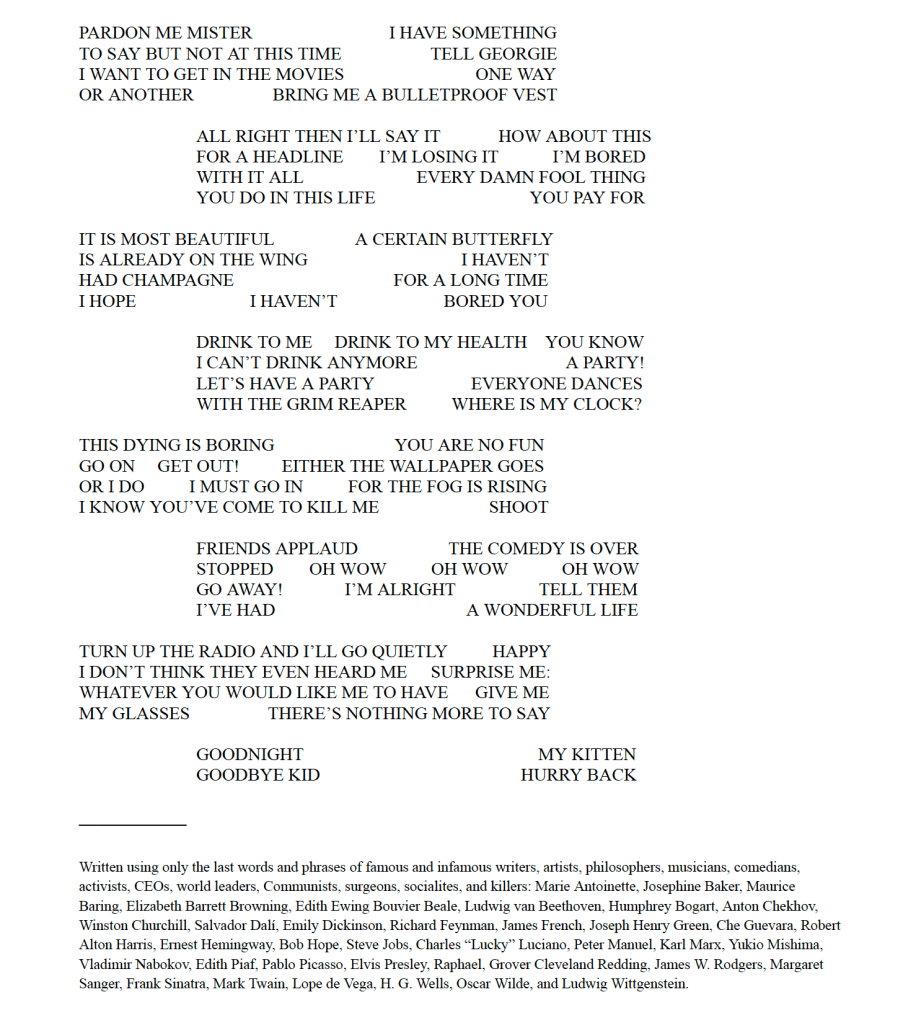
Decomposing at Bathhouse, FiDi by Grace Dilger

Link to PDF: Decomposing at Bathhouse, FiDi by Grace Dilger

GRACE DILGER is a poet and educator. Her work has been featured in Peach Fuzz Magazine, The Brooklyn Quarterly, The Southampton Review, Grody Mag, The Elevation Review, Proud to Be: Writing by American Warriors Vol. 9, Slug Mag, The Racket Journal, Yes Poetry, High Shelf Press, Defunct Magazine, The McNeese Review, Barzakh, Nonbinary Review, and The Bangalore Review. She received her MFA from Stony Brook University and teaches at Monroe University.

Spirals by Natalie Wallington

I am nine when I see the lights in the sky. I crow to Mom from the back seat that there’s a triangle over the field, moving away from us. She says she needs to keep her eyes on the road, but that I can draw it for her when we get home. I take some artistic liberties. What I saw as three soft, even lights I draw as a formation of floating spirals. I tell Mom that the aliens live inside each one like snails. I tell her their bright bodies are what make the rigid hulls glow.

I am thirteen when I see an alien’s ship behind glass at the natural history museum. The placard calls it an opalized ammonite; a curled fossil millions of years old and as big as a cinnamon roll, its pearly surface glinting back the whole cream-washed rainbow. I recognize it instantly, as if my drawing was some prophetic vision. I write my field trip essay about an ancient visitor from another world and get a D+ with the note “creative but false.” I start drawing the spiral on the back of my hand in crusty ballpoint pen, refreshing it whenever it fades, so when the aliens come back they’ll know right away who to trust.

I am seventeen when Mom finally sends me to therapy. The office has the color and smell of oatmeal. I invent a boyfriend who sometimes takes things too far in the back of his Jeep and feign angst over my belly fat. Mr. Dale eats it up. He doesn’t even ask about the spiral graffiti I’ve been caught leaving around town. I brag about my deception in the chatroom afterwards, where I’ve amassed a community of nearly two hundred fellow believers. They’ve seen the spiral ships too, hovering over pastures or appearing up close in dreams, glowing flesh moving inside translucent shells. Their descriptions color in the details of what I never saw.

I am twenty-one when I take a receptionist job at a medical imaging lab. I wear fingerless gloves to my interview so they won’t see the white scarring where countless metal nibs have etched the same spiral for almost a decade. I spend the workday on the paranormal message boards while the MRI revs in the next room like a jet engine. I map sightings of the aliens’ ships and misfile enough medical records that my boss checks the computer’s browser history. The day after I’m laid off, my online community reaches five thousand people. They comfort me when I share the news. I tell the truth: that I’m not upset. It just makes me want the ships to get here sooner.

I am twenty-five when my supporters pool the money to buy a condemned cottage in rural Oklahoma. The location was carefully chosen for its proximity to past sightings. The nearest neighbors are three miles away down a peanut-butter-colored dirt road. Mom begs me to reconsider, to get an apartment in the city where I can meet other people my age. I hug her and don’t answer — she doesn’t know about the others, a whole network around the world that looks to me as a visionary. She waves as I pull out of her driveway for the last time. A creek flows near my new house over a bed of muddy silt. I sit in it to cool off after mowing the first enormous spiral into the overgrown field.

I am twenty-nine when we begin making arrangements. There are several dozen of us scattered in trailers and tents around the property. The county won’t let us add rooms to the cottage until we fix the ones already there. We don’t plan to live here long enough for that. Every morning we gather in the field, tracing the spirals with our bodies. Every evening, we practice sinking into the creek. We light bonfires. We send letters that scare the few people who still love us. My drawing is framed behind glass above the crumbling mantlepiece. When I close my eyes underwater, I can see the spiral lights as clearly as if I actually had.

I am thirty-three when I awake from a dream surrounded by light, certain that the aliens have come for us after our years of sacrifice. But the headlamps are attached to men; the floodlights attached to their trucks lined at the gate. I’m dragged outside squinting. Around me I hear people running, hollering, trampling tents. Mom shows up to court and cries the whole time, like she really believes I would do what they’re claiming. My sweaty lawyer tries playing up the alien angle to get me deemed mentally unfit. A few defectors take the stand to say I’m dangerous. I feel sorry for them, having to go through life knowing nobody’s coming to save them.

I am thirty-seven when the letter arrives. The woman wants to interview me for a documentary. She says the county is even letting her film on the land they seized. In the visiting room I show her my ink. Spirals on the backs of both hands, done stick-and-poke by a kid in the next cell block. She wants to hear about my follower who died in the creek. I tell the truth: that he was tired of waiting. The woman asks me if I’m tired of waiting. For the first time in years, I think of the triangle over the field — three soft lights that could have been anything. And I tell her I’ll wait as long as it takes. I tell her I know what I saw.

Natalie Wallington is a writer living in Memphis, Tennessee. Her flash fiction has previously appeared in Wigleaf, Ellipsis and 101 Words. She is a co-founder of the Kansas-Missouri Writers’ Collective and was a finalist for the 2025 Mythic Picnic Postcard Prize.

There was a meaning by Amelia Averis

There is a boy who speaks in rain at arrivals.
He has time in this world
where the rockpooled minnow
flashes silver seconds.
We follow the funeral and I try to say
‘I am sorry I am not afraid of you’ but I cannot lie,
or forgive the recurrent ghost;
I cannot learn his lesson.
In this dream there is guilt but not enough of it.
I will not die on this hill
but I am freezing beautiful
to an accidental death.
With the moon hanging over the park as the sea, I kissed it
and cried twice
to make it real.

AMELIA AVERIS  is a writer and journalist from Jersey, Channel Islands. She was highly commended by judges of the Passionfruit Review “Here and Now” contest, and also appears in HeimatTiger Moth Review, Palette Poetry, and Prosetrics. The organs of her poems can be found in her decade of journals, where she explores themes of longing, loss, beauty, and memory. Her chapbook as the ink birds split the sunset with Alien Buddha Press is on Amazon. You can find more Amelia at https://ameliaaveris.journoportfolio.com.

You Be the Flotsam, I’ll Be the Jetsam by Melissa Rudick

I called off from my job as an IT Support Specialist at the local college Tuesday, and whether as punishment or absolution, was eaten by a whale. If you want to be technical about it, I wasn’t eaten so much as I was in its mouth. The esophagus of a humpback whale is too small to swallow a basketball, let alone an adult human male with a little extra around his midsection. I found that out later, when I saw a marine biologist talking about the incident on TV. 

My buddy Frank, who brought me kayaking that day, thanked me after. He said this was going to blow up his channel. Then he dropped me off at the hospital because of my “creepy smile and dead eyes.” The docs said I was in shock and gave me a full check-up. Seemed like everybody who worked there wanted to poke and prod at me and ask me questions. When they asked me what it was like inside the whale, I forced a laugh, said, “Dark and smelly!” 

To tell the truth of it was impossible. Hell, I didn’t even understand the truth of it myself. 

Mary picked me up at the hospital later. That one eyebrow of hers already raised, as if this was something I had done just to annoy her.

“You ok then?” she asked.

“Yeah, let’s go home,” I said. I reached out for her, but she was already halfway to the parking lot. 

In the car, she was quiet. I watched her chew the inside of her cheek. She turned on the radio and they were talking about me. She turned it off. 

“I don’t see what business you had being anywhere near a whale,” she said. 

“Frank said kayaking would help us relax some is all,” I said. I couldn’t explain it to her. The sameness of my days. She’d tell me that’s what life is for everyone. Why would you think you deserved more than the rest of us, she’d ask. 

“Frank is unemployed and a moron, you shouldn’t listen to him about anything,” she scoffed. “Case in point! I’m sure your boss will be glad to know you were too sick to work yet felt good enough to be swallowed by a whale.” 

“I wasn’t swallowed, Mary. I was just in its mouth for a little bit,” I said. “Frank sent me a video, let me show you.”

“In case you were wondering, I’d already had a massively shitty day, so thank you for all of this.” She pulled into our driveway and got out. “Anyways, it’s all over the internet. I’ve already seen it.” 

Mary’s put up with a lot over the last fifteen years. I get stuck in my head and forget things. I forget her. The only thing I brought to the relationship was being able to make her laugh. 

 “Then you saw how that whale spat me out like I was a band-aid in a pot roast! Like I was some factory worker’s finger in a can of pop! Like I was a pubic hair hidden underneath a burger bun!”

She flipped me the bird, which for Mary is darn close to a declaration of love, and maybe forgiveness too. 

Inside the house, I sat on the couch. “My life flashed before my eyes, you know.”

“What’d you see?” Mary asked.

“Not much,” I said. “Not much at all.”

“Sounds about right,” sighed Mary, sliding a frozen pizza into the oven. 

*

I sat on the toilet watching the clip again and again while Mary slept in our bedroom. There’s me on the water in my red kayak, paddling lazily. A bait ball explodes underneath me, silver fish launch into the air, then rain down on me. A half second later there’s a giant emerging from the ocean, mouth open wide. You can see me rise into the air, the kayak shooting up and away, now empty, and the whale returning below the water. Not even a second later I appear on the surface. 

That I was gone for less than a second didn’t make sense. All I can think is that time works different for a whale, that it operates on its own scale and when I dropped in, it all slowed down for me too. The seconds turned to minutes turned to hours turned to days and there I was submerged in that wet, black cave, the waves and their echo roaring in my ears. I was a speck. I was a nothing. Tiny and absurd is what I was. Am. 

I found a playlist of whale song, stuffed my headphones in my ears, and crawled into bed next to Mary. I pulled her tight the way she likes. She squeezed me back. The whales called to each other. Lonely, it seemed.  I imagined myself sloshing around in that black womb. I closed my eyes to make it darker.

*

Mary called it my Jonah Day. She hummed “Under the Sea” while she washed the dishes. She asked if I wanted to role-play as merfolk. Then, when she saw the teasing hurt me, she got mad again and asked why she never got to have fun. 

“What do you mean, fun?” I asked. 

“I mean, I used to be a person that did things. Like kayaking or jumping off a cliff into water. With you, sometimes. Remember?” 

I had made so many wrong assumptions about what Mary wanted from life and me. I forgot that side of her and we both lost out. 

 “So, neither of us are happy,” I said. 

“But you’re different now.” 

I tried to explain how I’d concluded that man held an outsized view of himself. How we loomed too large on this earth, in no way proportionate to the value we brought. I rambled about wars and climate change and mass extinction events. I told her that whatever fork on the evolutionary road led to us climbing up on land was a mistake.

“We’ve certainly made a mess of things up here.” She nodded her head, thinking. “And you want to go back?”

“Will you come with me?”

We busted into Frank’s garage, left a note that said, “Gone Fishing.” We tied the kayaks to the top of our car. It was night and no one saw us back up to the boat ramp. The ocean calm, we paddled side by side. Mary looked up at the stars. I told her I read online that you could take a scoop of this water, and it would contain more life than stars in the sky. 

Mary cupped the water in her hands, brought it close to her face. “Pleased to make your acquaintance,” she said.

We pulled our oars through the black water. We let ourselves be swallowed up by the enormity of the night sky above us and the sea and all the life it contained below us. We looked everywhere but back. 

We were specks, we were nothings, we were tiny and absurd, together.

Melissa Rudick is a writer living in Lehigh Valley, Pennsylvania. Her work is forthcoming in Vestal Review and The Blood Orange Review. She is currently at work on her first novel. You’ll most likely find her wherever there’s milkweed, looking for monarch eggs.

onwards and without delay by Alexandra Nwigwe

Well, I was late because I took the scenic route
to work, as in I missed my stop, too busy looking

up how to stop a fight, how to walk up to a monument
and scale him to size, how to be the kind of body that moves

like the girl on the bus who stepped in between a baby and a
man with a blowtorch. Either way, there is always a body

in front of the blowtorch. On the pucker-skinned road to Umueze,
you are the only one crying, my mother says

after a lurch pushes me out my skin, one inch closer
to the rifle in the front seat, jumping as well, maw ready

to swallow the ceiling. The soldier looks back while I make
my sobs silent in the middle and my mother smiles

through my tears. Much later, she tells me she was also scared,
that she has gotten more scared with age.

This does not bode well for me.

I imagine learning to eat a punch is akin to riding a bike,
lessons harkening back to middle school when I practiced falling,

challenged boys to races during recess, turned
myself upside down in a fast from any form of grounding.

Four years ago, I fell into traffic, flew even, and the brief gulp
of air I stole was not enough to recall any of the life I’d lived,

what I’d learnt. The pain did not set in until the mirror gifted me
with a busted lip and a torn up chin. I fended off my vanity by

holding hands with the dark.                           No, I kid. I walked
around with a swollen jaw to the tune of tire squeals.

ALEXANDRA NWIGWE is an engineer and writer based in San Francisco. She finds solace in making art with her hands and capturing her memories, whether through poetry or photography. Her photography has appeared in Lucky Jefferson, and her poetry has won MIT’s Isabelle Courtivron Award and has appeared in MIT’s Rune.

Door in the Woods by Chris Scott

Sarah is hiking up ahead of me, so she’s the first to see it. She goes around the bend, says “Hey now,” and stops in her tracks. Then I see it, too. Right there in the middle of the trail is a single door, like it’s been waiting for us. The door doesn’t belong here, obviously, with no structure around it except for a simple wooden frame holding it in place. “Weird,” I say, because what else can you say? 

We circle it once. Studying Sarah’s face, I can see her wheels turning, some private communion between herself and the door that I’m not privy to. Maybe it’s some kind of art installation? The remaining relic of an old, demolished cabin? The thing about the door though: It doesn’t look like it’s been here very long. Like it hasn’t weathered the elements really at all, like it was just constructed specifically for an audience with us.

Sarah steps right up to it, tries the knob, cracks the door open a bit. And because Sarah is Sarah, she says, “I mean, we have to, right?”

The door makes me uncomfortable but I don’t know how to say this in a way that doesn’t make me seem silly. “Do we? Doesn’t really seem like it belongs here.”

“Yeah, no shit,” Sarah says, the kind of offhand dismissal to which I’ve grown accustomed lately. “Okay then, you walk around it and I’ll go through.”

“Are you sure?” We came to the woods to keep a struggling thing going. Six months of couples therapy and my eyes are constantly peeled for any wrong decision that could strain or sever our increasingly tenuous connection, that could make a trial separation less hypothetical, in the future.

“Count of three,” Sarah says, “You go around it, and I’ll go through. One…”  Her hand still on the knob, the door partly open. “Two…” I run my fingers along the frame. “Three.” I go around just as Sarah walks through, and I’m overcome with the sudden certainty that she’ll vanish, the door transporting her to the moon or Siberia. But before my fear can get away from me, she’s already through. Just a door after all.

“Alright well… shall we?” I say, continuing on the trail, eager to put the door behind us. Sarah catches up with me.

“How do you feel?” I hand her the canteen.

“I feel great,” Sarah says. “How do you feel?” Also great. We round another bend, and I look back. The door is still there, closed again. Then I’m trying to remember, did Sarah shut the door after she walked through? But she must have.

In the car on the drive home, Sarah is taking off her hiking boots in the passenger seat when she says, “I can’t believe you did that.”

“Did what?”

Sarah turns up the radio even though we’re having a conversation. Strange habit. “Walked through that creepy ass door in the middle of the woods.”

I would normally assume Sarah was being ironic, making a joke. But. Seven years together, three of them married. I can tell she’s dead serious. “What are you talking about?”

“Umm…” Sarah curls her lips. “The weird door? On the trail?”

“Yeah, I remember the door. You walked through it, I walked around. I was too chicken. Are you messing with me right now?” I turn the radio off.

“Wait, no. What? That’s completely backwards. You walked through, I went around. Are you messing with me?” Sarah pleads, her voice rising. I turn back and forth from her to the road, trying to figure this out.

“What are we talking about, Sarah?” The door in the woods was maybe an hour ago. How could she be remembering it completely wrong? But her face says: She’s asking herself the same thing about me.

I don’t understand how this is happening. We volley back and forth like this for another ten, fifteen minutes, our accounts of what happened mirroring each other’s almost perfectly, but somehow inverted and wrong. We cycle through the conflict resolution methods Dr. Owens taught us. Patiently going over the details as we clearly remember them, over and over. Then one of us will say “reset” and we’ll take a deep breath and start over, but we always end in opposite places, unable to find our way back together. Sarah says I’m not listening to her, but I am. 

I ask Sarah what it will take to put this behind us. She shrugs, says I could remember walking through. That I could remember it how she remembers it. That would be a start. I don’t know what to say to this. I don’t know how to remember something that didn’t happen. Eventually we run out of energy, just sitting in our respective silences on either side of the car. It feels so ridiculous, all of it. The door. Who went through it, who went around it. But the problem is not the fight, it’s the door. I look over at Sarah a few times but she doesn’t look back at me. She’s somewhere else now.

Later that night I’m back at the trailhead, Sarah at home asleep in our bed. Illuminated in my flashlight, everything looks different than it did earlier, otherworldly, backwards in the dark. But I know the door should be just up ahead, maybe twenty minutes jogging. Assuming it’s still there, and that’s why I’m rushing through the woods now, why I had to do this tonight. This feeling that the door will disappear if I don’t reach it in time. Thinking all the while how absurd this is, but I don’t know what else to do.

Then a wave of relief when I finally see it, waiting for me, pale wood against the moonlight, appearing even more out of place than it was earlier. But right where we left it, still. I pause briefly before the door, thinking this through, but there’s nothing to think through, not really. I take the doorknob into my hand and turn. It’s locked. I try again, harder. Locked. I walk around to the other side, just as locked.

I slam on the door with both palms, the smack echoing through the woods, spooking the animals, species I can’t identify. Then both fists pounding now, not budging, not even a little bit, but I have to get through somehow. I can’t accept otherwise, and I can’t lose Sarah to this. So I’ll be here as long as it takes. Until daybreak, until some other hikers come along who can help me, until I am able to walk through this door finally, and go home to Sarah and say: I went through just how you told it. My world is still your world and I still have a place in it, I swear. How will I ever belong anywhere else?

Chris Scott’s work has appeared or is forthcoming in The New Yorker, Flash Frog, ergot., MoonPark Review, New Flash Fiction Review, scaffold, Gone Lawn, Maudlin House, and elsewhere. His fiction was selected for Best Small Fictions 2025, and has been nominated for the Pushcart Prize and Best of the Net. He is a regular contributor for ClickHole, and an elementary school teacher in Washington, DC. You can read his writing at https://www.chrisscottwrites.com.

Hot-Desking by Maxwell Minckler

Happy Monday, Gary! Gary is one of the interns stuck
to the giant strip of sticky tape hanging over the snacks.
Morning full-timer! he buzzes furiously with his one free arm,
revolving away like a sad piñata, Let me know where you need me!
Always a pleasure, Gary, but I’m hot-desking today,
which means I can take any open desk, anywhere.
This desk is bolted to a treadmill, and I get to catch
all of these falling motivational weights while I work.
This desk hangs half out of a top-story window,
to keep an eye on the competition.
This desk is in a vat of coffee — a soggy one, but productive.
This desk is a ping-pong ball with something alive inside it.
This desk is in a lion’s mouth.
This desk is made of something called wood, I think.
How to choose! There’s so much opportunity here!
Then I see it. Tucked in a corner, practically sizzling.
A desk designed to perfectly match my father’s,
smoldering with unfinished novels and seventy-five years
of undiagnosed magical thinking. They’ve even baked
his stay-at-home shame into the chair just right,
nicotine-yellow and padded with burnt job applications.
Here’s his electric typewriter with the E, V, O, and L keys missing.
The Mennin-green aftershave lighting puts the iron wool
of his beard right over my shoulder again,
half an inch above my next keystroke.
Such attention to detail! Management sure knows
how to show they care, to prove we’re part of the family.
Gary is weeping quietly again as the workday
comes to an end, and his feet begin to crisp and smoke.
So beautiful, he mutters to himself,
such beautiful, beautiful hot desks.

MAXWELL MINCKLER’s poems have appeared or are forthcoming in The Atlanta Review, Ambit, Krax, Okay Donkey, The Interpreter’s House, Obsessed with Pipework, and others. He holds an MFA from Durham University UK, was honored to win Lafayette College’s MacKnight Black Poetry Prize, and placed second in the New Writers UK poetry contest.  Originally from Hawaii, Max lives, writes, and works on tech-ish things around England.