On Your 60th Birthday, Resembling Our Mother, Dead at 61 by Patricia Q. Bidar

You emerge from your apartment, wheatfield hair ablaze in the afternoon sun. My big sister, skinny in a form-fitting dress. Today you are 60. I smooth my Hawaiian shirt over my paunch. 

“Birthday girl.” I hand you your gift, a bottle of second-to-cheapest tequila. I got Bellflower Pete to stop at the liquor store before he dropped me off. I’m thinking ahead to what I will drink. How you and I will arrive early and can get in a round or even two before your guests arrive. It’s been so long.

You pass me a tin of gummies and some weed cookies from your job at the dispensary. “For you, Princely.” Your nickname for me; my wife Pia has family money. 

You hold up a finger and vanish inside to put away your gift. You close the door quickly as you always do, leaving me on the step. You think I don’t know about the stacked-up newspapers and books and bottles and cans and CDs and record albums. All the sentimentalia you kept after our mother went. These objects provide you with comfort. I get that.

“Been a while.” I say when you reemerge.

“In the flesh.” Also, before I lost my license, you are nice enough not to say. Before my knee replacement; the botched tropical ale startup.

For a long time, I wondered whether you and I would stay in touch, once our mother went. Like us, she was a person of appetites. We share her face, wide and placid. We two share memories of being taken to the movies, her slipping alone to the back row where her married boyfriend waited. Another time, our mother and us, asked to leave our town’s Octoberfest, because she could barely walk. The face of the lady volunteer: Those poor kids. But life with our mother included small joys. She loved a celebration. And it is I who keep it going, now.

It’s bright outside. I lean against your mailbox as you secure your door, “Hang on, hang on, hang on.” I’m floating lightly. I’ve taken a hydrocodone pill. I tap at my phone and order the cheapest option on the Lyft menu. After she finishes work Pia, a teetotaler, will meet us at the brewery and drive us home.

Our driver is a young Latina in a black SUV. Her posture is very straight. “Your hair is really pretty,” I say.

“Thank you, sir,” she says, and I hear your soft guffaw. She passes the first three onramps. She stays on Western Avenue, even in East Hollywood, which is dodgier than when we grew up. But none of the raggedy characters near the 7/11 or clustered near boarded up storefronts pay us any mind.

“I just got a knee scooter,” you say with your crooked smile. “Well, a neighbor left it behind.” 

“Ooh.”

You add so quietly you are nearly muttering. “Can’t walk more’n a couple of blocks.” I hear you breathing beside me, an unsettlingly intimate sound.

“Since COVID, every time I sit down, I fall asleep,” I offer. I drop my head to my shoulder, eyes empty and tongue lolling. Refreshing your lip gloss, you chuckle. 

“Maybe you have that thing where a person keeps waking themselves up when their breath stops,” you say.

“Ha! Pretty sure my wife would have told me.” Underscoring the difference between us.

“Point taken,” you say sharply. You flash raised hands like a blackjack dealer and turn to the window.

You once told me that if you’d gotten married, you’d have saved hundreds of thousands in online shopping. Partied less. Stayed in good health. The presumption being that if it weren’t for my being married, my life would look a lot more like yours. I thought that was idiotic—why should it be another person’s job to keep us in line? But I have allowed the truth of it to soak in. You know how Pia takes care of me. She tells me when my food is burning, that the tub is about to overflow. Alone, I’d neglect my hygiene. I’d forget to feed the cats or pay our bills and lose my phone. In the end, I’d forget language altogether, reduced to aping lines from television shows and podcasts and graphic tees. 

Like our mother, you and I both hold an unfillable void inside, even as we participate now and then in life’s parade. She was so skinny and jaundiced at the end. Her formerly dancing brown eyes gone flat. The thought of that happening to you makes me swallow hard. I’d be alone, then. The last of our family.

We arrive in San Pedro and gritty Pacific Avenue. I hoist myself out of the car. You are already flitting around to my side. The driver pulls away, heading toward the harbor. To clear the air between us, I defer to you, asking sotto voce what tip I should give.

“Most people don’t even tip,” you answer absently, straightening your dress. 

“How do these drivers afford nice cars, when they get paid so little?”

“I just hope ours doesn’t take that same route all by herself,” you say. I rush to agree. We like thinking of ourselves as concerned for others. I’d told Pia I was worried you had terrible news about your health. I didn’t say I was invited to this shindig after one of my late night calls to you, lonely and high. That you were always cool about these calls and never threw them in my face. 

I crook my arm for you to take. Smiling together at the brewery’s entrance, we make our way across Pacific Avenue, ready for a celebration. We are our mother’s children, after all.

Patricia Quintana Bidar is a western writer from the Port of Los Angeles area, with roots in southern Arizona, Santa Fe, NM, and the Great Salt Lake. Her work has been celebrated in Wigleaf’s Top 50 and widely anthologized, including in Flash Fiction America (W.W. Norton), Best Microfiction 2023, and Best Small Fictions 2023 and 2024. Patricia’s debut collection of short works is coming from Unsolicited Press in December 2025. She lives with her family and unusual dog outside Oakland, California. Visit patriciaqbidar.com.
Notes Toward the Month After May by Penny Wei

I have started to count the number of times the microwave
hums before I eat. The evening it was seven I told myself
that odd numbers are lucky. Like the women who wear ankle-
length skirts and read weather reports for pleasure. Like
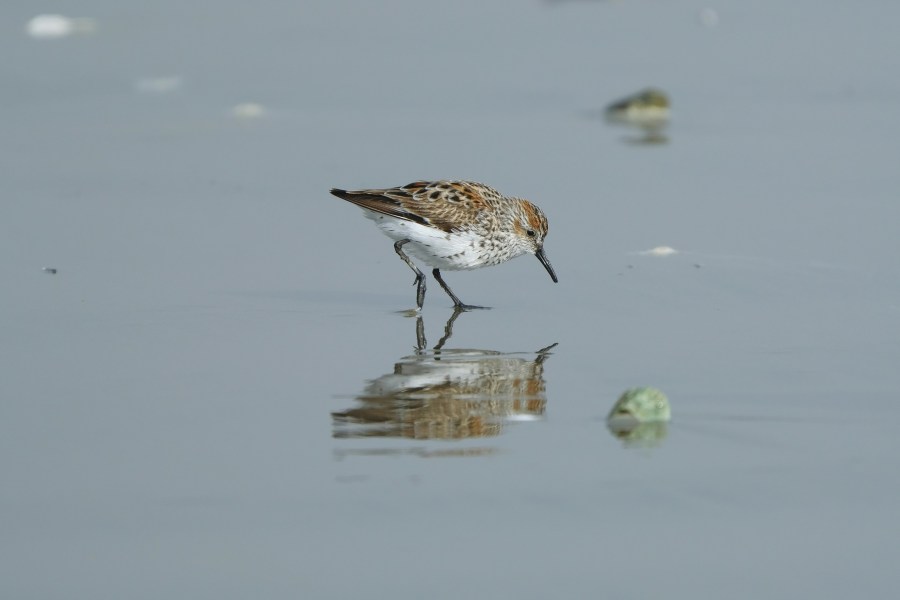
the crow that tipped over its feet on the edge of the Walgreens
parking lot and dipped its own beak in cement. I stepped around
it and said sorry, like you do when you bump into a mannequin
that looks like your father. The news says that the bees are
leaving but I’m still getting stung by things. Not insects, but
poorly-timed entrances of gods through oven sparks explaining
why all my dreams are just variations of that one bus
I never caught in 2017. They start with guilt, composting.
Somewhere, the glaciers are crying. Somewhere, my mother
is planting begonias in the shape of the Chinese character
for enough. I’m still wearing that eelgrass wig, blinking
Morse code at the sun. Except the sky has the vague look
of a person who has said too much at a dinner party. So I
tell my dog to stop sighing like a human. It questions
why I don’t stop answering to my government name.
I then remember the crow, who later exploded. Not like
boom, but like oops. Like it had a scheduling error and
forgot it was made of muscle. I try not to name the loam anymore.

PENNY WEI is from Shanghai and Massachusetts. She can be seen on Dialogist, The Weight Journal and Inflectionist Review and has been recognized by The Word Works and Longfellow House. She also has a passion for journalism.

Bed Rot by Sarah Chin

On the first warm morning of spring, Tom arrives holding half-wilted tulips like a man holding a bouquet of blunt instruments. He says he’s leaving me. For Amsterdam. Not the city—he clarifies—a woman from work. Named Amsterdam.

I do not cry. I do not rage. I do not pull his sweater over his head and pummel him with my fists like we’re in a hockey fight. No. I thank him. I say, Thank you so much, Tom, and close the door behind him, as if he’s just delivered an egg and cheese on poppy.

I don’t know why he brought a gift, but it would certainly make the whole thing worse if I refused it. I place the tulips—ten of them, all pink, smug, idiotic—in a blue Mason jar that’s been in the sink since Thursday. The tulips fan their little legs like debutantes on muscle relaxants. I put the stupid, little bitches in front of the open window by my bed.

Lovely women have fresh flowers in their homes. I read that in the Martha Stewart Living I keep under my toilet plunger. Lovely women don’t get left for women with architecture for legs. I want to be lovely, but my eyelids are heavy with exhaustion and SuperMax XXL Lash Wow! Mascara. In other words, I want to be unconscious.

I unzip my skirt like I’m shedding the fiction of who I thought I was. I remove the tastefully slutty blouse and distastefully supportive bra that I had so carefully picked for what I assumed would be a surprise brunch date. It’s horrific how excited I was. I collapse in bed. Flannel sheets from Costco. Grey and bleak, and so am I. The mattress groans. The tulips, meanwhile, look thrilled to be here. I can hear birds singing outside, and I hate them for it.

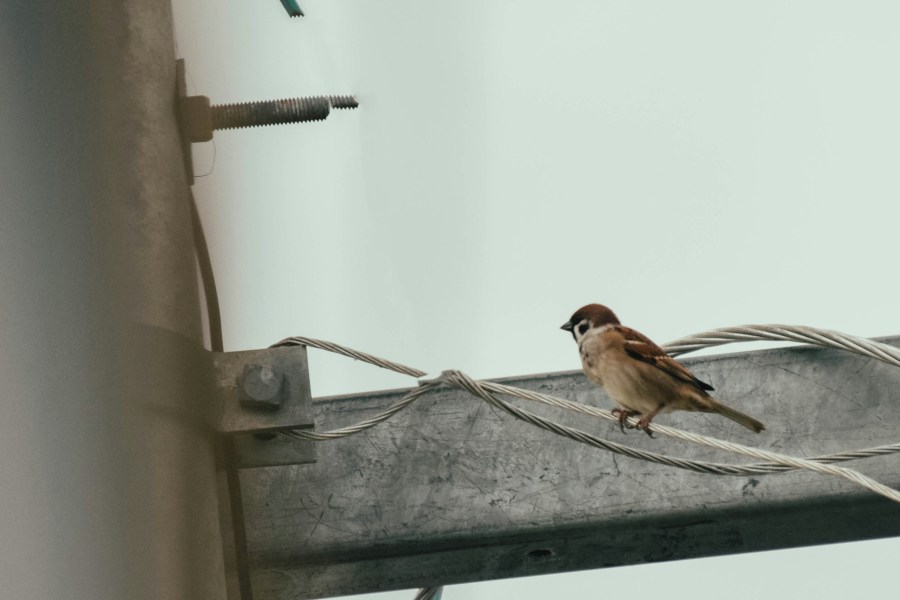
In another life, I was a sparrow. I sang loudly and often and took breadcrumbs from kindly strangers. I never once opened a shared phone plan with someone who said “babe” too often.

If I was a sparrow, I would be lapping at a glass of wine or pure love or whatever it is they drink in Amsterdam. This is not something I know. I have never had the occasion to get a passport. I’m not a globe-trotting hussy. My knowledge is limited to the Wikipedia page I skimmed after wondering what would possess someone to name a baby after a place half a world away. My guess is that it was a “creative” riff off one of those glossy city-names—Brooklyn, Paris, London—meant to sound worldly and sophisticated.

I’ve seen her photos, once, back when I was still trying not to be the kind of woman who Googles. But I Googled. It was after I saw her name on Tom’s phone. My first thought was, “oh, she’s lovely.” She has a face like a milk commercial. Her voice is a high-end essential oil. She probably doesn’t even try—or worse, pretends she doesn’t.

That’s the trick, isn’t it? Lovely women pull off femininity like backflips off the high dive. I’ve been trying so hard, since before I even met Tom. I smile at strangers. I go to Pilates. I say “sure” more often than “no”. I shave my body hair so that I’m smooth and blank.  Tom liked that about me, that I was “cool.” An iceberg. 

I watch the overripe tulips as morning turns into noon into everything after. One by one their petals fall, indecent and slow. He loves me. He loves me not. The petals scatter like little, pink casualties until there’s only one flower still perfectly intact in the ragged bunch. I reach from my supine position and pluck it out of the jar. I hold it to my nose, my lips. Then I bite. It tastes like pesticides and greenery. I chew and chew and chew the flower like cud.

Tulip madness. That’s what they called it. That’s what Amsterdam was famous for—at least according to Wikipedia. I think I understand something now, even if I’m not sure what it is.

I run to the bathroom and kneel on the floor. I vomit, knees pressed to the cold tile, hands gripping the rim as if I might fall through. The petals come up last—chewed, soft and blushing, floating wreckage in the toilet bowl. He loves me not.

I wash my mouth out in the sink. My lips are blood red, and my cheeks glow feverishly. My eyes shine—not with health, but with a kind of recognition. I look like someone I haven’t seen in a while. Not lovely, the way Amsterdam must appear when she enters a room like a neatly wrapped present, but raw and unruly.

I am already so alive.

I open the window all the way and lean out. It smells like warm dirt and a strange, feverish bloom. The birds are shrieking. They do not care if they sound lovely when they open their mouths. I scream back.

Sarah Chin is a writer with a day job in politics. Her work has been published in Epiphany, HAD, SmokeLong Quarterly, Points in Case, Sine Theta Magazine, and more. She lives in Chicago, Illinois and was born in the Year of the Fire Rat, which pretty much sums her up. More of her work can be found at sarahchin.net.

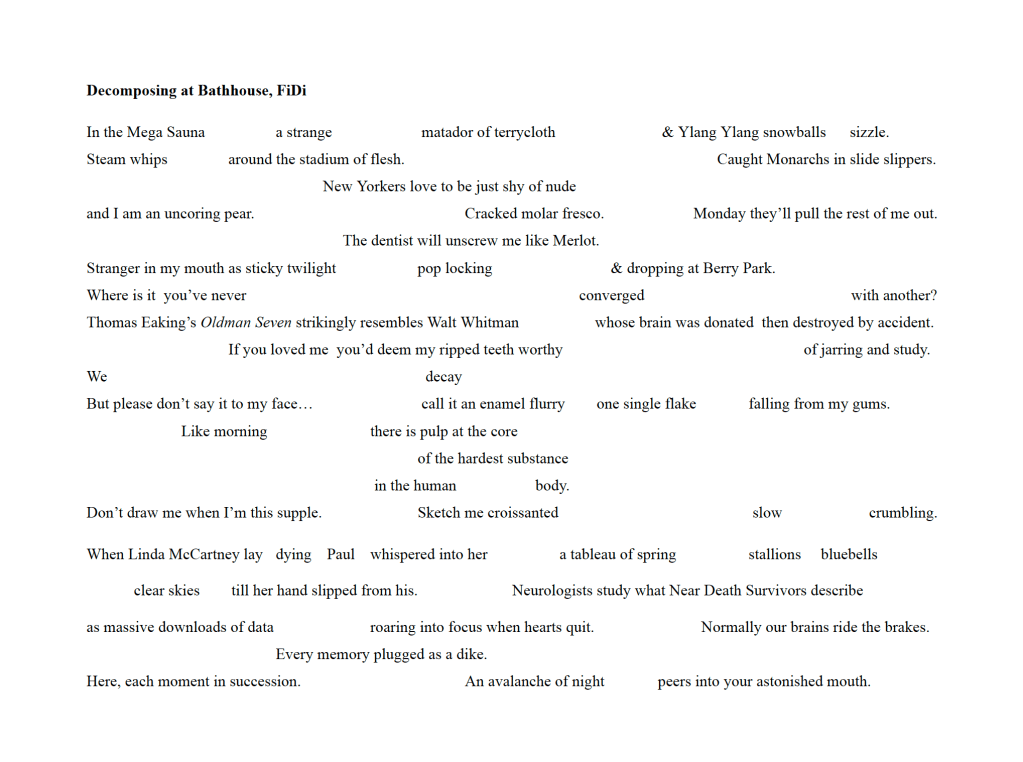
Decomposing at Bathhouse, FiDi by Grace Dilger

Link to PDF: Decomposing at Bathhouse, FiDi by Grace Dilger

GRACE DILGER is a poet and educator. Her work has been featured in Peach Fuzz Magazine, The Brooklyn Quarterly, The Southampton Review, Grody Mag, The Elevation Review, Proud to Be: Writing by American Warriors Vol. 9, Slug Mag, The Racket Journal, Yes Poetry, High Shelf Press, Defunct Magazine, The McNeese Review, Barzakh, Nonbinary Review, and The Bangalore Review. She received her MFA from Stony Brook University and teaches at Monroe University.