Hot-Desking by Maxwell Minckler

Happy Monday, Gary! Gary is one of the interns stuck
to the giant strip of sticky tape hanging over the snacks.
Morning full-timer! he buzzes furiously with his one free arm,
revolving away like a sad piñata, Let me know where you need me!
Always a pleasure, Gary, but I’m hot-desking today,
which means I can take any open desk, anywhere.
This desk is bolted to a treadmill, and I get to catch
all of these falling motivational weights while I work.
This desk hangs half out of a top-story window,
to keep an eye on the competition.
This desk is in a vat of coffee — a soggy one, but productive.
This desk is a ping-pong ball with something alive inside it.
This desk is in a lion’s mouth.
This desk is made of something called wood, I think.
How to choose! There’s so much opportunity here!
Then I see it. Tucked in a corner, practically sizzling.
A desk designed to perfectly match my father’s,
smoldering with unfinished novels and seventy-five years
of undiagnosed magical thinking. They’ve even baked
his stay-at-home shame into the chair just right,
nicotine-yellow and padded with burnt job applications.
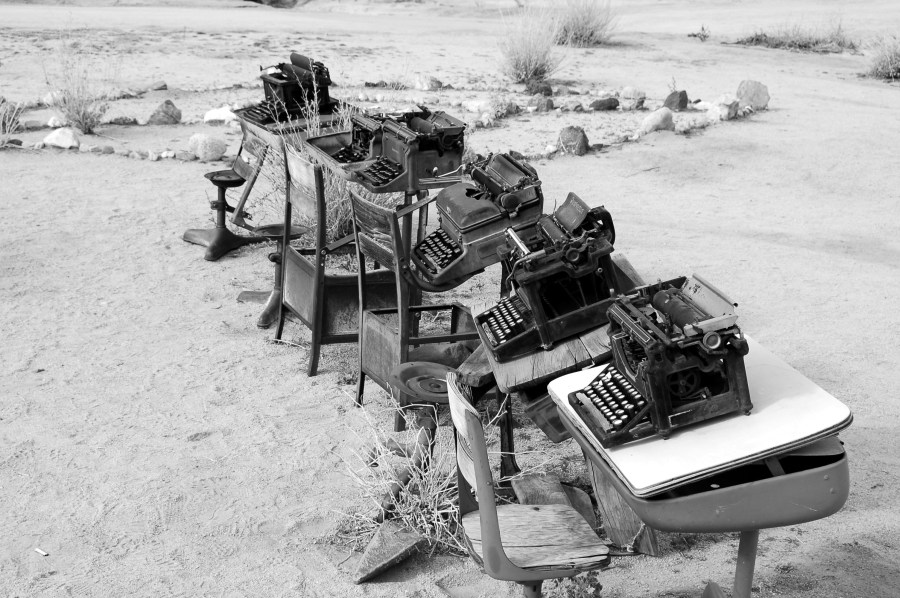
Here’s his electric typewriter with the E, V, O, and L keys missing.
The Mennin-green aftershave lighting puts the iron wool
of his beard right over my shoulder again,
half an inch above my next keystroke.
Such attention to detail! Management sure knows
how to show they care, to prove we’re part of the family.
Gary is weeping quietly again as the workday
comes to an end, and his feet begin to crisp and smoke.
So beautiful, he mutters to himself,
such beautiful, beautiful hot desks.

MAXWELL MINCKLER’s poems have appeared or are forthcoming in The Atlanta Review, Ambit, Krax, Okay Donkey, The Interpreter’s House, Obsessed with Pipework, and others. He holds an MFA from Durham University UK, was honored to win Lafayette College’s MacKnight Black Poetry Prize, and placed second in the New Writers UK poetry contest.  Originally from Hawaii, Max lives, writes, and works on tech-ish things around England.

13.1 Septillion Pounds by Emily Rinkema

To help her sleep, we give the baby a basketball, a full-size regulation ball that my husband, CT, puts in her crib one night. He writes her name on it with a black Sharpie, bold letters like they would appear on a jersey.

“Ten months is a little young,” I say.

“Never too early for our little athlete,” he says. CT played college ball for a season until he blew out his knee. The first thing he said when he held her was that she was the longest baby he’d ever seen. She came home from the hospital in a UCONN onesie.

When I check on her before I go to bed, she’s still awake with one tiny hand on the ball. She’s never been a good sleeper, but the last month has been significantly worse. She just stares at the slowly spinning mobile of the galaxy above her head, sometimes reaches for it with her fists. I kiss her on the forehead and whisper that the basketball is like the earth. A little poet is never too young for simile. 

In the morning, CT makes us coffee while I go get the baby. She’s asleep. The basketball is on the floor under the crib and the Sharpie is clutched in her hand. I turn on the light.

The walls are covered with math. Math formulas and numbers and equations and graphs and angles and shapes and arrows that direct us from next to the crib to above the changing table to the closet door to behind the rocker and under the window and then back to the crib. 

“Oh, fuck,” says CT, handing me a mug of coffee.

“Language,” I whisper.

“But,” he says, looking around.

“Yeah, fuck,” I say.

CT calls a mathematician while I try to feed the baby, but she wants nothing to do with the Cheerios or blueberries I put in front of her. She just bangs her spoon on the table. She’s got dark circles under her eyes and it’s like looking in a mirror. I can’t remember the last time I’ve slept through the night.

“We did this,” I say to CT, who is now Googling “baby math.” 

“Did what?” He asks.

“Stressed her out,” I say.

“Maybe it’s just math,” he says, putting some pumpkin puree down in front of the baby. “Maybe it’s nothing.” 

I spoon out some puree and bring it towards her, but she just clamps her mouth shut and grabs the spoon. I call my mom and ask if she can come over for a bit.

My mother agrees to take the baby to the park while we meet with the mathematicians. The park’s only a few blocks away, but with all the gear, I suggest she takes the car. On her way out the door, baby on one hip, car seat hooked over her elbow, she raises her eyebrows at me and says, “I told you she was gifted.” She kisses the baby on the top of her head and coos, “Gramma’s little genius.”

Two mathematicians arrive a few minutes later. They are younger than I expected. One is wearing a sweater vest. They both have glasses and are carrying briefcases. The men stand in the middle of the nursery and turn slowly from wall to wall to wall. The taller of the two men takes off his glasses and cleans them. He puts them back on. He opens his briefcase, takes out a notebook, and writes something down. He closes his notebook.

“Well?” asks CT, sitting down in the rocker. 

“Wow,” says the shorter man. “Amazing, really,” he says, taking a deep breath. He points at the wall under the crib. “She starts by calculating the weight of the earth,” he says.

“She’s a baby,” says CT.

“That’s pretty simple math, actually,” the mathematician says, “She just needs the weight of any sphere,” he points at the basketball, “and then she can plug it into Newton’s formula for universal gravitational attraction.” 

The taller man interrupts. “It gets much more sophisticated over here,” he says, pointing to the left of the closet. He bounces a bit on his toes.  “It looks like she’s using semi-parametric predictive modeling to determine existential risk.” He leans towards the wall and squints. He wipes his hands on his pants. He looks at the shorter man and shakes his head. 

 “Wait,” the shorter man says, “Is that strategy optimization for carbon reduction at the bottom of the door?” 

I stare at him, waiting for something I understand, a word, a phrase, a gesture. CT puts his head in his hands. “I have no idea what’s happening,” he says.

“I think she’s looking for a solution,” the tall man says, and when we don’t respond, he says, as if we’re children, “To climate change.”

“But,” I say, and I don’t know what comes after that. I don’t even know what to ask. I think of everything we’ve ever said in front of her, thinking she couldn’t understand. We watch the news during playtime. We listen to NPR in the car. We fight about solar panels and electric cars and how much meat to eat. When I was pregnant, we even fought about whether it was responsible to bring a baby into this world. Did she hear all that? Did she feel it?

CT stands up. “This is fucking ridiculous,” he says. He’s the one who suggested Meatless Mondays. He’s the one who wants a Prius. He’s the one who thought we should skip flying to see his parents this year so we could afford panels on our roof. 

“Wait,” the shorter man says, and looks at his partner for confirmation. He points to the right of the door. “There. Is she using partial differential equations to see if…” and then he stops, squatting in front of the wall nearest the crib. He shakes his head. The taller man keeps putting his hands in his pockets and taking them out again. “It looks like she gave up.” He’s tapping the wall where our baby scribbled with the Sharpie, age appropriate markings that in another world could have been made with crayon or finger paint. “She gave up,” he repeats. 

“She’s a fucking baby,” CT says, and his voice cracks. “A fucking baby.”

“I just want her to be happy,” I say.  “I just want her to write poetry,” I say. CT pulls me into a hug. “Or play basketball,” I say into his neck.

“She can be a poet-athlete,” he says, and we both start to cry.

I check on the baby before I go to bed. Her room still smells of fresh paint, a new color CT picked up at the hardware store after the mathematicians left this morning. Butter yellow to match the stuffed duck he bought on his way home. While the baby napped this afternoon, I took down the universe mobile and replaced it with the one his sister bought us for the baby shower–green giraffes and purple hippos–and CT painted over the math. We’d thought about keeping it, but decided it was all just too heavy for a baby.

“It’s a clean slate,” he’d said when he finished.

The baby is awake and content. She moves her hands in front of her face as if she’s in awe of them, as if she’s still working out whose they are. It’s the way she used to look at me. 

“It’s a blank page,” I whisper to her now, and kiss her on the forehead. And before I leave, I tuck a Sharpie into the corner of her crib, just in case.

Emily Rinkema lives and writes in northern Vermont, USA. Her writing has recently appeared in SmokeLong Quarterly, X-R-A-Y Lit, Variant Lit, and Flash Frog, and she has stories in the Best American Nonrequired Reading, Bath Flash, and Oxford Flash anthologies. She won the 2024 Cambridge Prize and the 2024 Lascaux Prize for flash fiction. You can read her work on her website (https://emilyrinkema.wixsite.com/my-site) or follow her on X, BS, or IG (@emilyrinkema).

Pete the Cat: All Grown Up & Alone In His Car by Emily Dressler

with help from my daughter


At the library,
we walk past Pete the Cat
and you say it’s weird and sad
how you grow up with these books
but they don’t keep growing with you.
Like, Pete the Cat doesn’t go to 5th grade
and lose a preschool best friend,
find humiliation from a teacher,
have ALICE drills
(but you did those in kindergarten too, I
want to remind you, but don’t
because Pete the Cat never does that shit),
strategize about how to take his pads
into the bathroom.

Like, Pete the Cat Gets Braces? I ask.
You smile and say, Pete the Cat Kisses a Girl with Braces.
That’s good, I nod.
We walk past a book titled
My Parents Forgot How to be Friends.
Pete the Cat Has Two Houses Now

you say, pointing.
I laugh. Poor Pete.
We’re going to put him through a lot:

Pete the Cat Learns to Lie
Pete the Cat Becomes Lactose Intolerant

That comes later, I say,
when he cares more.
For now, he is carefree:

Pete the Cat Finds Joy,
in which he learns how to love
being alone, and eats vegetarian
crunchwrap supremes in his car. He’s
happy, he really is. He doesn’t tell
anyone about the parking lot meals
even though they feel like the most
real part of him.

EMILY DRESSLER lives and works in Northeast Ohio. She works as a proofreader for a global ad agency. Her flash fiction has recently appeared in Villain Era Lit.

All the Friends I Could Have Made are Having Fun Without Me by Mackenzie McGee

Alexis throws a big party and everyone’s invited. She lives a half-hour drive from her childhood home, the one with the big bay window and the basement where we had sleepovers every other weekend for most of high school. 

I imagine she’s done well for herself. Her new townhome is in the affluent suburb that kids in our marginally less affluent suburb used to mock. Her Instagram is all pictures of her rescue corgi. Her Facebook is all tagged photos of her at friends’ weddings and thirtieth birthdays, but she’s not thinking about any of them right now. Tonight, she’s fifteen again, and she’s worried I won’t show.

It’s a cool summer evening in Minnesota. From the street I can see the glow of the string lights crisscrossing her treeless backyard. Citronella wafts through the air. I imagine there are two coolers on the concrete patio. The one on the right is stocked with beer and sparkling water. The one on the left is full of Monster Energy Drinks, the Zero Ultra flavor we were obsessed with in tenth grade. Alexis used to buy them two-for-three on her way to our 7 a.m. social studies class. She’s wearing a bracelet made from the can tabs we saved.

Teo’s the first guest to arrive. He pedals down the sidewalk on his childhood mountain bike. I crouch in my car when he passes by. Alexis notices the Jersey in his accent. She asks him, as she will ask everyone, how he knows me. 

He says we met Thanksgiving weekend twenty-five years ago, oh, maybe twenty-two. I was in town visiting my cousins. We were playing basketball in the driveway when he rode up and asked if we wanted to play Nintendo. I loved Nintendo and I hated my cousins, but they were older than me, and they hated Teo. They said he was weird, and when I asked why, they said I was weird too. I’d heard this before. I thought if I could make them like me then it wouldn’t be true.

Michaela comes in as Teo’s finishing his story. She carries her sharpie-covered JanSport on one shoulder, all cool and casual. She shrugs it off to dig for the mix CD she burned for the evening. 

Michaela and I—we shared a cabin at summer camp. We bonded over emo music and the art of tie-dye. We exchanged numbers. She called my house twice that August. I let the phone ring as I tried and failed to conjure a voice full of carefree enthusiasm, the self I could be away from myself. She couldn’t know that the real me was awkward and uncertain, that camp-me was a façade. This was years before I knew to call it fear, not fraud. Michaela left a couple of voicemails. She shrugs like, what are you gonna do?

Alexis nods. That is so like me.

The fashionably late arrive in clusters. Coworkers from my first full-time job sit on the kitchen counter sipping PBRs. Some of my sisters’ friends make friends with my brothers’ friends and share the wisdom I was too awkward to ask for: how to print in pretty bubble letters; how to tell when someone like-likes you, how to tell when someone likes you at all. 

The nice busboy from my short-lived waitressing career is using chunks of cheese to teach Alexis’ corgi to sit. He tells her about the time I got awful hives from the wool scarf I wore to work. He brought Benadryl, just in case. He asks if I RVSPed. Alexis lies and says I texted her to say I’m running late. She doesn’t want people to give up on me just yet.

The biochem TA offers charcuterie to the cute librarian who works the closing shift. The rec league volleyball team I quit after two practices arrives in two consecutive carpools. They dance ironically, and then, a few drinks in, it’s not ironic anymore.

And then they hear it: the drumline’s cadence, the drum major’s whistle. The crowd flows into the front yard to see my high school marching band chair-stepping up the street. Their teenage bodies carry the muscle memory of these instruments, and some of them are really, really good. Someone jumps on the upright piano and leads the living room in a singalong of “Don’t Stop Believing.” The party is in full swing. All that’s missing is me.

I’m still outside, sure I’m about to go home but not ready to admit it yet. I’ll wait in my car five more minutes, and then I’ll go in. I’ll walk through the front door and everyone will cheer, like I’m a fan favorite in a sitcom. There’ll be a big sheet cake decorated with loopy icing in the shape of my name. Everyone will want to know what I’ve been up to, how I’ve been. No one will be mad at me for not calling or texting them back.

I have a minute left when Alexis steps into the front yard, carrying a corner slice of cake on a paper plate. I watch over the steering wheel as she tiptoes between the instruments scattered on the grass. She finds a clear spot to sit cross-legged with the plate in her lap. She looks down the street, down the way I came, and waits for me.

We had every one of our sleepovers at her place, every other weekend for about three years. Then one day, we didn’t. A month went by, and then another. Growing up I often felt, sometimes I still feel, there had been a lesson in kindergarten about how to be a person in the world on a day that I, and only I, had missed. I had wanted to invite Alexis over and return the favor. For a long time, I didn’t know how.

Now everyone inside is getting to know each other and having a good time. Alexis should be inside having a good time. Someone should ask her how she knows me. She was kind enough to host, after all.

I shut the car door behind me. Alexis’ ponytail whips around at the sound. She waves me over and says she’s so glad I’m here, even if the part of the party that was for me is over. The cake has been cut; the end time on the invitation has come and gone. The music is louder than ever. Colored lights flash in the windows. That party, she says, has taken on a life of its own.

She doesn’t ask me to go inside. We sit in the grass and split the slice, taking turns taking bites. The can tab bracelet shushes softly on her wrist. It’s just how I remember it—two of the tabs face the wrong way, their silver underbellies exposed. We watch as guests slowly trickle home in new configurations of designated drivers and rideshares. For each one she says, look. They came here for you. Isn’t that nice? Everyone together, here tonight, and it’s all because of you.

Mackenzie McGee is a winner of the 2021 Pen/Dau Short Story Prize for Emerging Writers. Her fiction can be found in Nat. Brut, Alaska Quarterly Review, Cease, Cows, and elsewhere. She earned her MFA from the University of Arkansas, and she’s currently pursuing a PhD at the University of Kansas.