The soccer field was a miracle, an oval of grass behind a middle school where she could train her new small dog, play until it trusted her and understood their togetherness. She hoped to soften its vigilance, give it less reason to erupt.
Soon they met three other women and their dogs, two also-small ones and one big, and they formed a gang. The first summer of the pandemic, when being outside was the one thing you could do, though even that was a bit fraught, it’s not like the wind knew to blow the virus away from you and never towards you. But what a gift. After months of walks by themselves, each anxious for the other, she loved the ritual of heading to the soccer field, unhooking the lead and watching her dog run, thrilled, towards the clot of its friends. The sight of them leaping in greeting pleased her, the validation that her dog could make friends. The four dogs ran and feinted and rolled, sniffed each other’s glands, hunted along the perimeter of the fence for bits of old school lunches. They stayed out there for hours.
Surprisingly, inevitably, there was the gentle creep towards human friendship, which she knew was rare among strangers and rarer still at her age, almost fifty. They laughed over “Love Is Blind,” the debut season, wondered at sudden celebrity deaths. The doodle had a birthday with party games: dogs racing towards coupes of whipped cream, bobbing for hot dog slices. One of the women had a hysterectomy, another up and got married. They drank champagne for one, then the other. Other dogs came to the field but did not become part of the gang: Julius the Vizsla, Blue the wheezing Frenchie, Lola, curly-haired and shaped like a tipped-over fire hydrant. Their owners kept it moving, didn’t have or want dog treats, just a wave and some small talk.
Summer passed into dry fall, foxtail season, discussions of whether or not to cover a dog’s snout with protective netting. When the days turned even shorter, she bought four light-up collars so the dogs could play past dusk, a canine rave. They dressed the dogs up for Halloween, again for Christmas, and watched them learn the hard way to give a wide berth to the geese wintering on the field – the geese hissed and chased back, clouds of steam fuming from their beaks. Week after week, she walked to the field and sent her dog to its friends. Her dog looked for her now, came when called. She never quite got over the surprise of it all.
In the spring, she learned two of the women were moving to Oregon, one to Arizona. By summer, everyone was gone. Big dogs found the field, huskies, pit bulls. Sometimes the owners yelled at her even though their dogs were also off-leash, barking and coming too close.
She walked to neighborhoods with big houses and through the shopping center where she tried to pose her dog for a photo on a bench, Depressed Dog Sitting, c. 2021. It wasn’t the same. Her dog pulled her back to the field where it could spend time free, even if alone.
She threw the ball and her dog fetched it. This much they did for each other.
The two of them were not a gang, but they weren’t nothing.
The hot days evaporated into another autumn, and as the sky began to pink, her dog’s collar lit up. A husky entered the empty field. Her dog stopped, let the ball drop from its mouth. The husky considered the geese, then her dog. She moved towards her dog, who moved towards her. The husky chose the geese, sprinted at them. They pushed themselves aloft, rising, gaining smooth altitude, except one at the back, flying, but too low, too heavy.
The husky leapt, caught the goose in its teeth, snapped its neck left and right, thrashing the bird into the cold grass of the field, a spray of red on two white necks.
The goose lay in the center of its broken wings, the black feet pedaling as if trying to walk.
For days, she saw the carcass from the gate. She didn’t enter, didn’t want her dog to sniff the goose, hated to see it there, exposed and undefended, picked at. Finally, someone moved it by the fence to make room for soccer goals.
Within a week, the crater filled with new growth.
They went south, to the trail along the ocean, thick on one side with sea fig and saltgrass, land kelp. Dogs were not allowed on the beach, only the trail, saturated with animal smells and pocked with tiny tunnels that made her think of rabies.
Her dog strained at the limits of the lead, head lifted at the scent of endless brine. They stopped in a narrow pedestrian-trampled break to watch waves foam the shore below. Waves pushed in, and waves drained out.
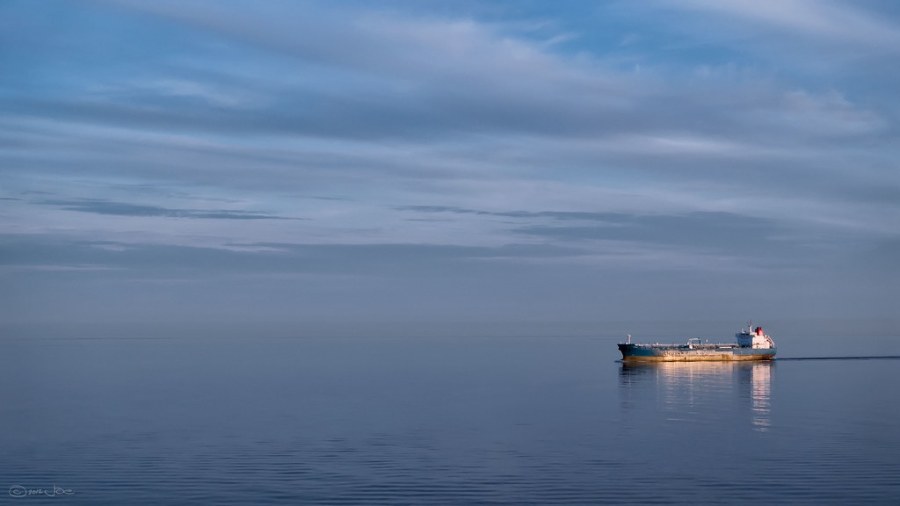
The far water was dotted with freighters and ferries, carrying cargo and commuters. The world was grinding its way back to rush-hour traffic and holiday sales. The day had begun to blue. There wasn’t another creature for miles, so she did the calculus and they walked onto the beach. She freed her dog. It stayed with her at first then started to wander away, braving good distance, nosing along crab husks, fifty feet, a hundred feet away, more. Stopping at crushed cans and torn wrappers, the possibility of scraps. Even after a good year, it was hard to trust one’s luck.
She turned back to look, the apartment buildings squat and flat, the gate to the field ajar, the only way in or out.
Far away, the dark of her dog glowed against the pocket of sky.
She opened her mouth and made a sound, two clicks of the tongue, a half-trill, not even her dog’s name. The silhouette bent, held, then the shadow moved, began to run.
Lydia Kim has published in Longleaf Review, Peatsmoke, Catapult, The Hellebore, and in the anthologies And If That Mockingbird Don’t Sing and Non-White and Woman. She’s a Tin House alum and 2024-25 Tin House Reading Fellow and her work has been supported by the Kenyon Writers Workshop, Rooted & Written, and the de Groot Foundation. She is currently at work on a novel and story collection, represented by Ashley Lopez @a_la_ash.


 Okay Donkey