Hypothesis – Or Why Steal Dorothy’s $3.5 Million Ruby Slippers Instead of Stars by Sandra Fees

I understand not seeing a thing for what it is, like the thief mistaking the carmine-red rhinestones for rubies. Shattering the moonlight, he plucked the size 5 slippers to the black market, leaving one careless sequin behind to squint in the museum case. For years, I mistook the bright blue along the ridged shell of a scallop for mere ornamentation, plucked at the sapphire gaze, an unintended cruelty, blinding what I thought was a starless galaxy without sight or grief. But I’ve learned that a galaxy with no stars is just a hypothesis. Gemstars, everywhere. And we, desperate to handle them like a rune or hand—their message indecipherable. Even if they turn out not to be rubystars, they might be perfect talismans. They might pity us, see that this is as close to real as we can get.

Sandra Fees lives in southeastern Pennsylvania where she is a Unitarian Universalist minister and past poet laureate of Berks County (2016-2018). Her poems have been published in The Comstock Review, Whale Road Review, Witness, and elsewhere. She also has a CNF piece published in The Citron Review.

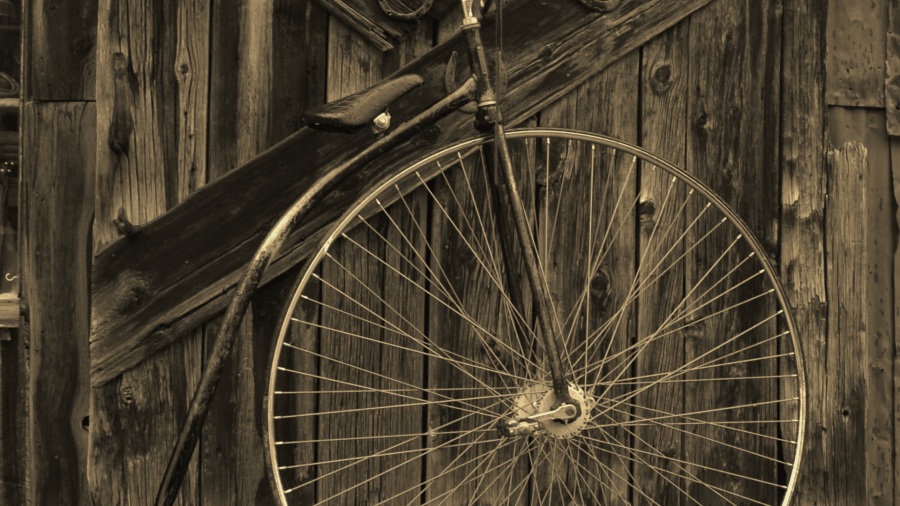
Baron Karl von Drais’ First Bicycle Ride by Andrew Graham Martin

My name is Baron Karl von Drais, and I aim to purge the horse from history.

I’ve got just the thing to do it, too.

But more on that in a moment.

First.

Horses: vile, repulsive, odorous beasts. There is no word strong enough for these devils. They foul our streets with their swamp-like waste and they toxify our already-charged atmosphere with their nasty temperaments. Horses are without virtue. A horse cannot love you. A horse cannot be tamed. A horse feels no pity when it flings you from its back.

So I shall bring the time of the horse to its end.

As I write this, the quill trembles in my hand and plops of my sweat dot this yellowed parchment. Two empty chairs sit across from me. One vacated willingly. The other unwillingly. The unwilling chair is a wooden child’s stool, with its seat removed. The seat is now outside, attached to my invention, baking in the hot German sun.

In this way, my boy will accompany me on my first ride.

In a few short moments, I will perform an inaugural journey from my home here in Mannheim to the Schwetzinger switch house. A nine-mile round trip.

I will complete this trek in mere minutes.

I will enlist the help of no odorous, dangerous beasts.

My journey will be a horseless one.

I will commit the journey on a transport of my own invention. A laufmaschine. A running machine. The English call it a draisine. I’m partial to the French term: draisienne.

My draisienne is unlike a horse in every conceivable way. My draisienne has carriage wheels for legs. My draisienne has no bones nor meat nor sinew; she is housed in a clean, wooden frame. My draisienne does not respond to prodding ankles in the ribs; her back wheel halts with the simple pull of a cord. My draisienne does not produce excrement, nor flatulence, nor snorts. My draisienne is silent as a windless night. She is cool to the touch, as willow bark in the shade. My draisienne is safe. If one were to fall from her seat, the distance would be inches, not feet. The draisienne will not continue running if she leaves a small broken body behind her on the pavement. My draisienne will slow to a stop if there is no one to propel her forward.

My draisienne will not wander. She yearns not for food nor drink nor company. My draisienne will not leave me, even should we encounter tragedy together.

My draisienne exists for one purpose.

To expedite my travel to Schwetzinger switch house.

I hear the crowd outside growing restless.

I am aware that there are those who oppose me. Old women in the town call me a scoundrel and a cur as I go to retrieve my mail. Children throw their apples at me, saying they’ll soon have extras, won’t they, if I get my way. Anonymous threats have been made against my life. I find their scrawled notes slipped under my doorframe every morning.

Man’s connection to horse is a strong one. I admit this. The bond will not be severed overnight. But severed it must be. However painful it is for us as a society, our reliance on horses cannot be sustained.

Our lives are being poisoned by these wretched creatures. Every day, our bronchi blacken further due to the fumes of their waste polluting our streets. These beasts do not care for us. They dirty our earth and disrupt our lives with their recklessness. They cast off what is most dear to us. Our children. They fracture families. They have no awareness. They have no remorse. They snort and they piss and they chomp their apple slices.

So, their time has come. If, in one hundred years’ time, the metropolises of the world are overrun with horse ghosts, my mission today will have been a success. Horse ghosts are unobtrusive and clean.

Despite knowing it is time to go, I must admit, I cannot stop my hand from shaking. My heart performs a tremolo against my sternum.

One final thought.

If I were truly confident what I was doing was a simple matter, that rendering the horse obsolete as a being would right the tragedies of my past, and set me on a course for contentment… If I were confident in this, would my brow now be as damp as it is? Would my breathing be so shallow?

Strike that.

There is no room for doubt on the narrow path of progress. There is no estate reserved for reminiscing. If uncertainty creeps in, if melancholy threatens, well.

I’ll simply push the carriage wheels beneath me to go faster.

Andrew Graham Martin’s writing has appeared or is forthcoming in McSweeney’s Internet Tendency, MoonPark Review, Post Road, SmokeLong Quarterly, X-R-A-Y Lit Mag, and elsewhere. He lives in Indianapolis, Indiana.

When I Was a Bearskin Rug by Shagufta Mulla

The only way you can strip a bear
down to skin is with dart and gas-

            (light),
            or bullet-
            hands
            and knife.

Shined shoes and bare feet
pooled in my pelt. I was family
room luxury—but not for me.

I tried to scrape myself off
the marble floor—tried to unbreak,
and remake, an entire body.

By the time I stood, my fur had turned
to felt. But I’m a girl—
I learned

            to tailor,
            to stitch,
            to cut and carve
            a covering.

Sometimes when I’m alone,
I remove my coat.

My glass eyes still reflect light—
but sometimes my fingers fumble
with the buttons made of bone.

Shagufta Mulla is the art editor of Peatsmoke Journal, a veterinarian-turned-content writer/editor for TIME Stamped, and an artist. Her poetry has appeared in or is forthcoming from Stoneboat, Crab Creek Review, Blood Orange Review, the speculative poetry anthology NOMBONO by Sundress Publications, and elsewhere. Shagufta lives in Oregon, but you can find her on Instagram @s.mulla.dvm.

Dadoo by Skyler Melnick

Dadoo is his name. He arrived on our doorstep after a storm. Hat crooked, coat unbuttoned. Told us he was our Dadoo. You mean father? we asked, unsure, and he nodded, repeated Dadoo.

Dadoo crawled into our house, and we let him, because we were in need of a father, and what were we to do, when one miraculously appeared, but let him in and thank our lucky stars.

As we were thanking our stars—Philip, the brightest, and Marigold, shy, flickering—Dadoo slithered toward us, in between us, and shut the window. Bedtime? we asked. He nodded.

We did it, my brother whispered. All the wishing, wondering, waiting. We did, I agreed.

Dadoo woke us for school by cuckooing like a rooster, cuckooing until our eyes adjusted to the morning light, and our ears to the sound. Is this what a father sounds like? We looked at one another, my brother and I, then at Dadoo, his head tilted toward the ceiling. Yes, my brother and I decided, this is a father.

For the time he was with us, which, admittedly, wasn’t long, Dadoo was focused, determined to raise us. After waking, he scoured the kitchen for breakfast food then watched us eat. Watched us crunch each bite. Watched our jaws churn the food. Watched our throats carry it down to our stomachs.

We weren’t sure he was our father, exactly. We weren’t even sure he was human. He appeared to us more creature-like, but we accepted him just the same. We accepted when we got home from school and found him crawling up and down the walls, opening his mouth and shooting out his tongue, catching flies and swallowing them.

Dadoo is marvelous! we clapped.

The marvels were unceasing. When he ripped our front door off its hinges and held it over his head, we applauded. We watched him carry it down to the beach and looked at each other, my brother and I, knowing what our father was trying to tell us, what he was trying to teach us, so viscerally—to be open, to let people in. And we would, we would try. We would have to, now that we had no front door.

He broke us down again—this time the entire back wall of the house. Carried the wall down to the beach as we clapped. We knew what this meant—we admitted to ourselves, my brother and I, that we knew. That sometimes, as Dadoo so eloquently demonstrated, you have to look back. The past has shaped us and, sometimes, we must look back.

Thank you, Dadoo, we said to him as he scurried back into the residence. It was cold without the back wall of our house, but the past can be cold.

As he put us to bed, for the fifth night, our beloved Dadoo ripped off the sheets, first from my brother’s bed, then mine. He bundled the sheets in his arms and stormed off with them.

My brother and I gazed at each other from our respective beds. Yes, we said to each other with our eyes, we must take off our protective layerings and expose ourselves to life.

We woke to the sound of distant cuckoos. We hurried awake like Christmas morning, excited to find where our Dadoo was hiding, what lessons he would teach us today. In our pajamas, we ran down the stairs and out the hole where our front door used to be.

There he is! My brother pointed.

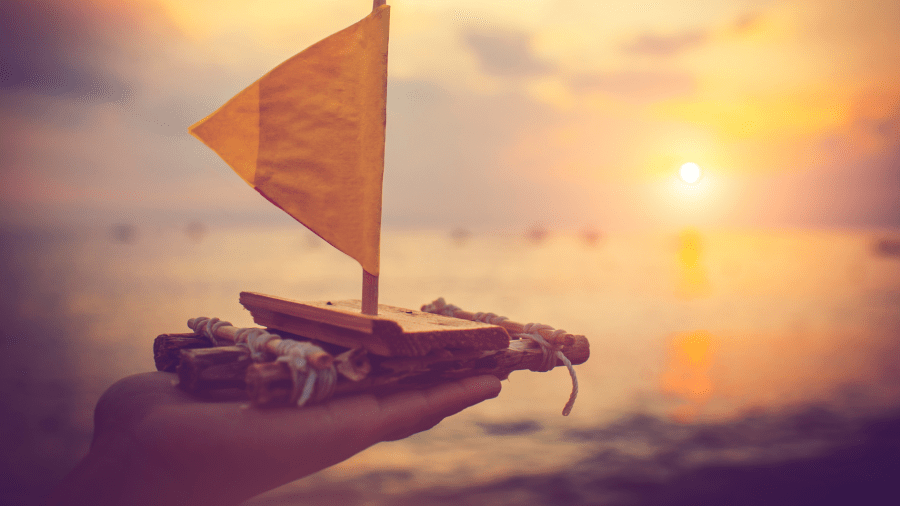
We went hand in hand to the shore and saw Dadoo standing on the back wall of our house, the front door propped up atop it, our sheets billowing like a sail.

Dadoo has made a boat! We clapped at this lesson, unsure what it meant. We watched Dadoo push his house boat into the water. We watched as the ocean took him in its arms, watched as he waved at us. We waved back. The greatest lesson of all, my brother and I agreed—letting go.

Goodbye Dadoo, whispered my brother. All the wishing, wondering, waiting. Goodbye, I agreed.

After trying and failing to swim out to him, we really let go. My brother and I cried into each other, sand crabs biting at our toes. A big sand crab crawled up my leg, and my brother snatched it up. We looked into its eyes, its monster sand crab eyes, so familiar, so distant, so longing. Mother? we asked the crab.

Skyler Melnick has an MFA in fiction from Columbia University. She writes about sisters playing catch with their grandfather’s skull, headless towns, and mildewing mothers. Her work has appeared in Pinch, HAD, Scoundrel Time, Terrain, and elsewhere. She was also awarded 1st place in Fractured Literary‘s 2024 “Ghost, Fable, and Fairy Tales” contest.